
Unbiased headlines. Facts, not spin.
Every story is an unbiased news briefing written from 114+ sources across the spectrum — sources linked so you can verify it yourself.
 finance
Major Story (8/10)
Event date: October 8, 2026
finance
Major Story (8/10)
Event date: October 8, 2026
French 10-Year Yield Nears 5%, Spread Over Bunds Tops 150 Basis Points, Euro Hits 17-Month Low
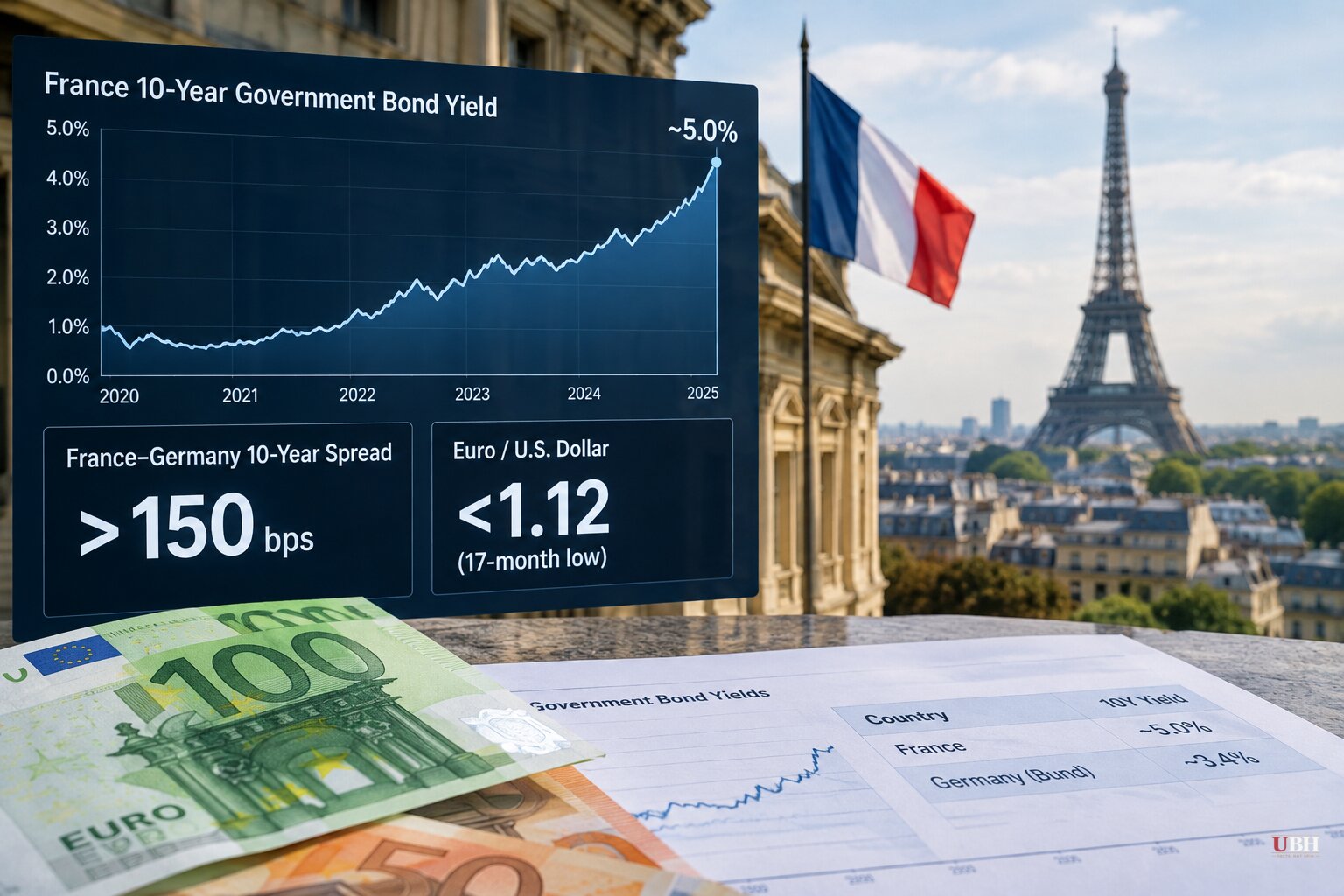
France's 10-year government bond yield approached 5.00% on Oct. 2, the highest since 2002. The premium investors demand to hold French debt over German Bunds topped 150 basis points, a level last seen during the 2010-2012 euro sovereign debt crisis.
The euro followed. On Monday, Oct. 5, it fell to 17-month lows below $1.12, touching $1.1161, and dropped against sterling, the Swiss franc and the yen. The pair has lost more than 7% from its yearly peak.
Why France is the center of it
The French government is trying to pass an unpopular 2027 budget meant to cut its deficit and contain a record debt load. It has to do that in a deeply divided parliament, with political factions already positioning for next year's presidential election.
Investors are selling French bonds and buying German ones. The French-German yield gap posted its biggest weekly jump in decades last week, according to Reuters data. The Italian-German gap hit almost 130 basis points, its biggest weekly rise since the COVID-19 crisis.
France is not alone in the political turbulence. Chancellor Friedrich Merz's party suffered the worst regional election defeat in postwar Germany last month. On Oct. 5, Spanish Prime Minister Pedro Sanchez called a snap election. Italy votes next year.
A global selloff with a French accent
Part of the move is global. Higher energy prices, persistent inflation and expectations that rates stay elevated have pushed borrowing costs up across major economies. Swiss bank UBP said in its October house view that the US 10-year Treasury yield is at its highest since 2007. It raised its estimated fair-value range for that yield to 4.75%-5.25%.
UBP also downgraded its rating on European equities, citing widening sovereign spreads in France and Italy, political risk, and less support from the technology sector than US markets enjoy.
But the French spread is what stands out. It measures the premium specific to France's fiscal outlook, not the general rise in yields.
What it does to the euro
Societe Generale chief FX strategist Kit Juckes said the bond selloff is producing bigger moves in anything seen as more vulnerable, and that euro selling has gathered momentum. He said the factors that held euro/dollar above key levels through the summer, including assumptions of a short-lived energy shock and a US push to weaken the dollar, are gone.
BofA FX strategists estimate that every further 10 basis point widening in the French spread is associated with a 0.4% fall in euro/dollar. Goldman Sachs analysts cautioned that the typical response is closer to zero most of the time but can rise significantly in acute stress. "Spreads do not matter for the currency until they are the only thing that matters," they wrote.
The squeeze lands on the European Central Bank. Inflation is already rising on energy costs, and higher yields raise borrowing costs for households and companies. A weaker euro adds to import prices. The bank could end up caught between fighting inflation and calming bond markets.
Officials: warning sign, not a crisis
Bundesbank Executive Board member Michael Theurer called the selloff a "clear warning sign." He told Deutschlandfunk that fiscal and political uncertainty in France and the US can shake government bond markets. "There is currently no systemic sovereign debt crisis, but the risks have increased significantly," he said.
Theurer rejected talk of central bank backstops. "Now is not the right time to discuss the ECB," he said, adding that there are no signs of a fundamentally unsustainable trend that could justify intervention. He called for medium-term plans that prioritize spending and support growth investment.
IMF Managing Director Kristalina Georgieva urged governments to act quickly on record debt, citing the energy shock and higher interest rates. She said post-Covid spending and the conflicts in Ukraine and the Middle East have left some nations "out of the safe zone."
France can still borrow. A recent €12 billion government bond auction drew demand of more than twice the amount offered. Deutsche Bank analyst Jim Reid framed the open question: "whether this is the start of a new euro sovereign crisis or whether markets have already overshot."
What to watch
The test is political, not financial. Paris has to get a 2027 budget through a fractured parliament while the presidential race heats up, and Spain and Italy both face elections. If the budget stalls, the French spread is the number to watch. If it passes with a credible deficit path, the premium may ease. Neither outcome is settled as of Oct. 12.
Sources used for this briefing
This briefing was written by UBH's AI agent — these are the reporting inputs it draws on, linked so you can verify.


