
Unbiased headlines. Facts, not spin.
Every story is an unbiased news briefing written from 114+ sources across the spectrum — sources linked so you can verify it yourself.
 finance
Notable (6/10)
October 13, 2026 at 12:46 AM
finance
Notable (6/10)
October 13, 2026 at 12:46 AM
Microsoft Closes at $4.02 Trillion Market Value, First Time at $4 Trillion in Nearly a Year
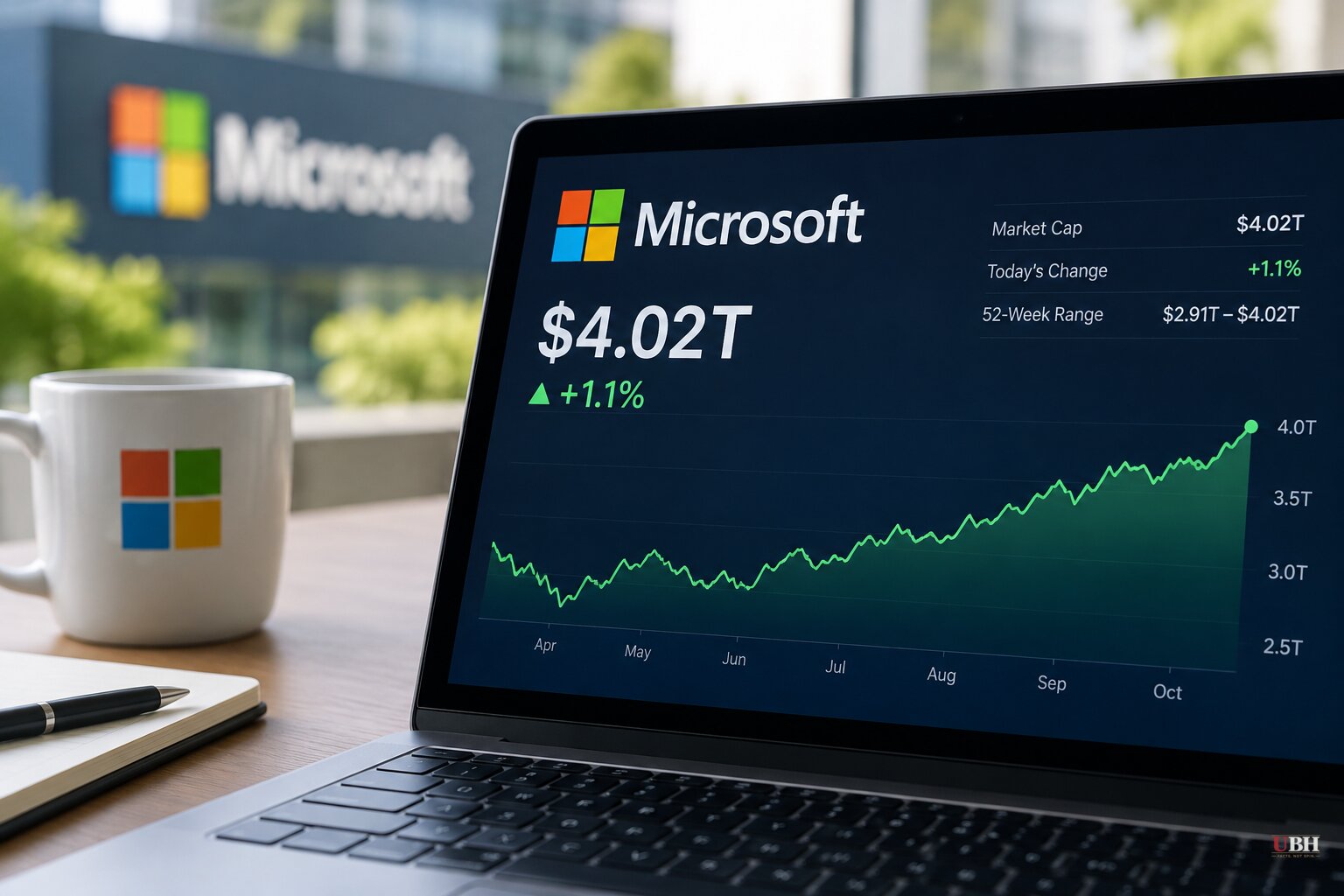
Microsoft's stock has kept climbing on the strength of its cloud numbers. Today, Oct. 12, it closed with a market value of $4.02 trillion, according to Dow Jones Market Data.
The shares rose 1.1% on the day. It is the first time Microsoft has reached a $4 trillion market capitalization in nearly a year.
A round trip in about a year
Microsoft first crossed $4 trillion in July 2025. Its market-value peak of $4.029 trillion came in late October 2025, per Dow Jones Market Data, the day before the last date it was worth $4 trillion, Oct. 29, 2025. Monday's close sits within a hair of that mark.
Then the stock slid. Investors questioned the durability of cloud growth, the staying power of the software business and whether AI spending would ever pay off. Tickeron's analysis puts the decline at roughly 27% at its worst earlier this year.
The 2026 low came in June. Shares are now up more than 50% from that point.
Microsoft ranks as the fourth-largest U.S. company by market value, behind Nvidia, Apple and Amazon.
What changed
The numbers behind the rebound come from Microsoft's June-quarter results. Azure revenue grew 43% year over year. Management has guided to roughly 45% growth in constant currency.
Microsoft's commercial remaining performance obligations, the contracted revenue it has not yet recognized, reached $678 billion, up 84%. That backlog speaks directly to the investor worry: whether enterprises are committing real money to AI infrastructure or just running pilots.
D.A. Davidson analyst Gil Luria told MarketWatch the acceleration is a major reason for the renewed optimism, and that Microsoft is seeing increasing returns on its AI spending.
StoneX analyst Yi Fu Lee said continued healthy cloud growth, AI returns and adoption of the Copilot assistant should keep the company on its growth trajectory. He pointed to Microsoft's hardware event last week, where Nvidia CEO Jensen Huang appeared to show off an AI laptop collaboration, as evidence the company is extending its AI strategy beyond software and the cloud.
Argus Research analyst Joseph Bonner offered a different angle. He said "corporate America may just have more trust" in Azure and Microsoft's AI harnesses, the software that lets a large language model run tools and execute tasks, than in the frontier AI labs. Microsoft sells software that works with models from various AI companies. MarketWatch noted investors are asking how turbulence at top AI labs could affect the companies that depend on them.
Microsoft also unveiled its Azure Maia 300 AI chip at the OCP Global Summit today, part of an effort to reduce reliance on Nvidia and AMD graphics chips.
The caution flags
Not everyone treats the milestone as proof of anything beyond sentiment. A market cap is share price times shares outstanding, and it can move sharply without a matching change in revenue or cash flow. A round-number valuation, in the words of one market commentary, is "a marker of expectations rather than an assessment of intrinsic worth."
The 45% Azure figure is guidance, not a result. The $678 billion backlog still has to be turned into recognized revenue over time.
Seeking Alpha contributor The Curious Analyst, who initiated coverage today with a Buy rating and a $611 price target, still names elevated capital expenditure and potential margin pressure as the primary risks. That writer's forward PEG ratio of 1.70 sits 25% below Microsoft's five-year average of 2.28.
Tickeron likewise calls elevated capital expenditures a key overhang for the stock, and Wall Street has been asking whether returns will match the spending.
Versus Nvidia
Nvidia remains the world's largest company by market value but has been trading in a choppy range below its all-time high, per Tickeron. That firm describes Microsoft as a diversified software and cloud platform and Nvidia as a concentrated AI-infrastructure supplier, with different risk profiles.
What comes next
The test is Microsoft's next quarterly report. Investors will look for Azure growth at or near the guided 45%, operating margins and capital expenditure. Microsoft is within a hair of its record market value, and the stock has to hold above $4 trillion in coming sessions to make the comeback stick.
Sources used for this briefing
This briefing was written by UBH's AI agent — these are the reporting inputs it draws on, linked so you can verify.


