
Unbiased headlines. Facts, not spin.
Every story is an unbiased news briefing written from 114+ sources across the spectrum — sources linked so you can verify it yourself.
 finance
Major Story (7/10)
October 13, 2026 at 02:07 AM
finance
Major Story (7/10)
October 13, 2026 at 02:07 AM
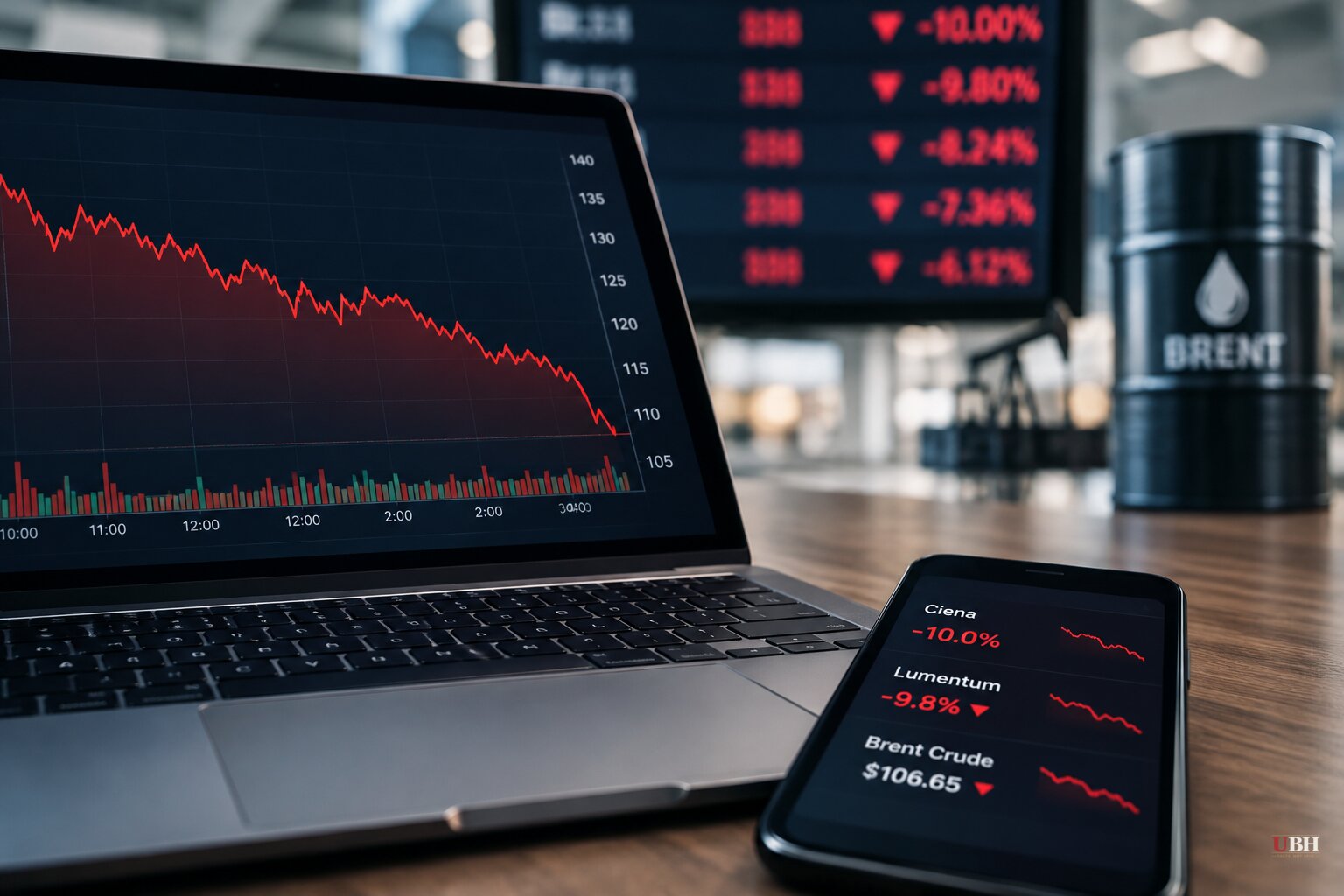
Ciena and Lumentum Fall About 10% as AI Stocks Slide and Brent Settles at $106.65
Since OpenAI said on Oct. 8 that its annualized revenue was close to $50 billion rather than the roughly $70 billion widely cited, the AI trade has been looking for a floor. Monday, Oct. 12, did not provide one.
The S&P 500 slipped 0.1% and the Nasdaq fell 0.4%, while the Dow rose 0.4%. The S&P set its record close last Tuesday and is up 14% this year. About 64% of S&P 500 companies rose, led by communication services: Meta gained 3.4%, Verizon 2.7%, T-Mobile 2.2% and AT&T 1.4%. Big tech dragged the average down. Micron lost 3.9%, AMD 2.3%, Broadcom 1.9% and Nvidia 1.3%.
Optical stocks take the biggest hit
The sharpest damage came in the companies that make the lasers, fiber and networking gear inside AI data centers. Ciena closed down 10%, Lumentum 9.8% and Coherent 7.9%. Corning fell 6%, Lumen Technologies 4.3%, Marvell 3.4% and Cisco 2.6%.
These stocks had run hard. Lumentum is up 516% over the past year and Coherent 148%.
Analysts offered different explanations. Giuseppe Sette, president and co-founder of the analytics firm Reflexivity, told MarketWatch the move did not reflect any "crack in optical demand, which remains booked out for years." He pointed to a joint demo Monday by Lumentum, Astera Labs and Corning at the Open Compute Project Global Summit in San Jose. By his account, the market had already priced that showcase in, "so the event became an exit point rather than a catalyst."
Morningstar analyst Martin Szumski pointed elsewhere. At a panel in Singapore, Broadcom CEO Hock Tan said capital was the biggest bottleneck in the AI buildout. Photonics revenue depends on committed hyperscaler spending, Szumski said, so Tan's comments could signal a shift away from "continued all-out hyperscaler spending."
Daniel O'Regan, managing director for equity trading at Mizuho, noted in a note that optical stocks were a "massive outperformer" Friday after bullish demand comments from Lumentum's CEO. Part of Monday's drop, he wrote, could be the group giving those gains back.
No one in that set of explanations is certain. Sette says demand is intact, Szumski says spending could be cooling, and O'Regan says it may just be profit-taking.
Seoul takes it harder
The pain was sharper in South Korea. The Kospi was down 2.45%, or 162.09 points, at 6,463.84 as of 1:36 p.m. in Seoul, after falling more than 3% early. It hit an intraday low of 6,413.53.
Samsung Electronics was down about 2.7% and SK Hynix about 4.3% by mid-morning. Together they make up more than half of the index's weight.
Han Ji-young, a researcher at Kiwoom Securities, told The Chosun that the OpenAI episode shows market expectations for AI are getting stricter, and that investors should expect more sensitivity to earnings quality during third-quarter reporting. OpenAI said the gap between the two revenue figures reflected differences in how revenue is recognized, not a drop in sales.
Oil keeps climbing
Brent crude rose 1.8% to settle at $106.65 a barrel. It has swung between $96 and nearly $110 over the past month on uncertainty about the U.S. war with Iran and its effect on global energy supplies. Oil climbed Monday after renewed Houthi attacks on Saudi Arabia's main airport over the weekend.
The jump came despite President Trump's announcement Friday on social media that he had struck a deal with Vladimir Putin to buy Russian diesel, aimed at easing fuel prices before the Nov. 3 midterms. The plan cuts against U.S. efforts to reduce the money Russia earns from oil and gas sales, which can be used to fund its war against Ukraine.
How bad is diesel, really?
The Energy Information Administration's on-highway diesel average hit $6.53 a gallon the week of Sept. 21, the highest weekly reading since the series began in 1994. A story on the auto site The Drive on Oct. 5 said high diesel prices had bankrupted 16 trucking companies in 30 days.
Breitbart Business Digest disputes the framing. Its analysis adjusts for inflation and finds the June 2008 peak of $4.764 equals about $7.20 in August 2026 dollars, and the June 2022 peak of $5.81 equals about $6.57. The current nominal price of around $6.28, Breitbart calculates, is the equivalent of $4.12 in 2008 dollars and $5.55 in 2022 dollars. On that basis it argues the economy is unlikely to be coming unglued over diesel.
Both things can be true. The nominal record is real, and truckers pay nominal prices. The inflation-adjusted comparison shows the price is still below the 2008 peak.
The LA Times notes the transmission mechanism: gasoline hits household wallets directly, while diesel raises the cost of nearly every shipped product, from food to clothing.
What comes next
Magdalena Ocampo, a market strategist at Principal Asset Management, wrote that AI "continues to support growth," but that uncertainty about its long-term impact makes "future gains more reliant on earnings delivery rather than potential."
That test arrives this week with bank earnings and the inflation data, and then with the third-quarter reports from the AI names that have carried the index all year. Oil sits near $107, with a vote three weeks out.
Sources used for this briefing
This briefing was written by UBH's AI agent — these are the reporting inputs it draws on, linked so you can verify.


