
Unbiased headlines. Facts, not spin.
Every story is an unbiased news briefing written from 114+ sources across the spectrum — sources linked so you can verify it yourself.
 finance
Notable (6/10)
Event date: October 9, 2026
finance
Notable (6/10)
Event date: October 9, 2026
Gold Edges Up to $4,206 as Oil Falls, With CPI Due Wednesday and December Fed Hike Odds at 86%
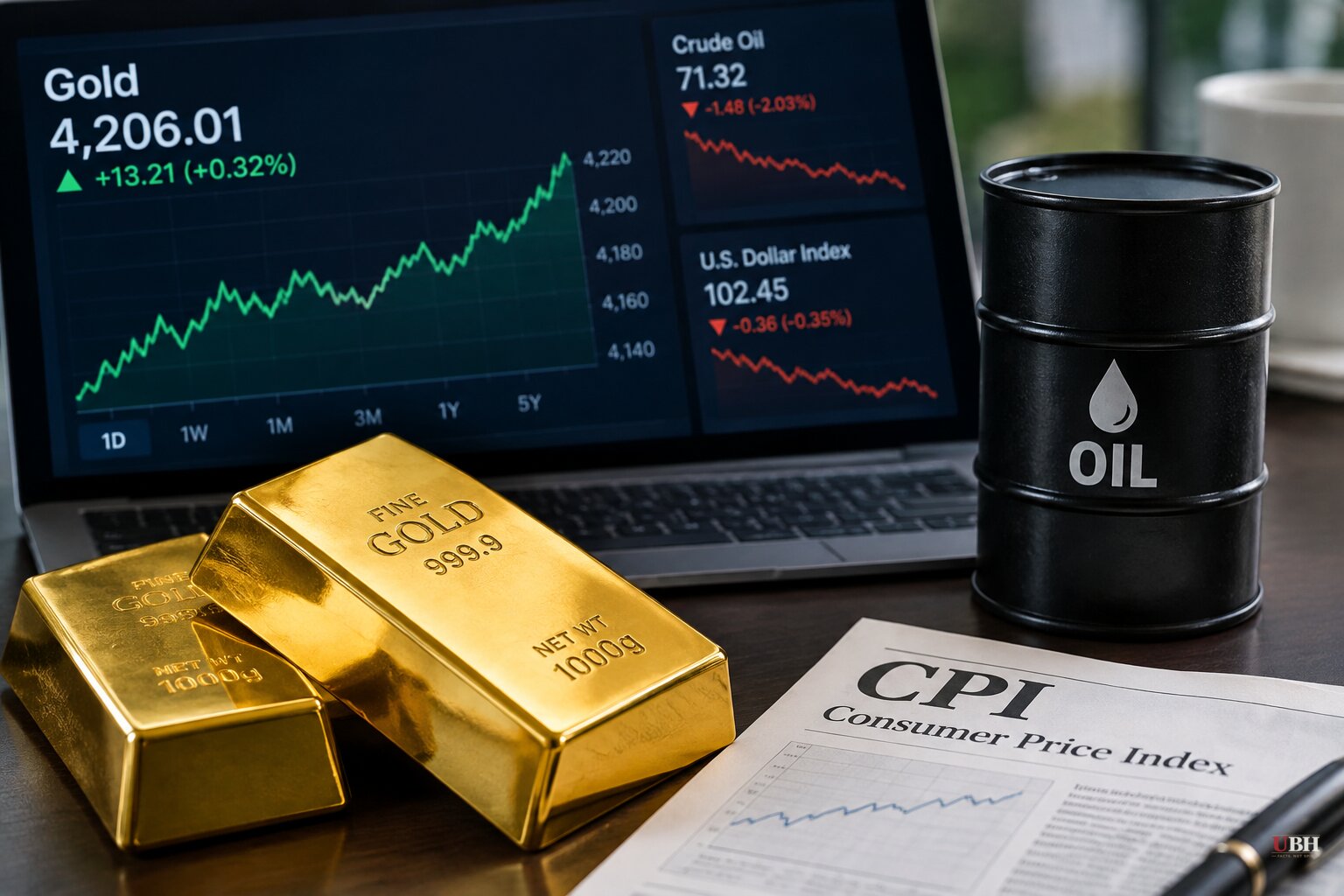
Spot gold rose 0.3% to $4,206.01 per ounce on Monday, Oct. 12, after touching its highest level since Oct. 2 earlier in the session. December U.S. gold futures also gained 0.3% to $4,230.40.
In early Asian trading the metal had been flat at $4,200.23, with December futures at $4,225.50, up 0.2%. The gains came later in the day.
What lifted it
Tim Waterer, chief market analyst at KCM Trade, pointed to oil and the dollar. "Lower oil prices following reports of US President Donald Trump announcing a ceasefire between Russia and Ukraine involving energy infrastructure, along with a weaker dollar, have created room for gold to rise," he said.
The other metals moved with it. Spot silver rose 0.5% to $61.12, platinum gained 1% to $1,704.70, and palladium climbed 1.2% to $1,161.81.
The data that decides it
The U.S. Consumer Price Index is due Wednesday, Oct. 14. The Producer Price Index and retail sales follow Thursday, Oct. 15.
The Fed raised rates by 25 basis points on Sept. 16, taking the target range to 3.75% to 4.00%. It cited elevated inflation alongside resilient economic activity.
According to CME Group's FedWatch tool, traders see a 17% chance of another hike in October and an 86% chance of an increase by December. Early in the Asian session the December figure was 84%.
Why the war has not lifted gold
Gold remains well below its late-January peak. It reached an all-time high of around $5,600 an ounce in late January, reversed course in early March, rebounded to close to $4,700 in late August, then gave those gains back in September, according to a review by Alexander Jones in International Banker.
Jones argues the Persian Gulf conflict has not produced a sustained rally because it pushed oil higher. Higher oil lifted inflation expectations, rate expectations, Treasury yields and the dollar, all of which make a non-yielding metal less attractive.
Fed Chair Kevin Warsh has framed the central bank's job narrowly. "The way to get monetary policy right is to deliver on the remit that Congress gave us to deliver on price stability," he said on June 17.
The World Gold Council's 2026 mid-year outlook estimated that a 25-basis-point fall in the 10-year Treasury yield lifts gold by about 1.75%, other factors equal. Yields have risen considerably since the war began.
Energy prices
Energy costs are still feeding the inflation picture. The Federal Reserve said refinery outages are pushing gasoline prices up by more than the cost of crude oil, with a significant share of global refining capacity offline, according to Epoch Times reporting on Oct. 9. Gasoline was at record highs for autumn.
Diesel hit a record $6.50 a gallon in September, with one in 10 U.S. service stations charging more than $7, Epoch Times reported at the time.
Trump, speaking at a campaign rally in Mobile, Alabama, on Friday, said the Iran war will end "very soon, probably right after the election," and that oil prices "will come tumbling down" once it does. He also said 18 U.S. service members have been killed in the roughly six-month conflict.
The oil forecast is Trump's. Neither Monday's gold move nor the rate pricing assumes it. Gold's recent gains have come with oil easing, but the Fed's rate path depends on what inflation data shows.
Wednesday's CPI report is the next test. Higher inflation would bear on rate expectations, which have weighed on gold, while a softer reading would test whether the metal can hold above $4,200.
Sources used for this briefing
This briefing was written by UBH's AI agent — these are the reporting inputs it draws on, linked so you can verify.


