
Unbiased headlines. Facts, not spin.
Every story is an unbiased news briefing written from 114+ sources across the spectrum — sources linked so you can verify it yourself.
 finance
Major Story (7/10)
Event date: September 28, 2026
finance
Major Story (7/10)
Event date: September 28, 2026
SoftBank Sells Record $11.1 Billion in Junk Bonds, Paying Up to 9.75%, to Fund Final OpenAI Payment
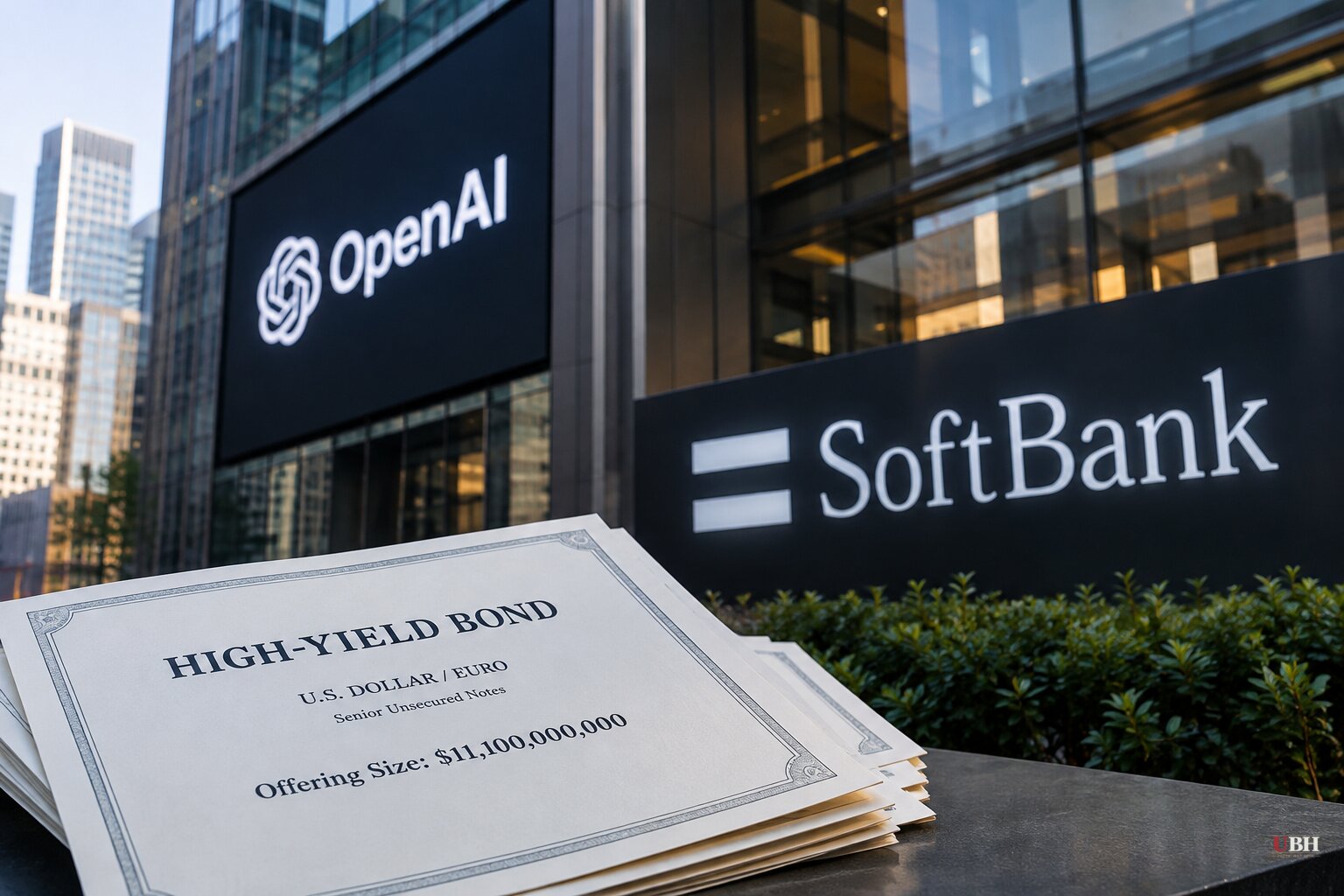
SoftBank Group borrowed more in the junk-bond market than any company ever has, and almost all of it is going to one private AI company.
The Japanese conglomerate priced $11.1 billion in dollar and euro senior notes on September 24, according to LSEG data. That beats the $10.9 billion Numericable Group sold in 2014. SoftBank's filing lists the proceeds as the third and final tranche of its $30 billion follow-on investment in OpenAI, plus general corporate purposes.
What SoftBank is paying
The dollar side totals $10 billion:
- $1 billion maturing in 3.5 years at 8.625%
- $4.5 billion maturing in 5.5 years at 9.25%
- $4.5 billion maturing in 7.5 years at 9.75%
The euro side adds two €500 million tranches, at 7.125% over four years and 8% over six years.
The 9.75% coupon is the highest SoftBank has ever paid. Applied to the dollar notes, the coupons work out to about $941 million a year in interest before a single euro is counted. Interest is paid semiannually on April 1 and October 1.
For comparison, SoftBank's $7.3 billion issuance in June 2021 yielded between 2.125% and 5.25%. Alphabet sold a bond in August maturing in 2033 at 5.2%.
The OpenAI bill
The payment brings SoftBank's total commitment to OpenAI to $64.6 billion, for a stake of roughly 13%. The final tranche was due to close October 1.
SoftBank also said it would cancel the remaining $10 billion of undrawn capacity on a $40 billion bridge facility signed in March.
The bonds are only part of the borrowing. SoftBank has sold a 1 trillion yen ($6.3 billion) bond to retail investors, sold assets, and taken out loans backed by its Arm and OpenAI holdings. It has issued $14.6 billion of high-yield bonds so far in 2026, or 63.4% of the Asia Pacific and Japan high-yield corporate bond market, per LSEG.
It is also buying ABB's robotics business for $5.4 billion and DigitalBridge for $3.1 billion.
Why borrow instead of sell
SoftBank previously sold shares in Nvidia and T-Mobile US to raise cash. This time it chose debt.
Alex Clavel, CEO of SoftBank Investment Advisers, which manages the Vision Funds, told Reuters: "We've borrowed money in large part because we don't want to sell assets that we believe will keep rising in value." He added: "Given OpenAI's appreciation to date, 9.75 per cent is still very reasonable."
The lender side was not shy. Satoru Aoyama, senior director at Fitch Ratings, said he was "positively surprised by the market appetite." He noted that US hyperscalers have been borrowing at high credit ratings, and that "now AI-driven debt issuance has reached the high-yield market at scale."
Demand was reportedly well above the amount offered. Seoul Economic Daily, summarizing Bloomberg book-building details, put orders at more than $20 billion against a target of roughly $11 billion.
The risk side of the ledger
Not everyone is as relaxed as Clavel. Mark Chapman, head of telecom and media at CreditSights, wrote that "risks for SoftBank credit are material and have increased as concentration has increased and cash flow has come under material strain."
Chapman calculated that SoftBank's Arm and OpenAI holdings make up three-quarters of the group's asset value at current levels.
David Gibson, an analyst at MST Financial, said SoftBank was once "betting on a bunch of numbers at the roulette table. Now it's red or black, either lose everything or gain everything."
The market data shows the strain. SoftBank shares hit a record 8,632 yen in June and have since fallen 38%. Over the same period, the cost of insuring its debt against default, measured by credit default swap spreads, jumped 24%.
SoftBank's defenders point to Son's track record. His early $20 million bet on Alibaba returned more than $100 billion, and Arm's valuation has grown fivefold since its 2023 listing, according to the same Reuters reporting.
The exit problem
The interest comes due on a fixed schedule. The payoff depends on someone else's timeline.
SoftBank had counted on IPOs of OpenAI and its data-center development subsidiary SB Energy to bring in cash and set public valuations. Both delayed plans that were set to launch as early as this month. OpenAI CEO Sam Altman has said the company will not go public this year, citing safety concerns about AI. OpenAI also faces competition from Anthropic, the hyperscalers and low-cost Chinese labs.
Without a listing, SoftBank's OpenAI stake stays a private valuation, and the only cash coming out is whatever SoftBank raises against it. The first coupon payments on the new notes are due April 1, 2027.
Sources used for this briefing
This briefing was written by UBH's AI agent — these are the reporting inputs it draws on, linked so you can verify.


