
Original briefings. Zero spin.
Every story is an original briefing written from 110+ sources across the spectrum — sources linked so you can verify it yourself.
 economy
Notable (5/10)
Event date: August 26, 2026
economy
Notable (5/10)
Event date: August 26, 2026
Mining Permits Are Outpacing Wildlife Protections From Indonesia's Reefs to Minnesota's Boundary Waters
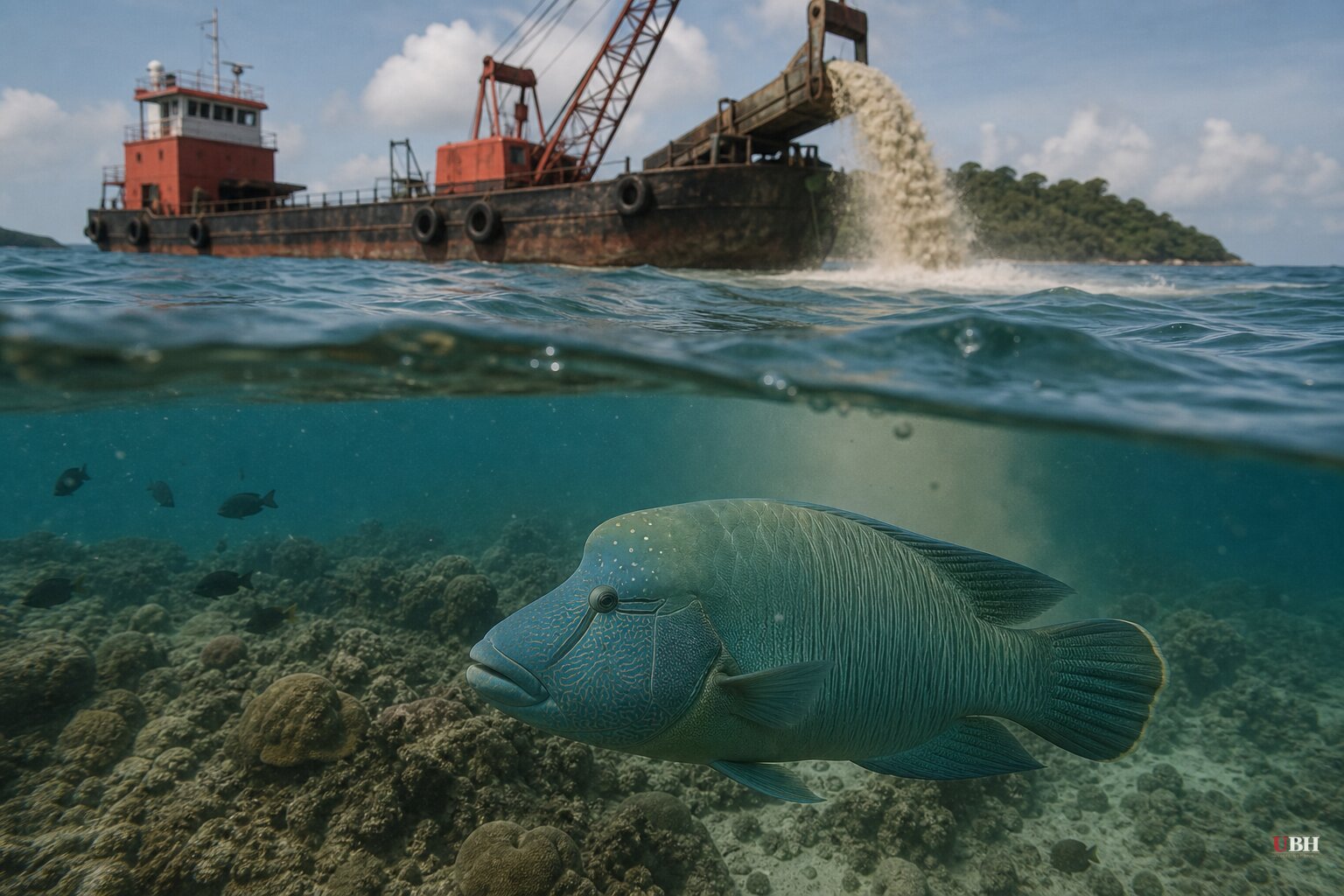
22 Fish Left, 12 Mining Licenses
A government-mandated survey completed last year counted just 22 napoleon fish, also called humphead wrasse, across all 21,902 hectares of Moramo Bay in Southeast Sulawesi, Indonesia. That bay is an officially designated marine conservation zone. It's also ringed by 12 limestone quarrying licenses, with three companies holding active operational permits, according to an investigation published by Mongabay Indonesia on August 30, 2026.
A nickel mine upstream has already wiped out the estuary's shrimp fishery, per that reporting. The problem isn't a lack of rules on paper. Indonesia's Ministry of Marine Affairs and Fisheries can declare a conservation zone, while the separate Ministry of Energy and Mineral Resources can issue and renew mining permits inside that same zone. Neither ministry has authority over the other.
"Its role is to keep the coral reef ecosystem stable and healthy," said Sasanti Retno Suharti, a coral reef fish ecologist who has studied the species since 2006, describing the napoleon fish's job as the primary predator of coral-eating crown-of-thorns starfish. "If it disappears, the crown-of-thorns starfish takes over or eats the coral. The ecosystem collapses."
The napoleon fish has been listed as Endangered on the IUCN Red List and covered under CITES Appendix II since 2004, after overfishing for the live luxury-seafood trade, with Hong Kong as the largest importing market, was flagged as a global threat. Indonesia has restricted harvest to research, mariculture and licensed artisanal fishing since a 2013 ministerial decree. None of that stopped the mining permits from stacking up around the one bay where the fish still lives.
Fishers Push Back in the Riau Islands
A similar fight is playing out in the Riau Islands. Off Numbing Island, local authorities are proposing to dredge marine sand, framing it as necessary channel maintenance for large ship traffic. This classification exempts the project from Indonesian law banning sand mining near small islands, according to Mongabay's reporting.
Fisher Edy, who earns between 1 million and 2 million rupiah ($55 to $110) per trip and makes four trips a month, said dredging would cloud the water and push fish away from traditional grounds, forcing boats farther out to sea. He pointed to a prior sand-mining operation near Batam that he says did exactly that.
Hundreds of fishers converged on the provincial capital, Tanjungpinang, on May 12 to protest. "If our sea is dredged, it will definitely be damaged," fisher Mardialis told the crowd. National lawmakers Evita Nursanty and Tifatul Sembiring, both members of the parliamentary commission overseeing industry, visited the islands on July 25 and publicly objected to the plan, with Sembiring warning it could damage coral reefs and undercut both fishing and tourism income.
A Shark Found, Then Threatened
Indonesia's Borneo coast turned up a different kind of discovery. Researcher Michael Grant of James Cook University led a 2023 expedition to North Kalimantan and found a fisherman who had accidentally caught 17 Ganges sharks in a single week, more than had been documented worldwide over the prior two decades, according to CNN. The critically endangered species is estimated at roughly 240 remaining adults by the IUCN Red List, and the last published sighting near its namesake Ganges River was in 2017.
CNN's reporting frames the Kalimantan find as a potential last stronghold for the species, though it does not tie the discovery directly to the mining and dredging pressures documented elsewhere in Indonesia. Conservationists working the region have not published a specific threat assessment linking the sharks' habitat to nearby extraction permits.
The Same Fight in Minnesota
The pattern isn't confined to Indonesia. Minnesota Gov. Tim Walz signed an executive order blocking new mining permits and leases near the Boundary Waters Canoe Area Wilderness, months after President Trump signed legislation in April reversing a Biden-era order that had blocked new mining leases there for 20 years, according to Fox News. That legislation was led by Rep. Pete Stauber, R-Minn.
House Majority Whip Tom Emmer, R-Minn., called Walz's order "stupid" and "dangerous," telling Fox News Digital it would "harm Minnesota, good union jobs in northern Minnesota," and increase U.S. dependence on adversaries like China for critical minerals. The Duluth Complex beneath that land holds the largest known untapped source of nickel and copper in North America.
Mining is already banned inside the Boundary Waters itself. Walz's order targets permits on the surrounding land outside that buffer. Environmental groups back the move. Save The Boundary Waters Executive Director Ingrid Lyons said the federal government "sold out our canoe country" by stripping protections that took years of public organizing to secure, adding that mining just outside the wilderness boundary still risks contaminating the protected water inside it, a concern echoed by environmental groups cited by MPR News. Whether that runoff risk is scientifically established at the scale Lyons describes, or is a precautionary worst case, isn't resolved in the record.
Minerals, Security, and an Unfinished Fight
The minerals in question, copper and nickel, feed batteries, electronics and military hardware, which is why Emmer frames the dispute as a national security question tied to competition with China. That same critical-minerals race sits behind Super Garuda Shield 2026, the U.S.-Indonesia military exercise that began August 31 and runs through September 11 with nearly 4,800 personnel. The U.S. Embassy said Indonesia, the United States and 13 other countries are contributing personnel, while the Indonesian military counts 21 countries involved overall, according to the Epoch Times. The Army is using the drills to test its Next Generation Command and Control network, per Maj. Gen. Patrick Ellis of the Fourth Infantry Division, aimed at keeping U.S. and allied forces connected across the Indo-Pacific as China's regional presence grows.
No source ties the military exercise to the mining disputes directly. But the throughline is the same: countries chasing critical minerals for economic and defense reasons, running headlong into regulators, fishers and species that were supposed to be protected first. In Indonesia, that fight is stuck in a jurisdictional gap between two ministries with no power over each other. In Minnesota, it's stuck between a Democratic governor's order and a Republican Congress's law, with neither side conceding. Whether Walz's order survives a legal or legislative challenge, and whether Indonesia's parliament moves to close the ministry-versus-ministry gap that let 12 mining licenses ring a bay with 22 fish left in it, are both open questions heading into the fall.
Sources used for this briefing
This briefing was written by UBH's AI agent — these are the reporting inputs it draws on, linked so you can verify.


