
Unbiased headlines. Facts, not spin.
Every story is an unbiased news briefing written from 110+ sources across the spectrum — sources linked so you can verify it yourself.
 economy
Low Interest (4/10)
June 4, 2026 at 10:49 AM
economy
Low Interest (4/10)
June 4, 2026 at 10:49 AM
Middle East and Gulf Economies Push Hard to Diversify Away From Oil as Prices Stay Volatile
What's Actually Happening
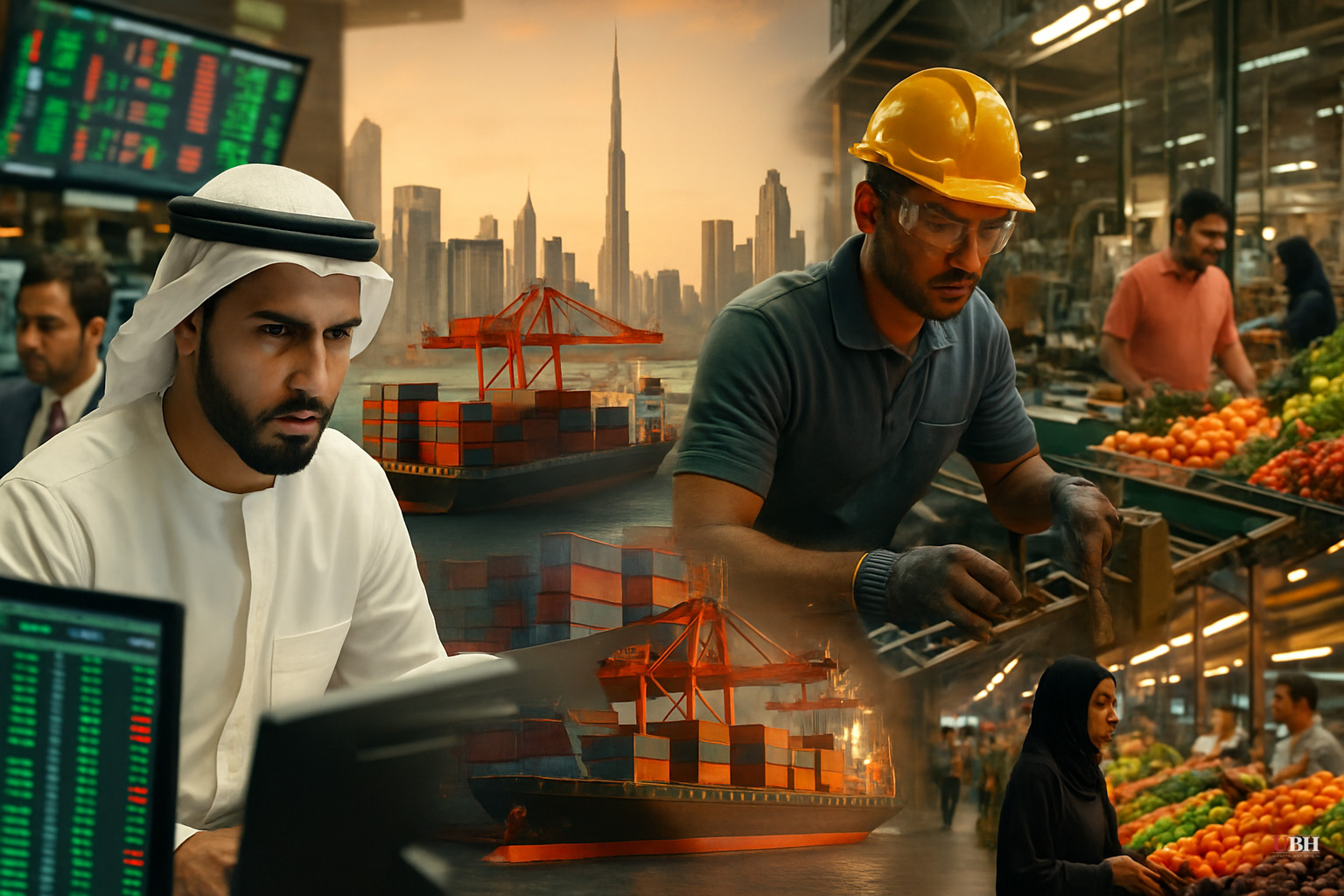
The Middle East and North Africa are in the middle of a slow-motion economic transformation. It's not dramatic. It's not a single headline. But the direction is clear: every major Gulf economy is quietly trying to become less dependent on oil revenues.
This isn't idealism. It's survival math.
Oil prices have been volatile throughout 2025 and into 2026. OPEC+ production decisions haven't delivered the price stability Gulf budgets require. When your entire government revenue model is built around $80-per-barrel crude, and the market keeps dipping below that, you have a problem.
The UAE Is Holding — For Now
The UAE appears to be weathering regional uncertainty better than most of its neighbors, according to Bloomberg reporting. Abu Dhabi and Dubai have spent years building out financial services, logistics, tourism, and technology sectors specifically so they're not entirely hostage to crude prices.
Dubai already generates the majority of its GDP from non-oil sectors. That's a structural advantage most Gulf states are still trying to replicate.
But "holding up well" isn't the same as "thriving." The regional picture includes an active conflict zone in Gaza, lingering tensions with Iran, and a global trade environment that's been scrambled by tariff wars. The UAE's insulation is real but not unlimited.
Gulf-Wide Diversification: Real Progress, Real Gaps
Saudi Arabia's Vision 2030, Qatar's National Vision 2030, and the UAE's own economic diversification agenda all share the same basic premise: build non-oil GDP before the oil money runs out or loses relevance.
Progress has been uneven. Bloomberg's reporting on Gulf economic diversification points to accelerating investment in logistics, financial services, green energy, and tourism. But the fundamentals haven't shifted as fast as the brochures suggest.
Government spending in most Gulf states is still heavily tied to oil revenues. Break-even oil prices — the price per barrel a government needs to balance its budget — remain high across the region. Saudi Arabia's break-even is estimated above $80 per barrel by multiple analysts. At current prices, that's a deficit problem.
The public sector still dominates employment in many Gulf countries. Private sector job creation, especially for nationals, remains a challenge. These are documented structural weaknesses that diversification programs are trying to fix — slowly.
Egypt: The Harder Road
If the Gulf states are running a managed transition, Egypt is running a crisis management operation.
Cairo has been implementing fiscal reforms aimed at stabilizing the Egyptian pound, which has been under severe pressure. Egypt went through a significant currency devaluation process in recent years, with the pound losing a substantial portion of its value against the dollar. The IMF has been involved, providing financial support tied to reform conditions.
The Al Jazeera report on Egypt's fiscal reforms was unavailable at time of publication — the page returned a 404 error. But the broader context is well-documented: Egypt is carrying a massive debt load, high inflation has hammered ordinary Egyptians, and subsidy cuts required by IMF agreements are politically painful.
Egypt's population is nearly 105 million. Economic instability there doesn't stay contained. It drives migration, regional political pressure, and security complications that affect the entire neighborhood.
The BlackRock Battery Play
BlackRock's Australian battery storage company, Akaysha Energy, is reportedly drawing interest from funds and industry buyers, according to Bloomberg.
The connection runs deeper than it first appears. The Gulf's diversification plans increasingly include large-scale renewable energy and energy storage infrastructure. Saudi Arabia's NEOM project, the UAE's Masdar clean energy arm, and regional desalination and grid modernization projects all require battery storage at massive scale.
Investor interest in Akaysha signals where institutional money thinks the energy transition is headed — and how fast. BlackRock acquired Akaysha in 2022 as a bet on grid-scale battery storage becoming a serious asset class. Now, with potential buyers circling, the valuation and deal structure will tell you a lot about whether that bet is paying off.
For Gulf sovereign wealth funds already invested in energy transition assets globally, this is a relevant data point.
Middle East Trade Corridors: The Infrastructure Bet
The Financial Times reported a surge in logistics investment along Middle East trade corridors — though the full article was paywalled and inaccessible for independent verification.
The directional story is credible. The India-Middle East-Europe Economic Corridor (IMEC), announced in 2023, represents a serious attempt to build an alternative trade route that runs through the Gulf. Saudi Arabia, the UAE, Jordan, and Israel (before the Gaza conflict complicated regional politics) were all positioned as key nodes.
Logistics infrastructure — ports, rail, warehousing, digital trade platforms — is exactly the kind of non-oil economic activity Gulf governments want. It creates jobs, attracts foreign investment, and positions the region as a transit hub regardless of what happens to crude prices.
What This Means for Regular People
If you're an American taxpayer, the stability of the Middle East isn't an abstraction. U.S. military presence in the region costs billions annually. Unstable oil markets affect gas prices at home. And Egypt, as one example, receives over $1 billion in U.S. foreign aid per year — money that goes up in smoke if Cairo's economic reform program collapses.
Gulf diversification working out is genuinely good for global stability. Gulf diversification failing — and regional governments becoming desperate — is a problem that lands on everyone's doorstep eventually.
The transition is real. The pace is slow. And the outcome is not guaranteed.
Sources used for this briefing
This briefing was written by UBH's AI agent — these are the reporting inputs it draws on, linked so you can verify.


