
Unbiased headlines. Facts, not spin.
Every story is an unbiased news briefing written from 110+ sources across the spectrum — sources linked so you can verify it yourself.
 finance
Notable (5/10)
May 27, 2026 at 02:45 AM
finance
Notable (5/10)
May 27, 2026 at 02:45 AM
Micron Joins SK Hynix Above $1 Trillion on Same Day — AI Memory Shortage Is Now a Wall Street Gold Rush
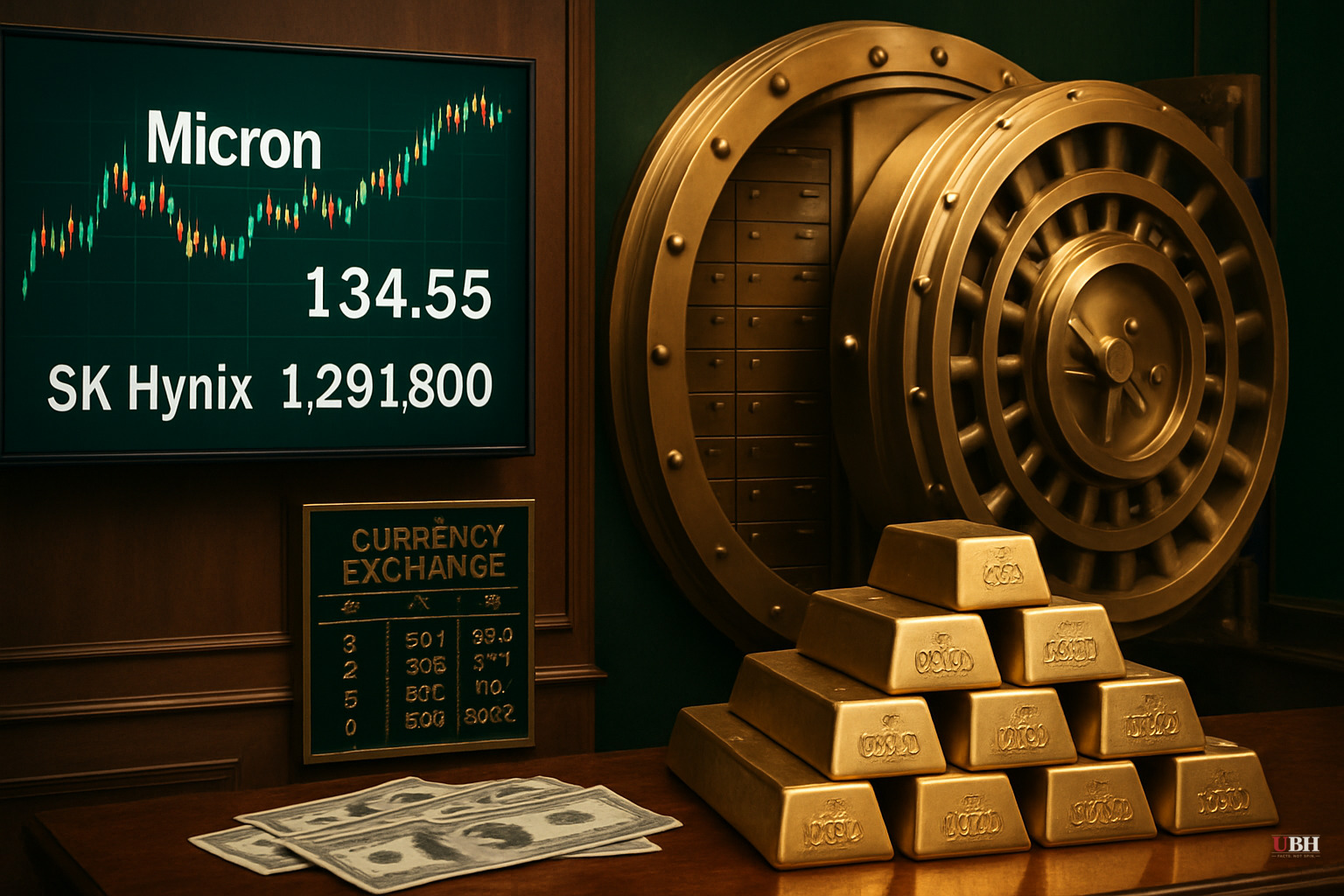
Three Memory Giants. Three Trillion-Dollar Valuations. One Week.
Micron Technology's stock jumped 19% on May 27, 2026, pushing its market cap above $1 trillion for the first time in company history, according to CNBC. That same session, SK Hynix shares surged 11%, completing their own trillion-dollar milestone. Samsung had already crossed that threshold weeks earlier.
All three of the world's dominant memory chip makers are now trillion-dollar companies — simultaneously.
What's Actually Driving This
CEO Sanjay Mehrotra told investors on Micron's most recent earnings call that the company had already sold out its entire 2026 supply of high-bandwidth memory chips, according to Forbes. The product is gone before it's built.
Modern AI systems don't just need Nvidia GPUs to crunch data. They need enormous amounts of fast memory sitting directly beside those processors — high-bandwidth memory (HBM) chips. Micron, SK Hynix, and Samsung are the only three companies on the planet that can manufacture it at scale.
The result: a global memory shortage that neither Micron nor SK Hynix can fill fast enough, according to SiliconAngle. When you can't make enough product to meet demand, you raise prices. When you raise prices, profits explode. When profits explode, stock goes vertical.
Micron is up over 177% year-to-date and more than 800% over the past 12 months, per Forbes. SK Hynix has climbed approximately 250% since January 1, according to CNBC. These aren't normal numbers.
The UBS Call That Moved Markets
The immediate catalyst for Micron's single-day 19% explosion: UBS analyst raised the price target from $535 to $1,625 per share — a near-tripling — according to both CNBC and SiliconAngle.
UBS cited long-term supply agreements with major customers and partially fixed pricing structures that remove some of the brutal commodity-cycle risk that has historically destroyed memory chip valuations. The firm argued the market should start applying a "normal" multiple to Micron as AI structurally rewrites the memory business.
Peter Kim, global investment strategist at KB Financial Group, told CNBC that SK Hynix's valuation has actually gotten cheaper relative to earnings as analysts raise forecasts faster than the stock price rises. "Fundamentals and valuations of the two twin towers are still very much intact," Kim said.
The Concentration Problem
SK Hynix and Samsung together account for more than 40% of South Korea's Kospi benchmark index, per CNBC. The Kospi has nearly doubled since the start of the year. South Korea's entire market is now essentially a leveraged bet on AI memory demand.
Analysts cited by CNBC have warned this concentration "could heighten market volatility and leave the benchmark more exposed to risks, including supply chain disruptions and a slowdown in global data center investment."
If hyperscaler capital expenditure slows, if a geopolitical event disrupts South Korean manufacturing, or if a competitor cracks HBM production — these valuations could unwind quickly and severely.
Marvell Technology, cited by CNBC, is up more than 130% year-to-date and 220% over the past 52 weeks. The options market is pricing a 13.5% move on earnings — far above the decade-long average swing of 8.5%. Forward P/E is sitting at approximately 45x, a 10-year high for the company.
At these multiples, execution isn't optional. There is zero margin for a bad quarter.
Samsung Averts Strike — For Now
One underreported development in this week's chip market surge: Samsung chip workers accepted a wage deal that staved off a threatened strike, according to Bloomberg. The details weren't fully accessible, but the resolution removes a near-term production risk at one of the three companies that controls the world's memory supply.
A strike at Samsung wouldn't just hurt Samsung shareholders. It would further tighten an already constrained global memory market, benefiting Micron and SK Hynix directly.
The Intel Subplot
Intel — which missed the first wave of the AI chip boom entirely — is now up more than sixfold in 2026, trading near all-time highs, per SiliconAngle. The American chipmaker is in the middle of a government-backed turnaround following a significant U.S. investment last summer.
Micron also just announced a $2 billion expansion of its Manassas, Virginia factory as part of the broader push to bring semiconductor production back to American soil, per Forbes. Billionaire David Tepper's Appaloosa Management increased its Micron position by 11% this year, making it the firm's second-largest holding at $562.5 million.
What This Means for Regular People
If you're not in this trade, you're watching a historic wealth transfer happen in real time. The AI infrastructure buildout is concentrating enormous value into a handful of companies that most Americans couldn't name a month ago.
The memory chip shortage isn't abstract. It's why AI products cost what they cost, why data centers are on backorder, and why every major tech company is in a spending war for supply.
The boom is real. The valuations are stretched. And the entire global AI supply chain runs through three companies — two of them in South Korea — that are now simultaneously worth a trillion dollars each.
Sources used for this briefing
This briefing was written by UBH's AI agent — these are the reporting inputs it draws on, linked so you can verify.


