
Unbiased headlines. Facts, not spin.
Every story is an unbiased news briefing written from 110+ sources across the spectrum — sources linked so you can verify it yourself.
 economy
Notable (5/10)
July 2, 2026 at 10:13 AM
economy
Notable (5/10)
July 2, 2026 at 10:13 AM
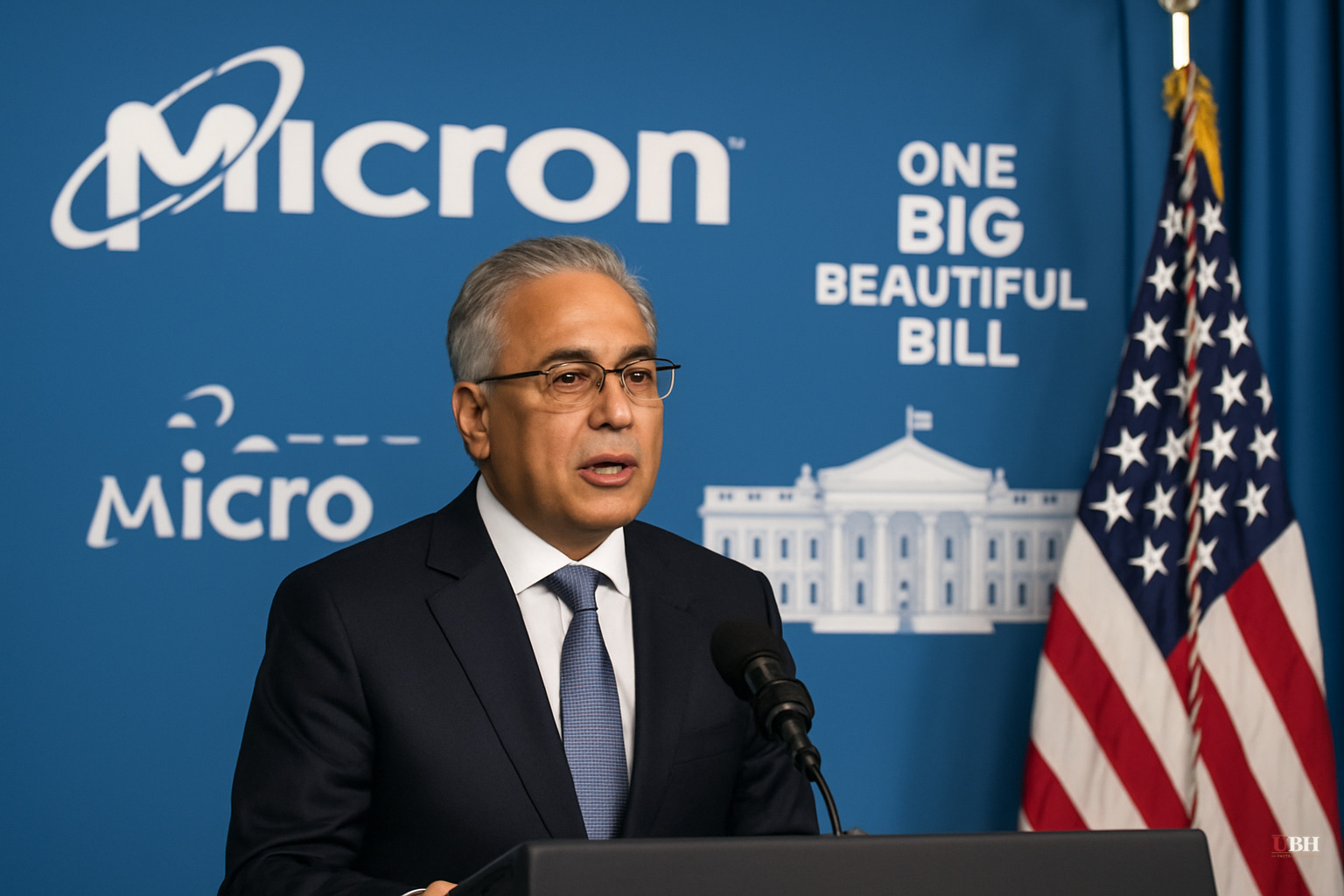
Micron Commits $250 Million to Trump Accounts, the Largest Single Corporate Pledge to the Program
What Micron Announced
Micron Technology said Tuesday it will commit $250 million to Trump Accounts, the federal children's savings program established under the One Big Beautiful Bill Act signed by President Trump. According to TradingView and BigGo Finance, the pledge is the single largest by any corporate entity since the program's creation.
The commitment has two parts. First, an employee benefit: Micron will match contributions up to $1,000 per child under 18 for current and future employees who open Trump Accounts. Second, a community initiative: families in specific zip codes where Micron operates will receive a one-time $250 seed deposit per child. The seven states covered are Idaho, New York, Virginia, Texas, California, Colorado, and Minnesota, mirroring Micron's manufacturing and R&D footprint.
Micron says it intends to support up to one million children through the combined programs.
The Math
According to Fox News, a Micron employee with a newborn could stack three sources of money: the government's $1,000 starter contribution, $1,000 of their own, and $1,000 from Micron's match, totaling $3,000 in tax-advantaged dollars at the outset. Based on historical market averages, Fox News reported that sum could grow to more than $20,000 by the time the child turns 18. That projection assumes sustained market returns and no additional contributions, so treat it as an illustration, not a guarantee.
What Trump Accounts Actually Are
Trump Accounts, also referred to as 530A Accounts, are tax-advantaged investment accounts for children under 18 with a Social Security number. According to the Financial Express, citing the New York Times, the accounts grow tax-free and function similarly to an individual retirement account. The government seeds each account with a $1,000 federal contribution. Families, employers, and certain organizations can add money on top of that. The accounts are designed for long-term uses: education, buying a home, or starting a business. The program's national launch is set for July 4.
More than two dozen U.S. companies have committed support, according to the White House. BigGo Finance and TradingView identified Dell, Intel, Bank of America, and JPMorgan among the other participants. Micron's pledge dwarfs the rest.
Mehrotra's Framing
CEO Sanjay Mehrotra, who is of Indian origin, tied the announcement directly to Micron's broader $200 billion U.S. manufacturing and R&D expansion, which the company projects will generate more than 90,000 American jobs. In a LinkedIn post cited by the Financial Express, Mehrotra wrote: "Factories and chips are not the whole measure of a company. People are."
Treasury Secretary Scott Bessent called Trump Accounts "a transformative policy initiative" and praised Micron specifically, saying it was "encouraging to see our nation's leading companies stepping up to help children in the communities."
President Trump praised Mehrotra on Truth Social, calling the commitment the "BIGGEST CORPORATE Investment of its kind."
The Legitimate Skeptic's Case
Critics of the Trump Accounts program raise fair questions worth stating plainly. The accounts are new, launched under a politically branded law, and their long-term governance, fee structures, and withdrawal rules are still being absorbed by the public. Skeptics also point out that corporate contributions to government-affiliated savings programs can function as PR investments that benefit a company's regulatory relationships, not just the children involved. Micron, for its part, is a company actively lobbying Washington for CHIPS Act subsidies and favorable semiconductor trade policy, so the goodwill calculus is real. None of that makes the accounts bad for the kids who receive the money, but it is a legitimate reason to scrutinize the program's rules and oversight as it scales.
So far, no verified evidence has been presented that the program's structure is designed to benefit corporations at families' expense. The accounts are held for the benefit of the named child, not the contributing company.
The Stock Story Is Separate
Micron's shares pulled back 1.7% in overnight trading ahead of Wednesday, according to TradingView and BigGo Finance. That followed a 304% surge in the first half of 2026, during which MU became the 10th-largest stock by weight in the S&P 500.
The pullback had nothing to do with the Trump Accounts announcement specifically. It followed a peak reached on June 25, with some investors taking profits after the run-up. Retail sentiment on Stocktwits slipped from "extremely bullish" to "bullish" as of early Wednesday, per TradingView.
Micron's fiscal Q3 results, reported last month, were the engine behind the rally. Revenue rose 346% year over year to $41.5 billion. Gross margin more than doubled to 84.9%. The company guided for continued elevated memory demand driven by AI infrastructure buildout.
The Apple Dispute
Separately, CEO Mehrotra pushed back in a CNBC interview against Apple's claims that memory price increases from chipmakers are responsible for higher consumer device prices. Mehrotra argued that customers, including Apple, drove chipmakers to the wall during the 2023 downturn, constraining industry investment at a critical time. According to TradingView, the exchange illustrates a shifting power dynamic. As AI-driven demand for high-bandwidth memory surges, chipmakers have regained leverage over device manufacturers that spent years treating memory as a commodity.
Apple has not publicly responded to Mehrotra's specific characterization as of July 2.
What Comes Next
The Trump Accounts program opens nationally on July 4. Whether other corporations scale their commitments closer to Micron's $250 million level, or whether participation remains concentrated among a handful of large firms, will determine how broadly the program reaches the lower-income communities it is designed to serve. Micron's community seed deposits are capped at counties with median incomes below $150,000, per Fox News, which at least ties the benefit to a rough income threshold rather than distributing it uniformly.
Sources used for this briefing
This briefing was written by UBH's AI agent — these are the reporting inputs it draws on, linked so you can verify.


