
Unbiased headlines. Facts, not spin.
Every story is an unbiased news briefing written from 110+ sources across the spectrum — sources linked so you can verify it yourself.
 economy
Major Story (7/10)
July 7, 2026 at 02:01 AM
economy
Major Story (7/10)
July 7, 2026 at 02:01 AM
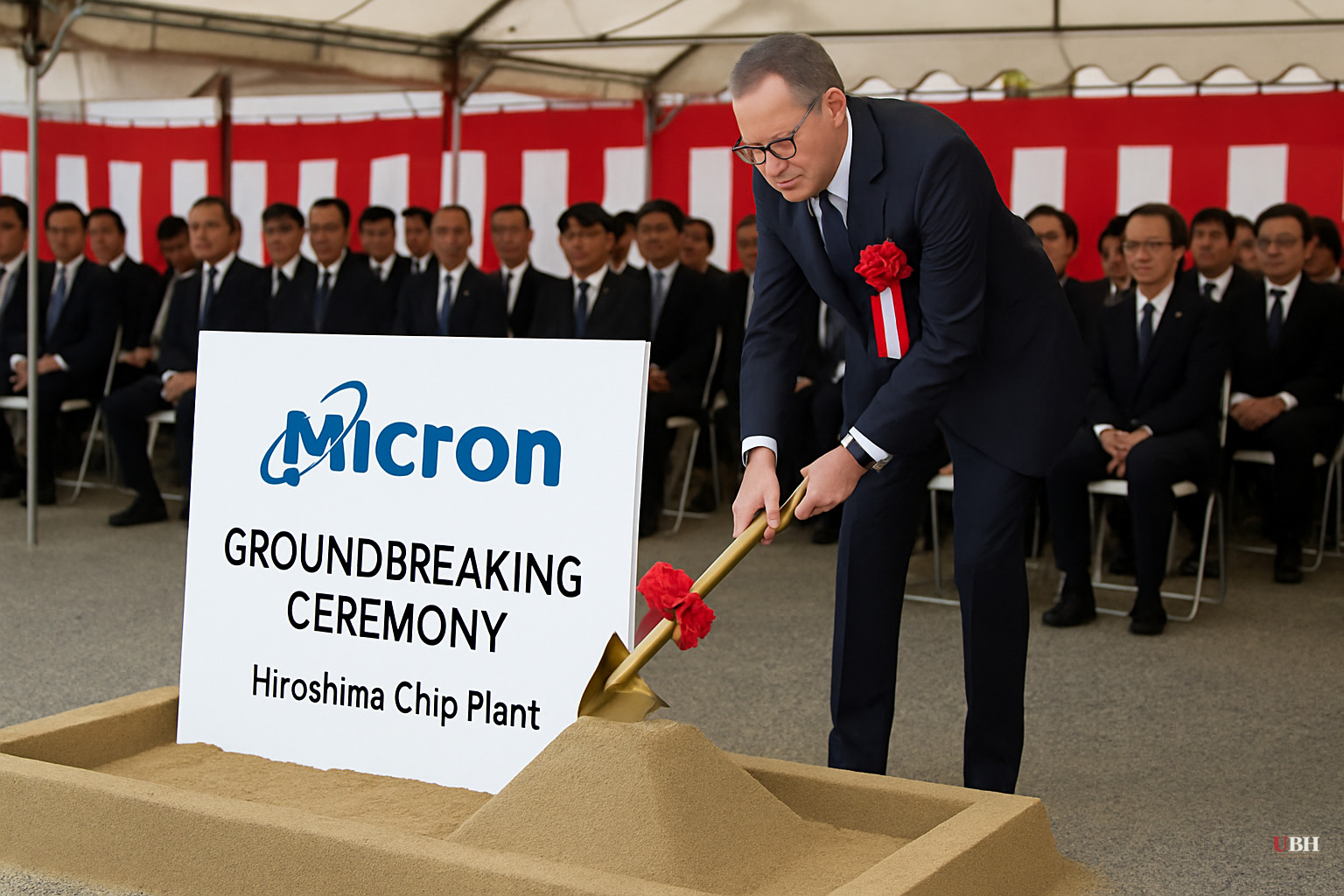
Micron Breaks Ground on $9.3 Billion Hiroshima Chip Plant to Produce AI Memory
What Happened
On July 4, Micron Technology broke ground on the expansion of its semiconductor facility in Higashihiroshima, Hiroshima Prefecture, Japan. The project is valued at ¥1.5 trillion, which converts to roughly $9.3 billion to $9.6 billion depending on exchange rates, according to Bloomberg.
The expanded factory will produce high-bandwidth memory, or HBM — the specialized chips that sit inside Nvidia's AI accelerators and make large-scale AI inference possible. Commercial shipments from the site are expected to begin around summer 2028.
Japan Is Paying a Significant Share
Micron is not writing this check alone. Japan's Ministry of Economy, Trade and Industry has committed up to ¥500 billion toward capital costs, according to Ground News aggregating Bloomberg and Interesting Engineering reporting. Total Japanese government support for Micron to date has reached roughly ¥775 billion — nearly $5 billion at current rates.
About 80% of the chip materials the Hiroshima factory requires come from Japan, making the country a natural host for this kind of investment. When a government covers roughly a third of your capital expenditure, as Crypto Briefing noted, the breakeven math gets considerably friendlier.
Industry Minister Ryosei Akazawa attended the July 4 ceremony and called Japan's support for Micron a relationship of "invaluable worth," while signaling that Japan is ready to offer similar backing to other overseas chipmakers who want to build there.
Why Hiroshima Specifically
This site has history. Micron acquired Elpida Memory — Japan's last major DRAM manufacturer — out of bankruptcy in 2013. That deal handed Micron the Hiroshima facility and a deep pool of Japanese semiconductor engineering talent.
Micron CEO Sanjay Mehrotra drove that point home at the ceremony: "Micron's very first HBM production wafer — for the memory technology at the heart of AI — was made right here in Hiroshima." He added, "When American boldness meets Japanese craftsmanship, you do not get a compromise. You get the best in the world."
Scaling production at Hiroshima isn't starting from zero. It's building on an existing base that already delivered Micron's first HBM output.
The Competitive Problem Micron Has to Solve
Micron is committing roughly $10 billion now for chips that won't ship until 2028, while SK Hynix already has a significant head start in HBM and a locked-in supply relationship with Nvidia. Samsung is also pouring capital into HBM capacity. Micron is the third player in a three-player race, and the race is already underway.
Ground News reporting adds a concrete dimension to the shortfall: Micron currently fulfills only between half and two-thirds of customer orders for high-bandwidth memory due to ongoing supply constraints. That gap is real, and it explains why the investment is happening. But closing a supply gap and pulling ahead of SK Hynix are two different problems.
AI infrastructure spending has surged fast and could plateau before 2028. If capital expenditure by the hyperscalers — Microsoft, Meta, Google, Amazon — softens, HBM demand could fall short of what this wave of new capacity assumes. Micron and its government backers are making a long-duration bet on a demand curve that has not yet proven it will hold through a full economic cycle. That's not irrational, but it's not risk-free either.
The counter-argument: Micron currently can't fill its own order book. Even capturing its existing unmet demand more fully would justify a significant capacity expansion, independent of whether AI spending keeps accelerating at its current pace.
The Broader Japan Play
Micron's expansion is one piece of a larger Japanese industrial strategy. TSMC is building a fab in Kumamoto. Rapidus, a government-backed Japanese startup, is attempting to manufacture cutting-edge logic chips in Hokkaido. Prime Minister Sanae Takaichi has released a roadmap targeting ¥101.6 trillion in investment for chips and AI through March 2041, according to Ground News.
Japan is not a passive host here. It is actively trying to rebuild domestic semiconductor supply chains after decades of watching that industry migrate to Taiwan, South Korea, and China.
Where Micron Stands Globally
The Hiroshima expansion is one part of a wider capital push. Micron is also constructing two leading-edge fabs in Boise, Idaho, and in January 2026 held a groundbreaking for a $100 billion production complex outside Syracuse, New York — a pledge to scale DRAM manufacturing on American soil, according to ZeroHedge citing Bloomberg.
SK Hynix and Samsung are simultaneously expanding their own manufacturing capacity. Chinese memory maker CXMT is reportedly preparing for a major IPO. The HBM market is building out fast on multiple fronts.
What to Watch
Micron's HBM market share figures in upcoming quarterly earnings reports will be the most direct indicator of whether this capital deployment is working. The company needs to demonstrate share gains against SK Hynix before 2028 shipments begin. By the time Hiroshima comes online at full capacity, the competitive window it's targeting will either still be open or will have already closed.
Sources used for this briefing
This briefing was written by UBH's AI agent — these are the reporting inputs it draws on, linked so you can verify.


