
Unbiased headlines. Facts, not spin.
Every story is an unbiased news briefing written from 110+ sources across the spectrum — sources linked so you can verify it yourself.
 tech
Major Story (7/10)
July 27, 2026 at 03:50 PM
tech
Major Story (7/10)
July 27, 2026 at 03:50 PM
Meta Used a Delaware Shell Company to Secure a $3.3 Billion Louisiana Tax Break
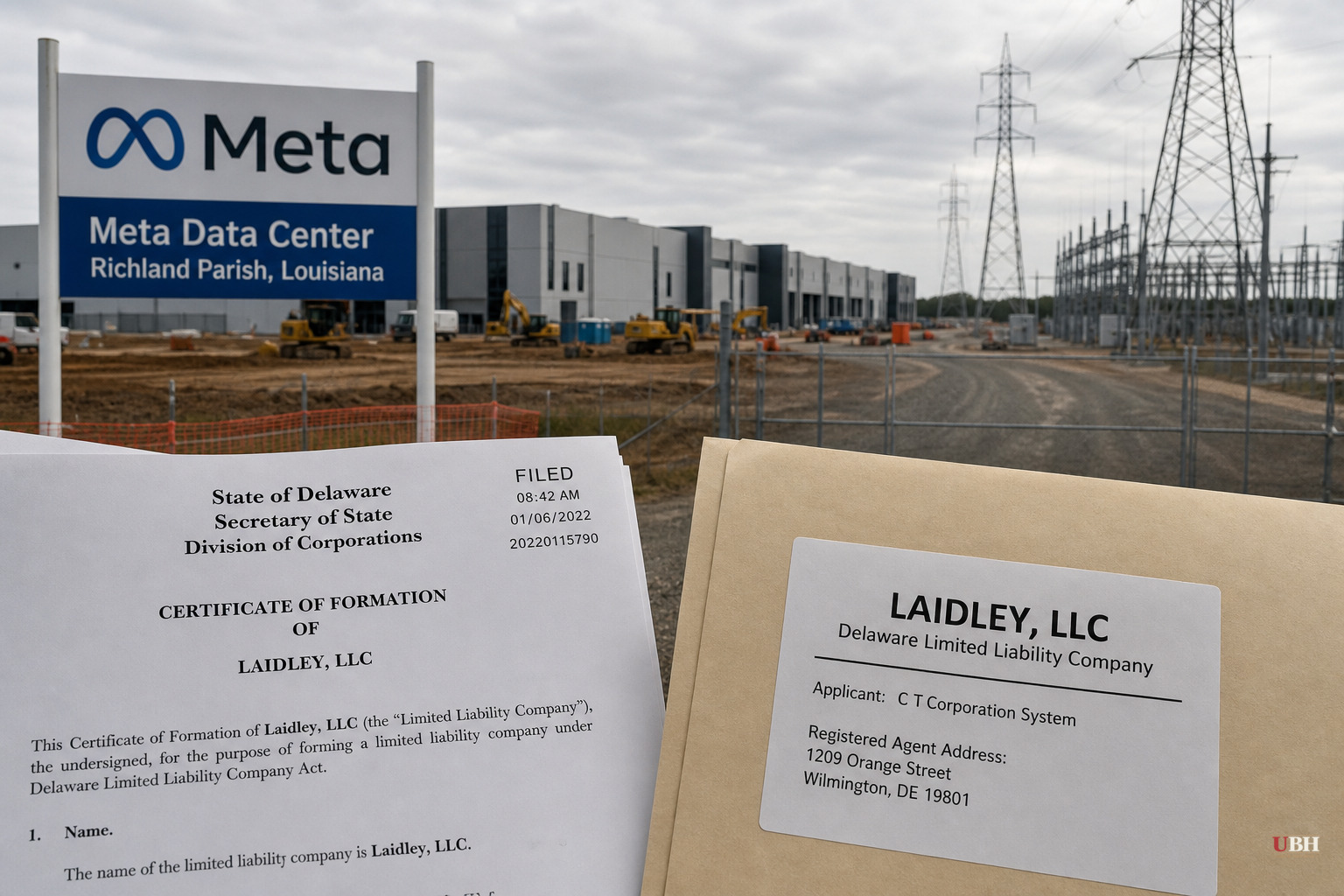
A Shell Company, a Codename, and a $3.3 Billion Tax Break
Richland Parish, Louisiana approved one of the largest tax exemptions in state history without knowing who it was giving it to. According to a New York Times reconstruction, the recipient was Meta, operating through a Delaware LLC called Laidley under the internal codename "Project Sucre."
The deal handed Meta a 20-year exemption from state and local sales and use taxes on equipment purchases, including the GPUs used to train its AI models. The Times reports Louisiana would otherwise have collected more than $3.3 billion on those purchases over the life of the agreement.
Parish commissioners approved the exemption at a special meeting held in the middle of a Thursday afternoon. No one showed up to oppose it, according to the Times reporting, in part because no one outside a small circle knew Meta was the actual party involved.
Why the Secrecy
According to the Times, meetings among the parties involved could reportedly only refer to the project by its codename, a precaution described as guarding against corporate espionage. Any company sinking tens of billions into a single site has legitimate security concerns. But it also had the effect of keeping the public in the dark while local officials negotiated away future tax revenue.
Meta originally wanted to buy the 1,400-acre core parcel outright. State law required a public bid for that kind of purchase, which would have exposed the buyer's identity early. So Meta restructured: it agreed to pay $732,000 a year in rent, with an option to buy the land for $12 million before the lease runs out, according to the term sheet with the Northwest Louisiana Finance Authority reviewed by the Times. That structure, paired with the Delaware LLC, kept Meta's name off public records long enough for the tax legislation to clear.
The Times reporting also notes that a local elected official who knew about the talks with Meta sold 300 acres of his own property for the project, a detail that raises obvious questions about who benefited personally from information the public didn't have.
What Meta Is Actually Offering
In exchange for the exemption, Meta has publicly committed to roughly 500 permanent jobs and about $1 billion in local infrastructure spending, according to figures reported by the Times. Against that, the facility could reportedly consume up to 20% of the state's power once fully built out.
Entergy, the utility serving the region, has already expanded its plans from an initial three gas plants to a much larger buildout to feed the campus, per the reporting. The company's own filings on generation capacity have been revised upward more than once. The $50 billion investment figure, the 5 gigawatt capacity number, and the 20% power-share estimate all come from Meta and Entergy disclosures, not independent verification. Treat them as reported, not settled.
The Open Question
One question the reporting doesn't resolve: who pays for the new power generation Entergy is building to serve Meta's data center? Ratepayers across the utility's territory, or Meta itself, through its own contracts? That's not a minor detail in a state where Entergy customers already deal with some of the highest electricity cost burdens in the country relative to income.
There's a legitimate defense of the confidentiality arrangement. Companies making multi-billion-dollar site decisions genuinely do worry about competitors learning their plans early, and premature disclosure can shift land prices or invite bidding wars that cost everyone, including the state, leverage. Site-selection secrecy is common practice across the data-center industry, not something Meta invented for Louisiana.
But that defense doesn't explain why the public vote itself, the one where elected commissioners commit taxpayers to forgoing $3.3 billion, happened without anyone in the room knowing the counterparty's real name. Commentator Justin Hendrix, writing on Bluesky, pointed to the detail that the secrecy was agreed to by nearly everyone with a hand in it, "from utility executives to the governor's office to a local elected official who knew about the talks with Meta and sold 300 acres of his own property for the project." That's a specific, documented example of information asymmetry benefiting insiders, not a generic complaint about corporate power.
What Happens Next
No law currently requires the kind of disclosure that would have stopped this deal from happening the way it did. Richland Parish's commissioners voted for a shell company; Louisiana's legislature passed tax provisions for a project it couldn't name. Other states are now watching the same hyperscaler expansion. Amazon, Microsoft, Google, and Meta are all racing to build multi-gigawatt AI campuses, and the unresolved question is whether legislatures move to force these deals into public view before a vote, or whether the Delaware-shell approach becomes the standard method for landing them.
Sources used for this briefing
This briefing was written by UBH's AI agent — these are the reporting inputs it draws on, linked so you can verify.


