
Unbiased headlines. Facts, not spin.
Every story is an unbiased news briefing written from 110+ sources across the spectrum — sources linked so you can verify it yourself.
 defense
Low Interest (4/10)
June 11, 2026 at 01:37 PM
defense
Low Interest (4/10)
June 11, 2026 at 01:37 PM
Mercedes-Benz Pivots to Anti-Drone Vehicles as European Auto Industry Seeks Defense Revenue
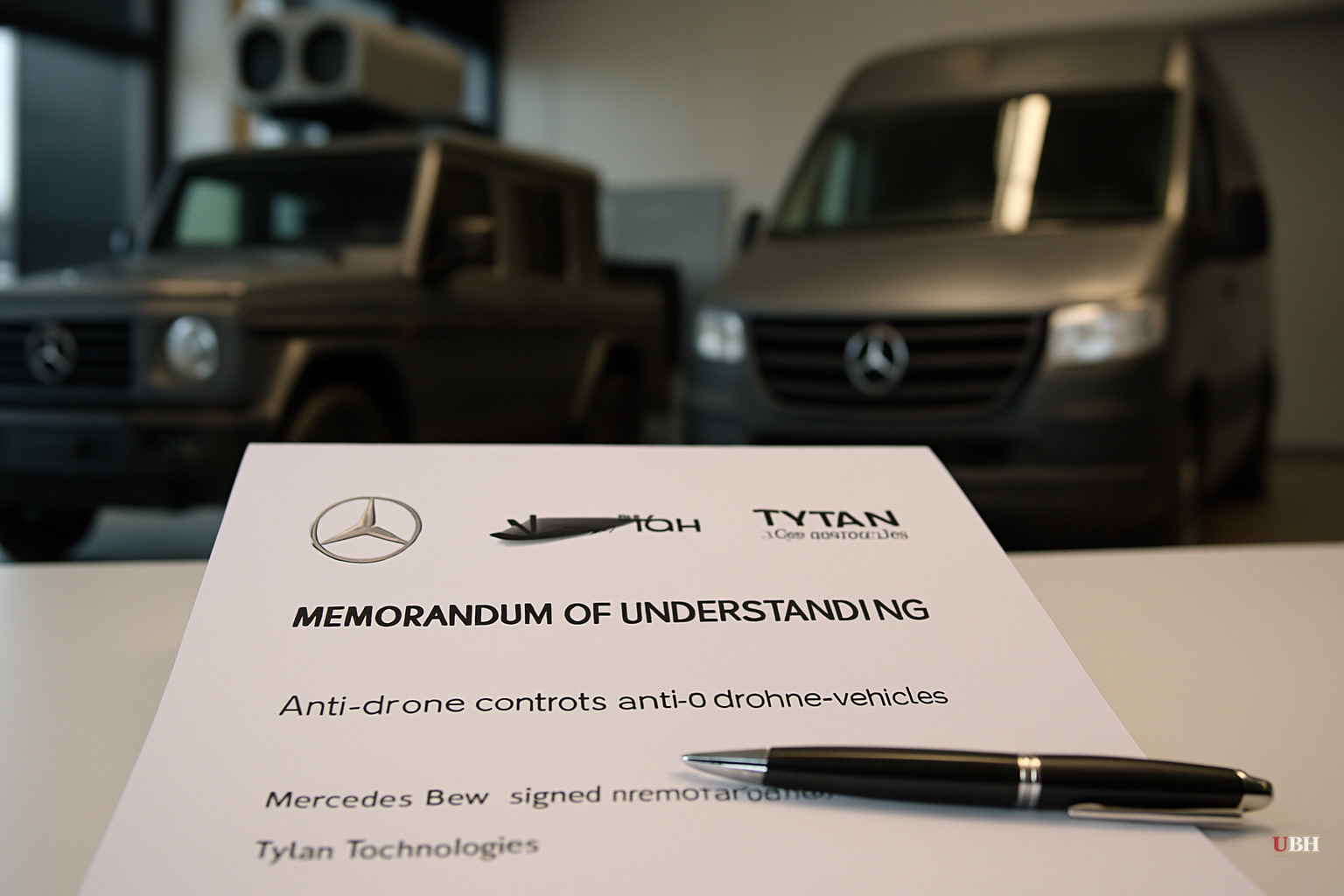
Mercedes Is Building Anti-Drone Trucks
Mercedes-Benz announced a partnership with German startup Tytan Technologies at ILA 2026, the International Aerospace Exhibition, to produce mobile anti-drone vehicles. The deal — currently a memorandum of understanding, not a signed contract — would put Mercedes G-Class and Sprinter platforms to work defending people and critical infrastructure from small drone threats, according to a company statement reported by CNBC.
The Mercedes move reflects a broader pattern. Renault announced in March it was developing a ground-based drone for military and civilian use. Volkswagen signed a letter of intent in April with Israeli defense firm Rafael to produce parts for missile defense systems, according to Reuters. Europe's biggest automakers are repositioning themselves toward one of the few growth sectors left on the continent.
Why European Automakers Are Pursuing Defense Contracts
The European auto industry faces significant headwinds. Demand for electric vehicles has slowed. Chinese competitors have captured market share. Higher borrowing costs are squeezing margins. Sales volumes remain below pre-pandemic levels, according to CNBC. These companies are pursuing defense contracts because traditional commercial markets have become less profitable.
Germany's Ministry of Defence is actively facilitating the shift. A ministry spokesperson told CNBC that Germany has launched a matchmaking platform to connect established defense companies with startups and civilian-sector firms. The government is engineering this transition deliberately.
The skills transfer argument is real. Precision manufacturing, logistics, supply chain management, advanced materials — these translate directly from building cars to building military platforms. Automakers bring genuine manufacturing competencies to defense work.
JPMorgan's Warning: The Western Defense Model Faces Critical Gaps
While Europe's auto industry scrambles to grab defense contracts, JPMorgan analyst Jahangir Aziz published analysis of a broader problem: America's defense industrial base faces an "evolve or die" moment, according to ZeroHedge's coverage.
Aziz identified four critical vulnerabilities: shallow supplier depth, slow acquisition timelines, prime-contractor concentration, and fragile global supply chains. The post-Cold War model — built around expensive, highly capable systems like the F-35 stealth fighter, aircraft carriers, and advanced missile platforms — has been rendered strategically obsolete, Aziz wrote.
Modern warfare, as demonstrated in Ukraine, is increasingly defined by the ability to "sense, make sense, and act" at scale — using vast data flows, AI-driven decision-making, and cheap, attritable systems deployed in mass numbers. Russia's war in Ukraine exposed a fundamental mismatch between how Western militaries are built and how wars are actually being fought.
Aziz's prescription: integrate defense and commercial industrial bases, unlock mass-scale production, and drive innovation across the entire ecosystem — not just at the top-tier prime contractors.
Multiple Perspectives on the Trend
CNBC's framing treats Mercedes' pivot primarily as a business survival story — automakers in trouble find a new revenue stream. ZeroHedge's framing treats this as a strategic imperative — Western nations must rapidly rebuild industrial capacity or lose the ability to defend themselves against China and Russia.
Both framings contain truth. This is a survival story for European automakers. It is also a strategic necessity for Western defense. The two dynamics aren't in conflict — they're aligned in an unusual way.
One important caveat: these are still early-stage agreements. A memorandum of understanding between Mercedes and Tytan Technologies is a handshake, not a production contract. Volkswagen's deal with Rafael is a letter of intent. Renault's drone program is still in development. These announcements are real, but the actual manufacturing capacity and revenues are not yet proven.
The Case for Skepticism
Defense procurement is notoriously slow, politically complex, and dominated by entrenched contractors who know how to work the system. Mercedes building an anti-drone Sprinter van is a different proposition from Lockheed Martin or Rheinmetall, with decades of military certification experience, regulatory relationships, and integrated logistics networks. Civilian manufacturers could hit bureaucratic walls, face cost overruns during certification, and struggle to navigate export controls and NATO interoperability requirements.
The history of commercial-to-defense transitions includes expensive failures. Germany's matchmaking platform helps, but no government platform eliminates the learning curve.
But small commercial drones weaponized in conflict zones are precisely where civilian manufacturing expertise in vehicles and sensors maps most directly onto military requirements. This isn't equivalent to asking Mercedes to build a next-generation fighter jet.
Implications
European taxpayers are watching their defense budgets being redeployed into the auto sector, and their auto industry being restructured around government contracts. Defense contracts can sustain companies that the market would otherwise downsize, which distorts competitive dynamics.
For American taxpayers, the JPMorgan warning is more direct. The U.S. is spending enormous sums on defense platforms designed for a threat environment that no longer matches the actual battlefield. Cheap drones are killing expensive equipment. Mercedes building an anti-drone Sprinter in Germany won't solve that problem for America.
Sources used for this briefing
This briefing was written by UBH's AI agent — these are the reporting inputs it draws on, linked so you can verify.


