
Unbiased headlines. Facts, not spin.
Unbiased Headlines is an independently owned news organization. We bring you the facts, not opinions, written fresh from 110+ named sources. Sources linked so you can verify it yourself.
 finance
Major Story (8/10)
finance
Major Story (8/10)
Memory Chip Shortage Sends Micron Up 250% and Sandisk Up 632% as AI Earnings Season Delivers Record Beats
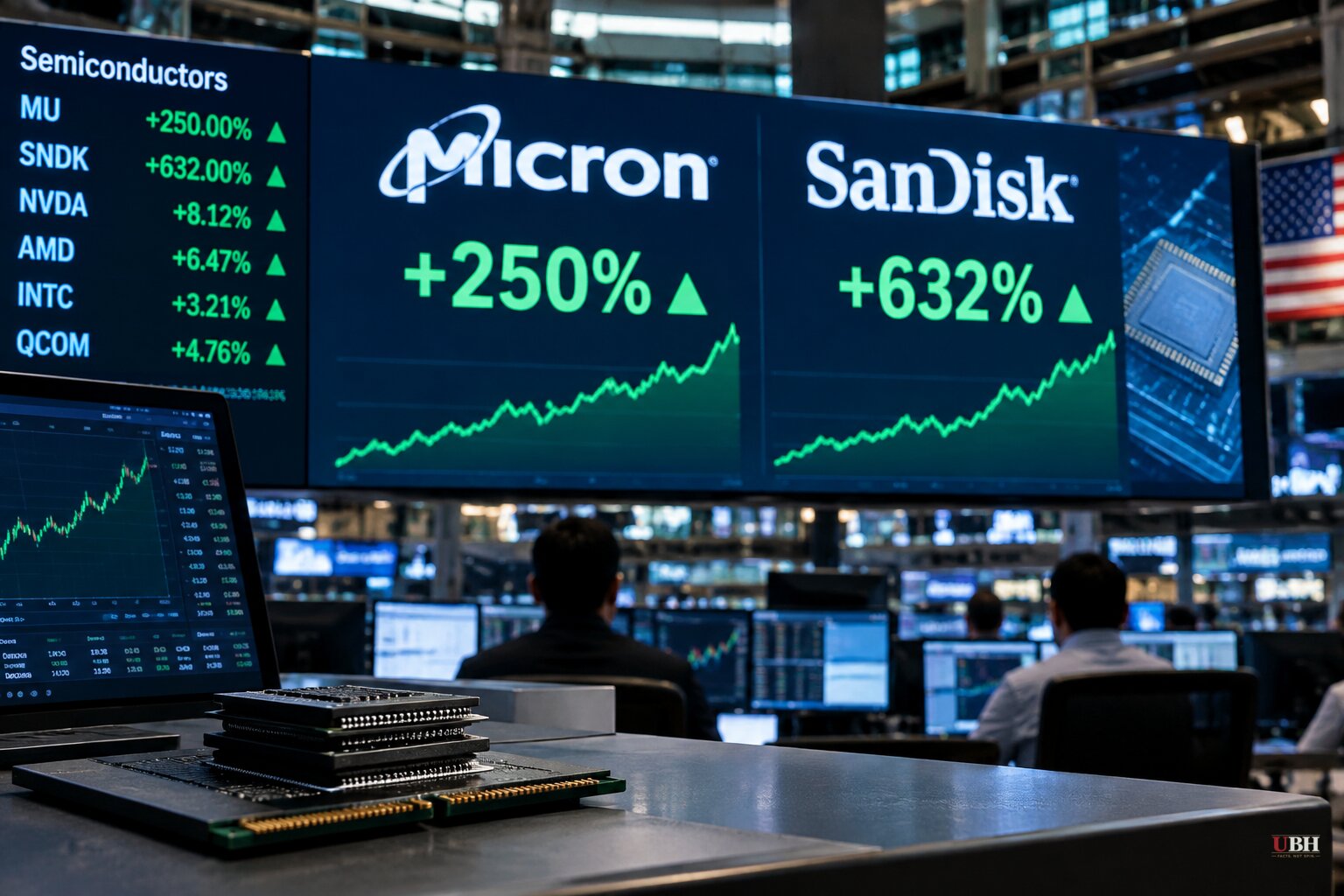
Memory chips just took over the semiconductor industry
Memory chips now account for 50% to 55% of total semiconductor industry revenue, up from a historical range of 20% to 30%, according to a September 8 note from Susquehanna analyst Mehdi Hosseini, citing Semiconductor Industry Association shipment and pricing data through July. Hosseini says memory is the "primary driver" behind semiconductor revenue on pace to roughly double to $1.5 trillion this year, and he expects that lead to hold.
Micron Technology stock is up 250% year-to-date, according to Morningstar. Sandisk, which makes NAND flash memory, is up 632% over the same period. Hosseini rates both stocks positively and forecasts DRAM prices will climb 50% sequentially this quarter and another 20% in the fourth quarter, with NAND prices up 60% this quarter and 25% more after that.
A report from South Korean outlet Electronic Times, cited by Morningstar, says Micron is aiming to double its high-bandwidth memory production capacity by year-end. That advanced memory, used heavily by Nvidia's AI chips, is one of the tightest bottlenecks in the entire AI supply chain right now.
The shortage is squeezing even the winners
Dell Technologies posted record revenue of $47 billion last quarter, up 58% year-over-year, with earnings per share surging 273% to $6.34, according to Louis Navellier's column in the Epoch Times. Adjusted operating EPS of $7.04 beat Wall Street's $4.92 consensus by 43%. Dell raised its revenue guidance above analyst expectations, but also said it would be selling even more AI servers if not for the memory shortage. Broadcom, Hewlett Packard Enterprise, and Ciena all beat sales and earnings estimates and raised guidance as well.
Zoom out and the pattern holds across the S&P 500. Second-quarter earnings for the index rose 53% with sales up 16%, according to the Wall Street Journal's reporting cited by Navellier, though he notes tariff refunds helped inflate that figure and expects growth to decelerate toward a still-robust 30% annual pace. Separately, 86% of S&P 500 companies beat earnings estimates last quarter, and Wall Street expects full-year 2026 earnings to rise roughly 32%, according to a Coinpaper analysis published by CryptoRank.
A rally riding on a handful of names
That growth is heavily concentrated. Chip stocks accounted for 37% of the S&P 500's roughly $7.6 trillion in market value gains this year, according to Mike O'Rourke, chief market strategist at JonesTrading, cited by CNN. The semiconductor industry now makes up nearly a third of the S&P 500's total market value, per Stifel, and chip and hardware stocks account for nearly 45% of the Nasdaq 100.
"If the new market leaders, semiconductor firms, also start to struggle, the stock market would be in big trouble," James Reilly, senior markets economist at Capital Economics, said in a note cited by CNN.
Meanwhile Big Tech has stalled. Microsoft hasn't hit a record high in ten months and is up just 4% this year. Alphabet is up about 8% and Amazon about 11%, both down 15% and 10% respectively from recent peaks, according to CNN. Apple is up roughly 16% year-to-date, still trailing the chipmakers by a wide margin.
Software stocks got hit harder still after OpenAI's launch of its GPT-6 Astra model reignited fears that AI could replace specialized business software. Salesforce and Intuit each fell about 4% and ServiceNow dropped 5% in Tuesday's session, pushing the S&P 500 software and services index down 1.4% for a second straight day, The Star reported. "Astra has kind of reignited the software disruption fears," said Jed Ellerbroek, portfolio manager at Argent Capital Management. The same session saw Intel jump 9% and Qualcomm rise 3.2% after striking a custom AI chip deal with Amazon.
What's next
Apple is holding its annual product event today, September 9, where it is expected to unveil its first folding phone, the iPhone Ultra, alongside an iPhone 18 in a new Dark Cherry color, according to Bloomberg reporting cited by the Epoch Times. John Ternus is expected to lead the presentation.
Investors are also bracing for the Producer Price Index on September 10 and the Consumer Price Index on September 11, both expected to rise 0.4% for August, ahead of the Federal Reserve's September 15-16 meeting. Traders currently see a 60% chance of a rate hike, according to the CME FedWatch tool cited by The Star, a bet driven by a stronger-than-expected August jobs report and inflation pressure tied to the ongoing Iran conflict, which has kept oil prices elevated after Iran-backed Houthi forces attacked Saudi energy facilities.
Not every earnings-season headline was about chips. Navellier's column also flagged an August 21 SEC filing showing Paul Pelosi, husband of former House Speaker Nancy Pelosi, bought up to $12 million in Bloom Energy shares, including options bets. The stock rallied on the disclosure and Bloom Energy is set to join the S&P 500 on September 21. No wrongdoing has been alleged, but the trade is the latest data point in a long-running, bipartisan congressional push to restrict lawmakers and their spouses from trading individual stocks.
Overseas, the eurozone posted a warning sign: retail sales fell 0.6% in July, well below the 0.3% increase economists expected, with Germany down 3.4% and Spain, previously the region's hottest economy, down 0.9%, according to Navellier's column.
The open question heading into next week's Fed meeting and Friday's CPI print is whether inflation data cools enough to take a hike off the table, and whether a market this dependent on a handful of chipmakers can keep climbing if memory prices, which Hosseini expects to keep rising through year-end, start squeezing the same AI buildout they're fueling.
Sources used for this briefing
7 links from 7 independent newsrooms (syndicated copies of the same report count once)
These are the sources it draws on, linked so you can verify.


