
Original briefings. Zero spin.
Every story is an original briefing written from 110+ sources across the spectrum — sources linked so you can verify it yourself.
 finance
Notable (6/10)
September 9, 2026 at 03:02 PM
finance
Notable (6/10)
September 9, 2026 at 03:02 PM
U.S. Bancorp Completes Live Cross-Border Payment With Its Own Stablecoin, USBDC
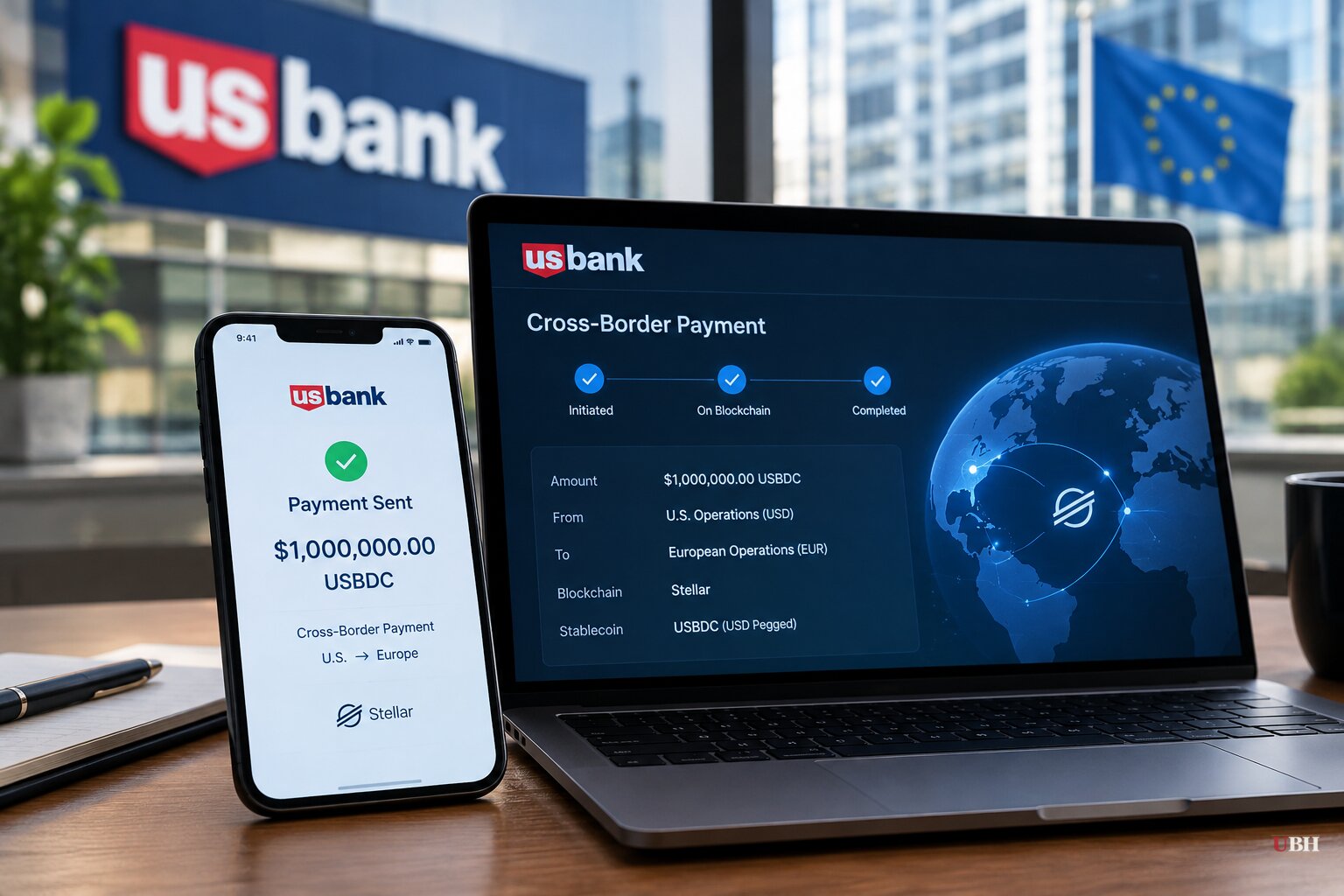
U.S. Bancorp (NYSE: USB) just did something most big banks have only talked about for years. On Wednesday, September 9, 2026, the Minneapolis-based lender announced it completed a live pilot transaction using its own dollar-pegged stablecoin, USBDC, moving money between its North American and European entities on the Stellar blockchain, according to U.S. Bank's own statement carried by Business Wire.
The bank says it tested minting, redemption, freezing and clawback functions, all running through its internally built Digital Asset Platform, which is designed to link blockchain rails to the bank's existing finance, risk, compliance and operations systems.
Why This Bank, Why Now
U.S. Bank isn't walking into this cold. The lender partnered with the Stellar Development Foundation and PwC back in November 2025 to explore custom stablecoin issuance, according to Crypto Briefing. A month before that, in October 2025, U.S. Bank was picked as custodian for the reserves backing stablecoins issued by Anchorage Digital Bank, one of the few federally chartered digital-asset banks in the country, per the same reporting. That gave U.S. Bank hands-on experience managing stablecoin reserves before building its own token.
"This live pilot demonstrates our ability to accelerate global cash management and money movement capabilities," said Gunjan Kedia, President and CEO of U.S. Bancorp, in the company's statement. Jamie Walker, the bank's head of digital assets and money movement, added: "Our focus remains on delivering solutions that solve real client challenges while maintaining the safety, security and reliability that clients expect from U.S. Bank."
The bank has not said when, or if, USBDC will be available to ordinary clients. There's no commercial rollout timeline. This is a pilot, full stop.
Freeze and Clawback: Feature, Not Bug, For a Bank
Crypto Briefing pointed out something to consider: USBDC includes built-in mechanisms to freeze tokens and claw them back. That's the opposite of what crypto purists usually want out of a blockchain asset. But for a federally regulated bank, it's not optional. Compliance officers need the ability to freeze a stolen or fraud-linked transaction. Regulators expect it. Without those controls, a bank issuing a stablecoin on a public blockchain would be a non-starter with its own risk department, let alone the OCC or the Fed.
That's the legitimate tension here. Crypto advocates who value censorship-resistant, permissionless money will look at freeze-and-clawback features and see exactly why bank-issued stablecoins aren't a replacement for decentralized alternatives. This reflects a real difference in purpose. USBDC is a corporate treasury and payments tool wearing blockchain rails. It's not built to compete with decentralized finance on its own terms.
The Bigger Picture: Banks Racing to Not Get Left Behind
U.S. Bancorp isn't moving alone. A week before this pilot, 21 financial institutions, including Bank of America and Goldman Sachs, announced plans to form a joint venture to issue their own dollar-pegged stablecoin, with a target launch in the first half of 2027, according to Yahoo Finance and Reuters reporting carried by WTVB-AM. Citigroup and Wells Fargo are also part of that consortium.
Right now, the stablecoin market is dominated by non-bank issuers. Tether's USDT and Circle's USDC account for the overwhelming majority of the roughly $305.4 billion stablecoin market, with dollar-denominated tokens making up more than 99% of that total at roughly $303.8 billion, according to DeFiLlama data cited by Finance Feeds. Stellar itself carries just $938 million of that supply, meaning U.S. Bank has plenty of room to grow on the network if it chooses to scale USBDC.
A federally regulated bank entering that market changes the reserve-trust equation. USBDC's backing doesn't need a third-party attestation to convince skeptics it's real, because U.S. Bank already answers to federal banking examiners as a matter of routine operation. That's a structural advantage neither Tether nor Circle can claim in the same way.
The Regulatory Fight Nobody's Settled Yet
Regulators are simultaneously tightening the rules around this whole space. Under the GENIUS Act framework, regulators have proposed bank-style customer identity checks for stablecoin issuers, according to Finance Feeds, even as a coalition of lenders has warned the current framework creates problems for how banks operate. Those objections haven't been resolved, and no final rule has been reported in these sources.
Reuters, in reporting carried by WTVB-AM and WMBD Radio, framed stablecoins more narrowly as tools "mostly used in crypto trading." That undersells what U.S. Bank is actually pitching here: a treasury and cross-border settlement tool aimed at corporate clients, not crypto traders. The bank's own language, in the Business Wire statement, points to liquidity management, collateral mobility and 24/7 cross-border treasury operations as the target use cases, not speculative trading.
USB shares have climbed 27% over the past 12 months, trading around $62.49, according to Yahoo Finance. Whether USBDC moves the needle on that stock price, or just becomes another bank pilot that never reaches customers, depends on a commercial rollout timeline the bank still hasn't announced.
Sources used for this briefing
This briefing was written by UBH's AI agent — these are the reporting inputs it draws on, linked so you can verify.


