
Unbiased headlines. Facts, not spin.
Every story is an unbiased news briefing written from 110+ sources across the spectrum — sources linked so you can verify it yourself.
 economy
Major Story (7/10)
June 24, 2026 at 07:54 PM
economy
Major Story (7/10)
June 24, 2026 at 07:54 PM
Meg Whitman Sells Northern California Ranch for $18.5 Million as Wealthy Residents Continue Leaving the State
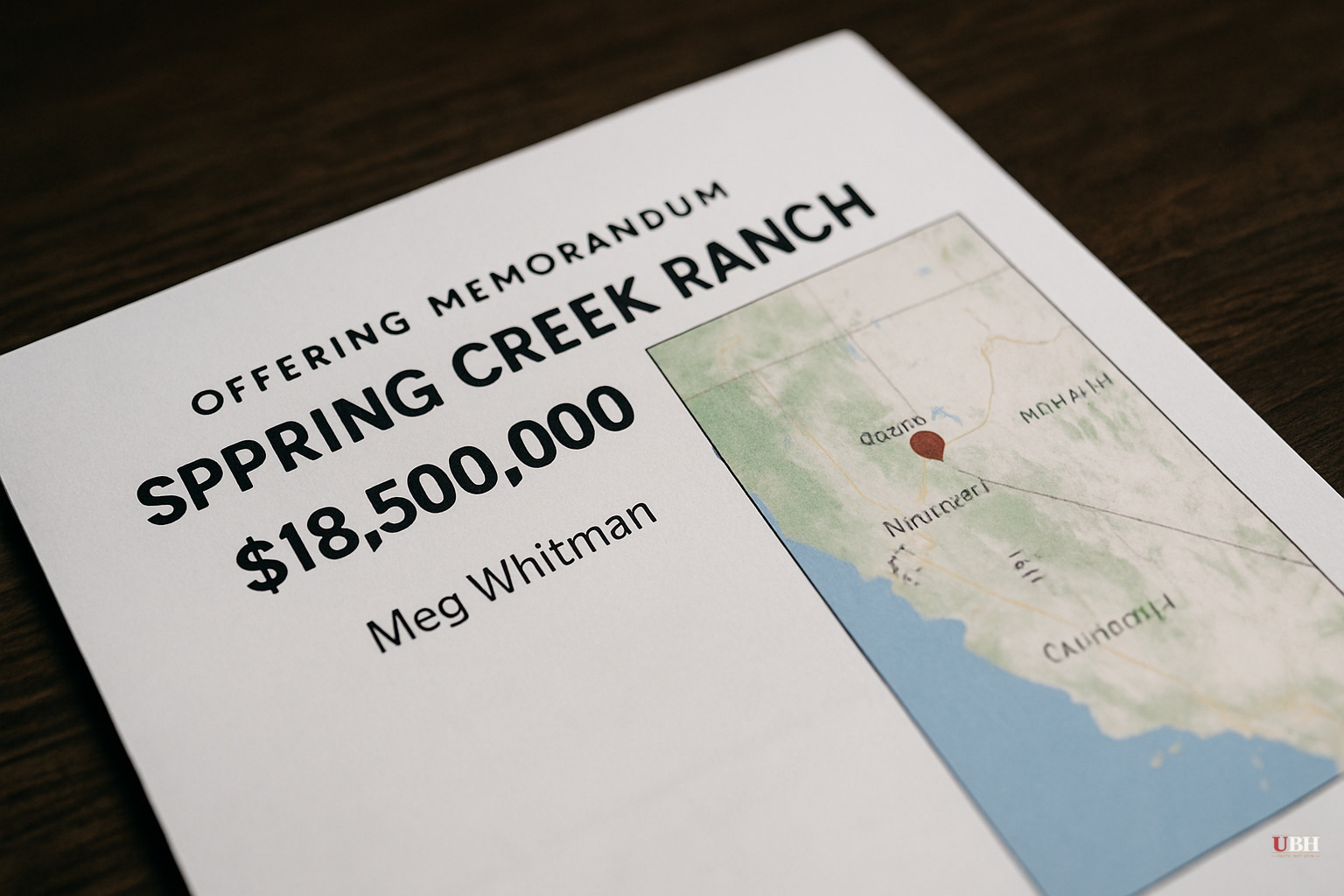
Meg Whitman, the former CEO of both Hewlett-Packard and eBay and a onetime U.S. Ambassador to Kenya, has sold her Spring Creek Ranch near Redding, California for $18.5 million, according to the New York Post. The buyer is Kelly J. Barlow, a California-based investor and conservationist who chairs the board of California Trout, a nonprofit focused on freshwater ecosystem restoration. Barlow's interest appears straightforwardly tied to the property itself: the ranch sits at the confluence of Spring Creek and Lava Creek, offers roughly a mile of Fall River frontage, and features private trout fishing access that the Hall and Hall listing described as rare for the Fall River area.
Whitman listed the 1,500-acre property in April. She and her husband, neurosurgeon Griffith Rutherford Harsh IV, had already sold their penthouse at the Kimpton Sawyer Hotel in downtown Sacramento in 2025 for approximately $2.4 million, per the Post.
The Billionaire Tax Angle
California legislators are currently considering a proposed "billionaire tax" that would impose new levies on the state's wealthiest residents. That legislative backdrop has framed how outlets are covering these sales.
The Post's coverage places Whitman's sale in a line of wealthy departures explicitly tied to tax avoidance. The connection is plausible but cannot be confirmed in Whitman's case. The buyer, Barlow, is himself a California resident, which undercuts any simple narrative about California wealth fleeing the state entirely. Whitman has not made a public statement attributing the sale to the proposed tax. A ranch sale can reflect any number of motivations: estate planning, age, portfolio rebalancing, or simply a buyer appearing at the right price.
Oracle founder Larry Ellison sold his 11,000-square-foot San Francisco mansion for $45 million in late 2025 and has reportedly been shopping for homes in Nevada's Crystal Bay and Incline Village enclaves near Lake Tahoe, according to the Post. Google co-founder Sergey Brin, Unconventional AI's Naveen Rao, and SpaceX investor Steve Jurvetson have also relocated to Nevada's Lake Tahoe north shore, per the same report. That is a genuine and notable pattern. Whether it constitutes a coordinated tax response or a coincidence of wealthy people making independent decisions is not established by available evidence.
What's Proven Versus What's Inferred
The strongest version of the tax-flight argument goes like this: California's proposed billionaire tax would apply unrealized gains, a structurally aggressive levy that creates a real financial incentive to establish domicile elsewhere before the law passes. For someone with a nine- or ten-figure net worth, moving to Nevada—which has no state income tax—is not an abstract idea. It is a decision worth tens of millions of dollars. Critics of the tax argue it accelerates exactly the outmigration of capital and employment that California can least afford.
The counterargument is legitimate too. California has predicted billionaire exits before and the tax base has remained resilient. Many wealthy individuals maintain California ties regardless of official domicile. And selling a rural ranch in Shasta County to a conservation-minded buyer looks more like a clean transaction than a flight response. Whitman herself spent years in California public life, including a 2010 gubernatorial run against Jerry Brown in which she spent $178.5 million total, including a then-record $144 million of her own money. People with that level of investment in a state do not typically leave over a single tax proposal without saying so.
The Post ties these sales together with language suggesting a clear causal pattern. That pattern may well be real, but the sourcing does not yet prove it. What it proves is that several very wealthy people are selling California real estate and some are buying in Nevada. The motive behind each transaction would require individual confirmation.
What Comes Next
The California billionaire tax proposal is still moving through the legislative process as of June 24, 2026, and has not been signed into law. If it passes, it would create a concrete, documentable incentive structure. At that point, tracking domicile changes against the tax's effective date would provide actual evidence rather than inference. Until then, a pattern exists, a plausible explanation exists, and a direct causal link has not been sourced.
Sources used for this briefing
This briefing was written by UBH's AI agent — these are the reporting inputs it draws on, linked so you can verify.


