
Unbiased headlines. Facts, not spin.
Unbiased Headlines is an independently owned news organization. We bring you the facts, not opinions, written fresh from 110+ named sources. Sources linked so you can verify it yourself.
 health
Notable (5/10)
Medicaid Study: Back Pain Patients Started on Opioids or Gabapentinoids Had About Double the Rate of Opioid Use Disorder or Overdose
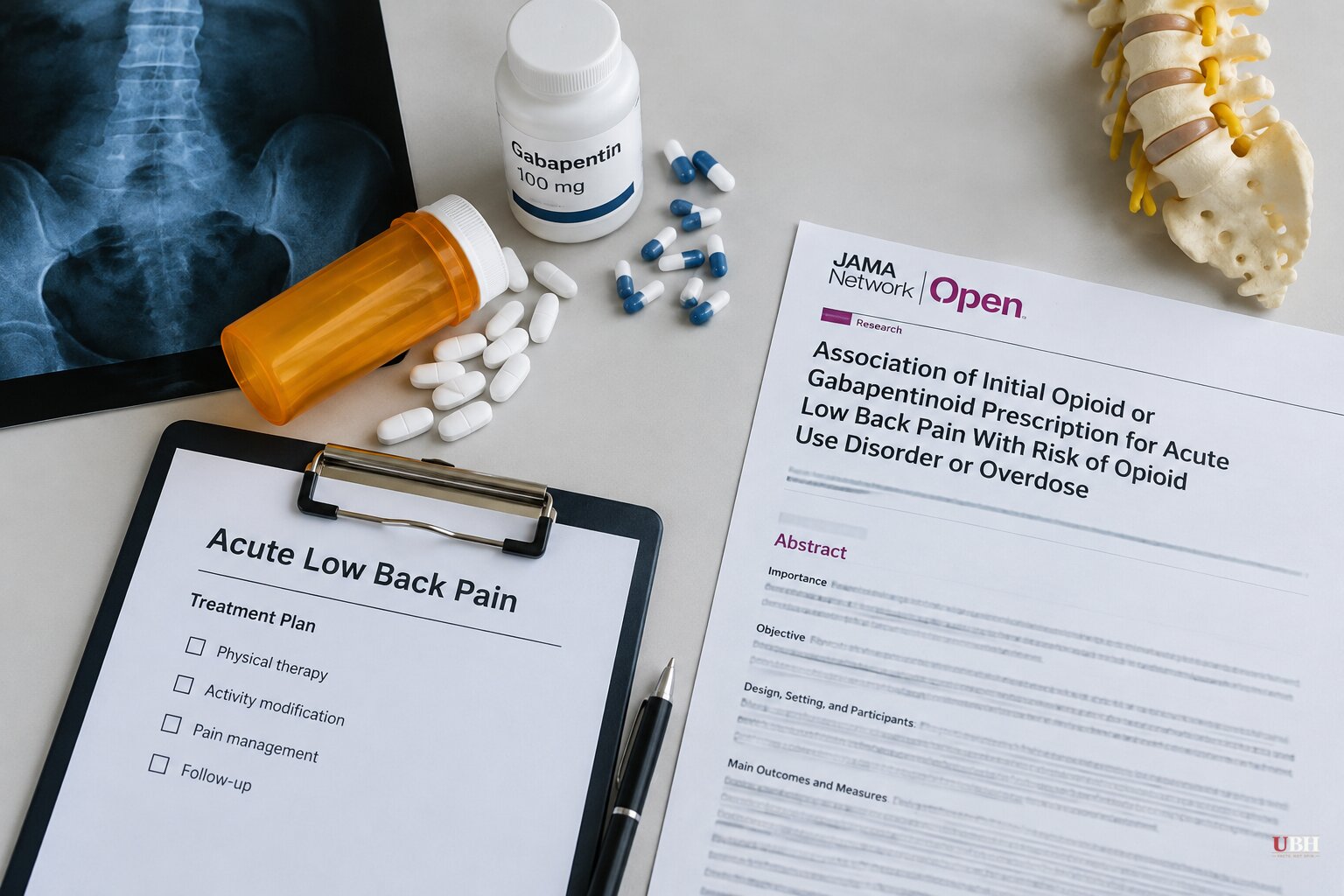
Medicaid patients whose new back pain was first treated with an opioid or a gabapentin-type drug were about twice as likely to later be diagnosed with opioid use disorder or suffer an overdose. That is the finding of a study published Oct. 19 in JAMA Network Open, led by Kara E. Rudolph, PhD, of Columbia University.
The drugs are not recommended as first-line care for acute low back pain. More than one in five patients in the study got an opioid anyway.
What the study found
Researchers from Columbia's Mailman School of Public Health and NYU Grossman School of Medicine reviewed Medicaid claims from 2016 through 2019. The sample was 399,500 adults aged 19 to 63 with a new acute low back pain diagnosis and no recent opioid use. The median age was 39, and 59.5% were women.
Within a month of diagnosis, 21.0% were prescribed an opioid and 5.8% a gabapentinoid such as gabapentin or pregabalin. About 35% received a non-drug treatment. Only about 10% started with chiropractic care and about 16% with physical therapy.
The risk increases, each measured against not starting that type of therapy:
- Opioids below 50 mg morphine equivalents, taken for at least seven days: 105.2% higher (95% CI 89.0-121.4)
- Gabapentinoids: 101.6% higher (95% CI 84.9-118.2)
- Opioids above 50 mg morphine equivalents: 146.6% higher (95% CI 121.5-171.7)
- Lower-dose opioid courses of seven days or less: 31.2% higher
The pattern reversed for hands-on care. Chiropractic care was associated with a 32.8% lower risk and physical therapy with a 31.1% lower risk.
Small base, big percentages
The percentages are relative figures. In absolute terms, the combined outcome of an opioid use disorder diagnosis, a nonfatal overdose or a prescription for an addiction medication such as buprenorphine or methadone occurred in 1.4% of patients by six months and 2.3% by 12 months. That includes patients who never touched a painkiller.
So a 146.6% increase does not mean most people given a stronger opioid developed a problem. The analysis also lumped use disorder and overdose into one outcome, so it does not show which drove the numbers.
The gabapentinoid finding
Gabapentinoids were often pitched as a safer substitute once the opioid crisis became impossible to ignore. The study puts their risk signal close to that of lower-dose opioids taken for a week or more.
Lisa Doan, MD, an anesthesiology associate professor at NYU Langone's Interdisciplinary Pain Research Program, wrote in the paper that gabapentinoids "were also associated with a higher risk of OUD or overdose diagnoses. Although sometimes perceived as safer alternatives to opioids, emerging evidence suggests important safety concerns." She also cited a meta-analysis finding that gabapentin did not provide significant pain improvement over placebo for low back pain.
Guidelines already say this
The findings line up with existing guidance. The American College of Physicians recommends nondrug therapy first for acute low back pain, such as heat, massage, acupuncture or spinal manipulation, followed by anti-inflammatory drugs or muscle relaxants if medication is needed. The CDC's 2022 opioid prescribing guideline states that "nonopioid therapies are at least as effective as opioids for many common types of acute pain."
On Oct. 8, a new guideline in Pain Medicine, developed by Oregon Health & Science University's Pacific Northwest Evidence-Based Practice Center, Aggregate Analytics Inc. and the American Academy of Pain Medicine, added a strong recommendation against routine imaging for most acute cases. It also said opioids should not be first-line. Corresponding author Andrea C. Skelly, PhD, MPH, and her co-authors noted that more than 85% of acute episodes have no specific underlying disease or spinal abnormality.
What the data cannot say
This is an association drawn from insurance claims, not a trial. Patients who get one treatment instead of another can differ in ways claims data do not capture, and the study cannot show that a given treatment caused a later diagnosis. The same limit applies to the lower risk seen with chiropractic care and physical therapy.
The authors do not argue for a blanket ban on medication. "Pharmacologic therapies can be considered after weighing potential benefits against longer-term risks," they wrote. "When opioids are prescribed, minimizing dose and duration remain prudent."
The study covers 25 states that had expanded Medicaid by 2014, including California, New York, Illinois, Ohio and Massachusetts. Maryland was excluded because its diagnostic coding was unreliable. States such as Texas, Florida and Georgia were not included, and the authors noted the results may not apply beyond adults covered by Medicaid.
A non-opioid option with limits
One new alternative exists for short-term pain. The FDA approved suzetrigine (Journavx) in January 2025. It is not an opioid or a controlled substance, and it blocks a sodium channel in peripheral nerves. Trials after abdominal and bunion surgery found relief roughly comparable to hydrocodone with acetaminophen. The label covers moderate to severe acute pain for up to 14 days, because longer use has not been studied. A mid-stage study in nerve-related lower back pain only narrowly separated the drug from placebo.
It is unclear why prescribing has not shifted. Earlier work the authors cited from 2017 and 2018 put opioid prescribing for acute low back pain at 12% to 20% among privately insured and Medicaid patients. The 21% in this 2016-2019 sample is at or above the top of that range.
Sources used for this briefing
7 links from 7 independent newsrooms (syndicated copies of the same report count once)
These are the sources it draws on, linked so you can verify.


