
Unbiased headlines. Facts, not spin.
Unbiased Headlines is an independently owned news organization. We bring you the facts, not opinions, written fresh from 110+ named sources. Sources linked so you can verify it yourself.
 health
Notable (6/10)
Event date: November 16, 2026 ·
Mayo Clinic Study: Blood Test for p-tau217 Paired With Age and Genetics Estimates 5- and 10-Year Cognitive Impairment Risk
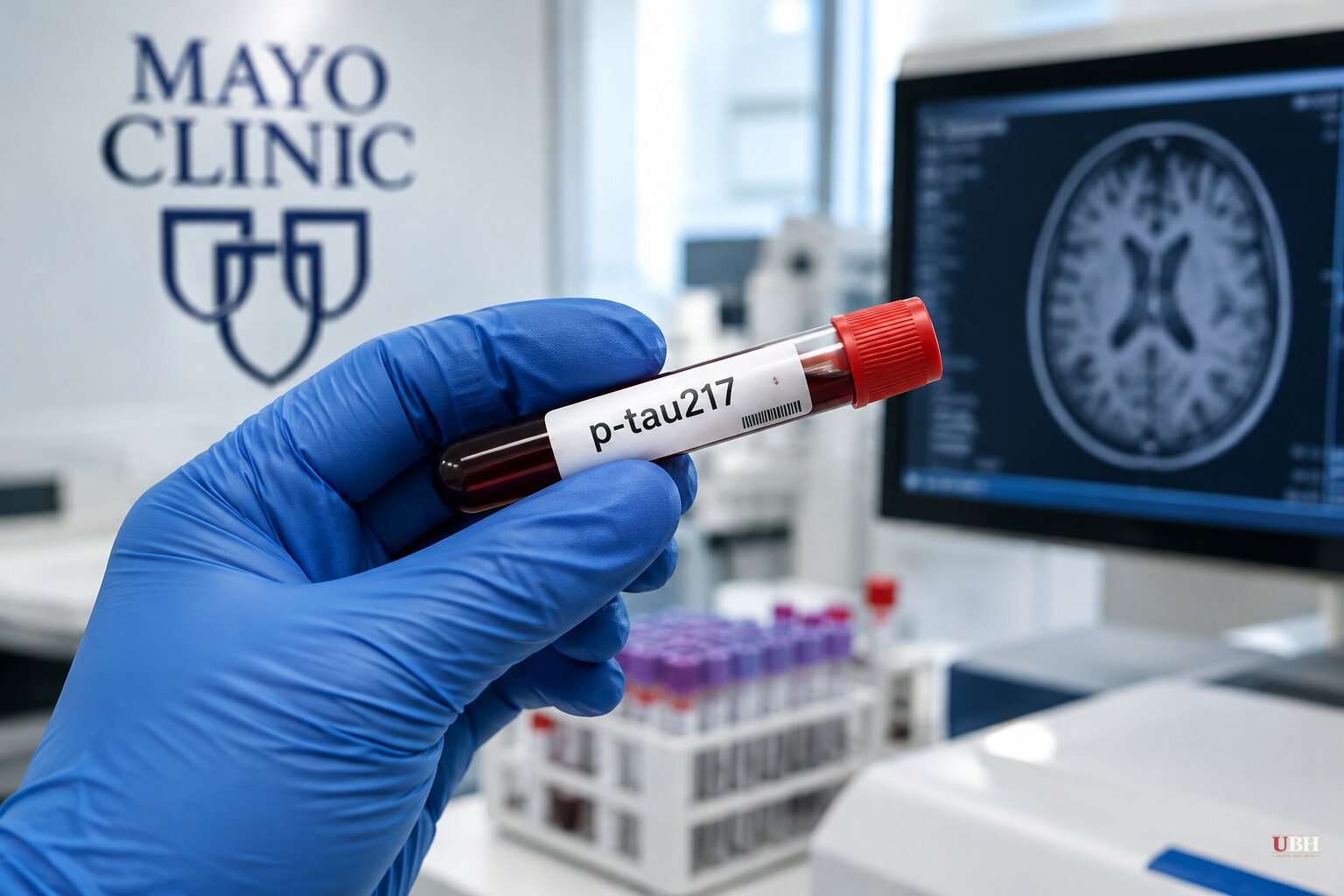
A blood test can put a number on a healthy older person's odds of developing memory and thinking problems. That is the claim of a Mayo Clinic study published Nov. 16, 2026, in JAMA Neurology.
The model combines a blood level of phosphorylated tau 217, or p-tau217, with age, sex and genetic risk. It then estimates the chance of mild cognitive impairment or dementia within five and 10 years.
It does not diagnose anything. It does not tell anyone they will get dementia.
What the researchers measured
The team analyzed 1,644 cognitively unimpaired participants in the Mayo Clinic Study of Aging. All were ages 60 to 90. They had p-tau217 blood measurements, genetic testing and repeated cognitive assessments over time.
The researchers then checked the findings against 534 participants in the Alzheimer's Disease Neuroimaging Initiative. That second group confirmed the link between higher p-tau217 and greater risk of cognitive decline.
Higher p-tau217 and older age were both tied to greater risk. The APOE ε4 gene variant, a known Alzheimer's risk factor, had a modest association once p-tau217 was accounted for.
The numbers
The study gave examples. A 75-year-old woman without APOE ε4 had an estimated five-year risk of mild cognitive impairment of 5% with a relatively low p-tau217 level. With a higher level, it was 16%.
Her estimated 10-year risk rose from 12% to 35%.
Age moved the figures sharply. At the same high p-tau217 level, the estimated five-year risk was 6% at age 65 and 37% at age 85.
Mayo's rationale
Mayo's earlier work used amyloid PET brain scans to estimate future impairment. The new approach swaps in a blood draw, which the researchers describe as less invasive and potentially more scalable.
"The goal is to provide a personalized estimate of the risk of developing cognitive impairment that is more meaningful than simply reporting whether a blood test is positive or negative for amyloid pathology," said Alicia Algeciras-Schimnich, Ph.D., a Mayo laboratory medicine and pathology researcher and the study's first author.
Clifford Jack Jr., a Mayo neuroradiologist and senior author, said "absolute risk gives the biomarker result clinical context." He added that if preventive treatments become available, the information could help patients and clinicians weigh the potential benefits and risks.
Ronald Petersen, M.D., Ph.D., a Mayo neurologist and director of the Mayo Clinic Study of Aging, framed the question patients may ask. "A person may want to know: What is my risk of developing cognitive impairment in the next five or 10 years, and how does this blood test change that risk?" he said. "If preventive therapies prove effective, those numbers could become very important in treatment decisions."
The limits
The researchers say the estimates need further study in more diverse populations. The model was built on one Minnesota-based study group.
Alzheimer's biomarker testing is not currently recommended for people without cognitive symptoms. The study is observational. It found an association between p-tau217 levels and later impairment. It did not test any treatment, and it did not show that lowering p-tau217 prevents decline.
Mass General Brigham researchers, who published separate work on p-tau217 in JAMA, urge the same restraint. Reisa Sperling, M.D., director of the Mass General Brigham Center for Alzheimer Research and Treatment, said the time is not right for universal screening.
"Until we have treatments to slow or stop the onset of Alzheimer's disease in people who do not yet show symptoms, biomarker testing in asymptomatic adults should only be used in clinical research," Sperling said. "Right now, the blood test results would not change our recommendations to focus on a healthy lifestyle."
Mass General Brigham also warns patients against online biomarker tests. Its experts say results delivered without a medical professional's insight can be confusing and alarming.
What comes next
The practical value of a personal risk number depends on whether anything can be done about it. Two ongoing prevention trials, AHEAD 3-45 and TRAILBLAZER-ALZ 3, are testing whether amyloid-targeting therapies can delay cognitive decline before symptoms appear. Both used blood biomarkers to help identify participants.
If those trials show a benefit, a p-tau217-based risk estimate could become part of treatment decisions. If they do not, the number remains a research tool. The trials have not reported results.
Sources used for this briefing
7 links from 7 independent newsrooms (syndicated copies of the same report count once)
These are the sources it draws on, linked so you can verify.


