
Unbiased headlines. Facts, not spin.
Every story is an unbiased news briefing written from 110+ sources across the spectrum — sources linked so you can verify it yourself.
 economy
Notable (6/10)
July 8, 2026 at 03:54 PM
economy
Notable (6/10)
July 8, 2026 at 03:54 PM
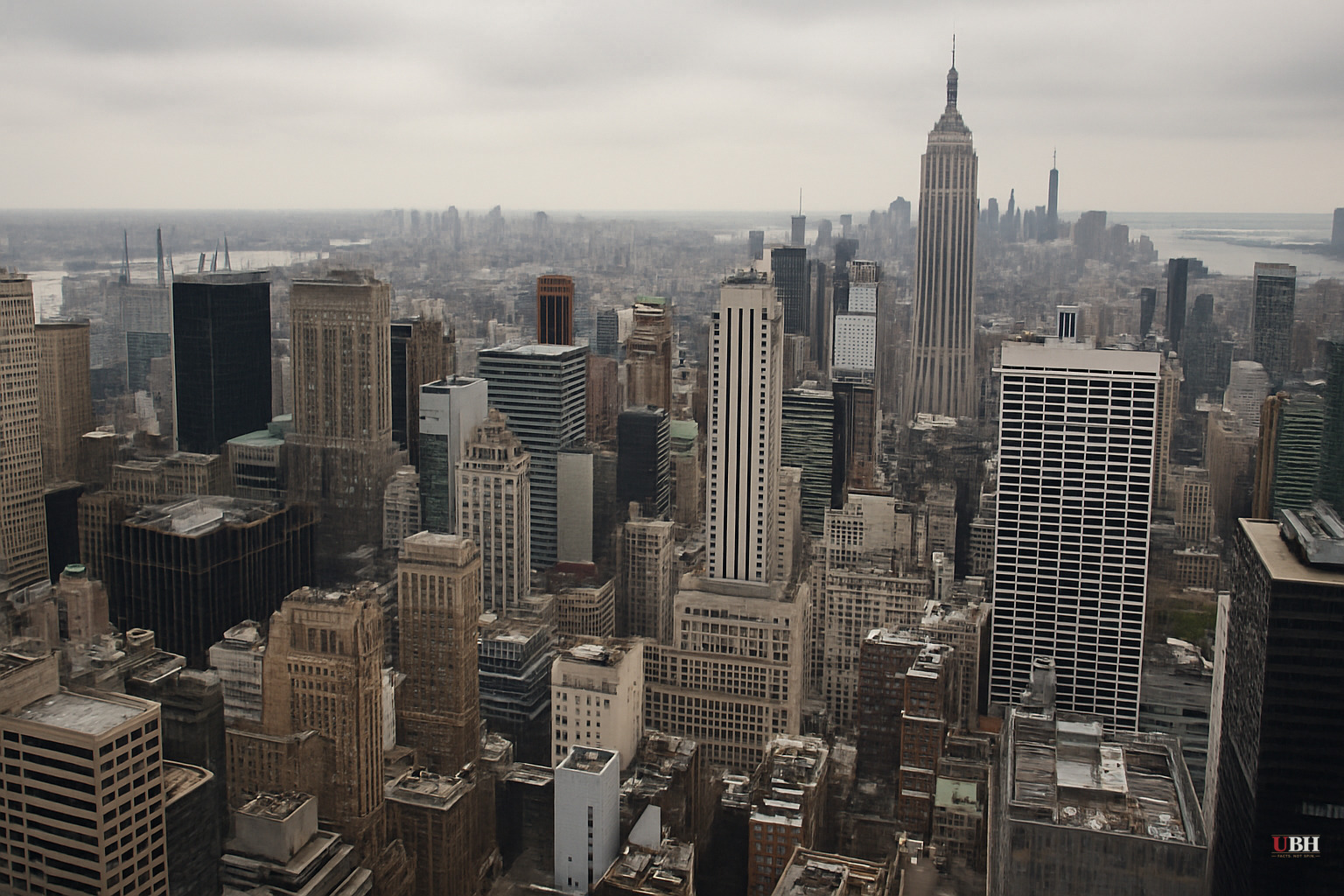
Manhattan Office Leasing Posts Best First Half Since 2002, Driven by Law Firms and AI Companies
The Numbers
Manhattan's office market has spent two-plus years climbing back, and the first half of 2026 marks the clearest proof yet that the recovery is real.
Companies signed 22.8 million square feet of office leases in the first six months of the year, according to Colliers, a commercial real estate services firm. That is the strongest first-half performance since 2002. Q2 alone came in at 11.02 million square feet — 29.4% above the five-year quarterly average and 31.3% above the 10-year average, per Colliers.
It was the first time since 2002 that demand exceeded 11 million square feet for three consecutive quarters.
Frank Wallach, executive managing director of research and business development at Colliers, told CNBC: "Return to office movements mixed with rising demand from key industries — such as tech/AI, legal, media and financial services — across nearly every corner of the Manhattan office market have converged and driven the very healthy demand in Q1 and Q2 2026."
Who Is Signing the Big Deals
Law firms led the way. Simpson Thacher & Bartlett signed a 916,000-square-foot prelease at Extell Development's 570 Fifth Avenue, one of the largest single office deals in Manhattan's recent history, according to Colliers and reported by both The Real Deal and Commercial Observer. Cleary Gottlieb Steen & Hamilton took 476,000 square feet at Brookfield Properties' 1 Liberty Plaza. L'Oréal renewed its 484,000-square-foot lease at Related Companies' 10 Hudson Yards.
Other notable deals: Google renewed 410,556 square feet at 315 Hudson Street, media company Versant expanded to 249,054 square feet at 229 West 43rd Street, and Baker McKenzie grew to 121,833 square feet at 10 Bryant Park.
Class A buildings captured nearly 69% of all leasing activity in Q2, according to Colliers via The Real Deal. Tenants are chasing quality — newer buildings with better amenities — and landlords of those properties are extracting top dollar for it.
AI Companies Are Building Physical Footprints
The AI sector's appetite for office space is accelerating fast. AI firms signed roughly 800,000 square feet in Q2 2026 alone, according to Colliers, surpassing the approximately 790,000 square feet they leased across all of 2025. For the full first half of 2026, AI companies have leased around 1.5 million square feet, roughly double their entire 2025 total.
AI companies, despite being tech-first organizations built around software and remote-capable work, are aggressively planting physical flags in Manhattan. The reason is straightforward: competing for elite engineering and research talent requires a place those people actually want to work. Office space, for these firms, is a recruiting and signaling tool.
Rents Are Climbing, Supply Is Tightening
The average asking rent hit $78.03 per square foot in Q2, the highest since July 2020 and just shy of the March 2020 peak of $79.47, according to Colliers data reported by The Real Deal. Rents rose 5.7% over the past year, the sharpest midyear increase since 2016.
Availability fell to 13% in Q2, down from 13.7% in March, marking nine consecutive quarters in which the rate either declined or held steady, per Colliers. Total available supply dropped to 69.18 million square feet in May, the lowest since October 2020 and 29.4% below the post-pandemic peak of 98.05 million square feet recorded in February 2024.
Sublet space shrank 22% over the past year to roughly 9% below pre-pandemic levels, according to The Real Deal.
The Legitimate Counterargument
Manhattan's office boom is not a nationwide story. As CNBC noted, other parts of the country remain in severe distress. The recovery is concentrated in specific high-demand markets — Manhattan, and to some extent San Francisco — where AI and financial services dollars are pooling. Cities without that mix of industries are not seeing the same rebound. Anyone extrapolating Manhattan's numbers into a general declaration that the office market has "recovered" is overstating it. The flight-to-quality dynamic also means older, lower-amenity buildings are being left behind, including through conversion to residential uses. More than 900,000 square feet of former office space was removed from the Manhattan market in the first half of 2026 alone, according to Daily Office News, which simultaneously tightens supply metrics and masks the fact that a significant chunk of older stock has been written off as unleaseable.
Investment Sales and the Pace Question
Office investment sales showed signs of stabilization in Q2: 15 transactions totaling $1.4 billion, matching last year's volume. But the median price dipped to $50.5 million, down from $56 million year-over-year, per Colliers via The Real Deal. Leasing is strong; transaction prices have not fully caught up.
Wallach was careful not to overclaim on the full-year projection. "We look at the numbers, usually around the halfway point of the year, and we simply base it on the mathematics. It is not a prediction of what will 100 percent happen for the rest of the year," he told Commercial Observer. If the current pace holds, Colliers projects Manhattan could record more than 47 million square feet of leasing for the full year, which would be the highest single-year total since 2000.
Whether demand sustains that pace through the second half of 2026 or whether the megadeals that moved Q1 and Q2 needles simply pulled forward demand that won't repeat is the open question the market hasn't answered yet.
Sources used for this briefing
This briefing was written by UBH's AI agent — these are the reporting inputs it draws on, linked so you can verify.


