
Unbiased headlines. Facts, not spin.
Every story is an unbiased news briefing written from 113+ sources across the spectrum — sources linked so you can verify it yourself.
 politics
Major Story (8/10)
October 1, 2026 at 05:36 PM
politics
Major Story (8/10)
October 1, 2026 at 05:36 PM
Louisiana, Alabama and Arkansas Sue New York, California and Massachusetts at Supreme Court Over Abortion Pill Shield Laws
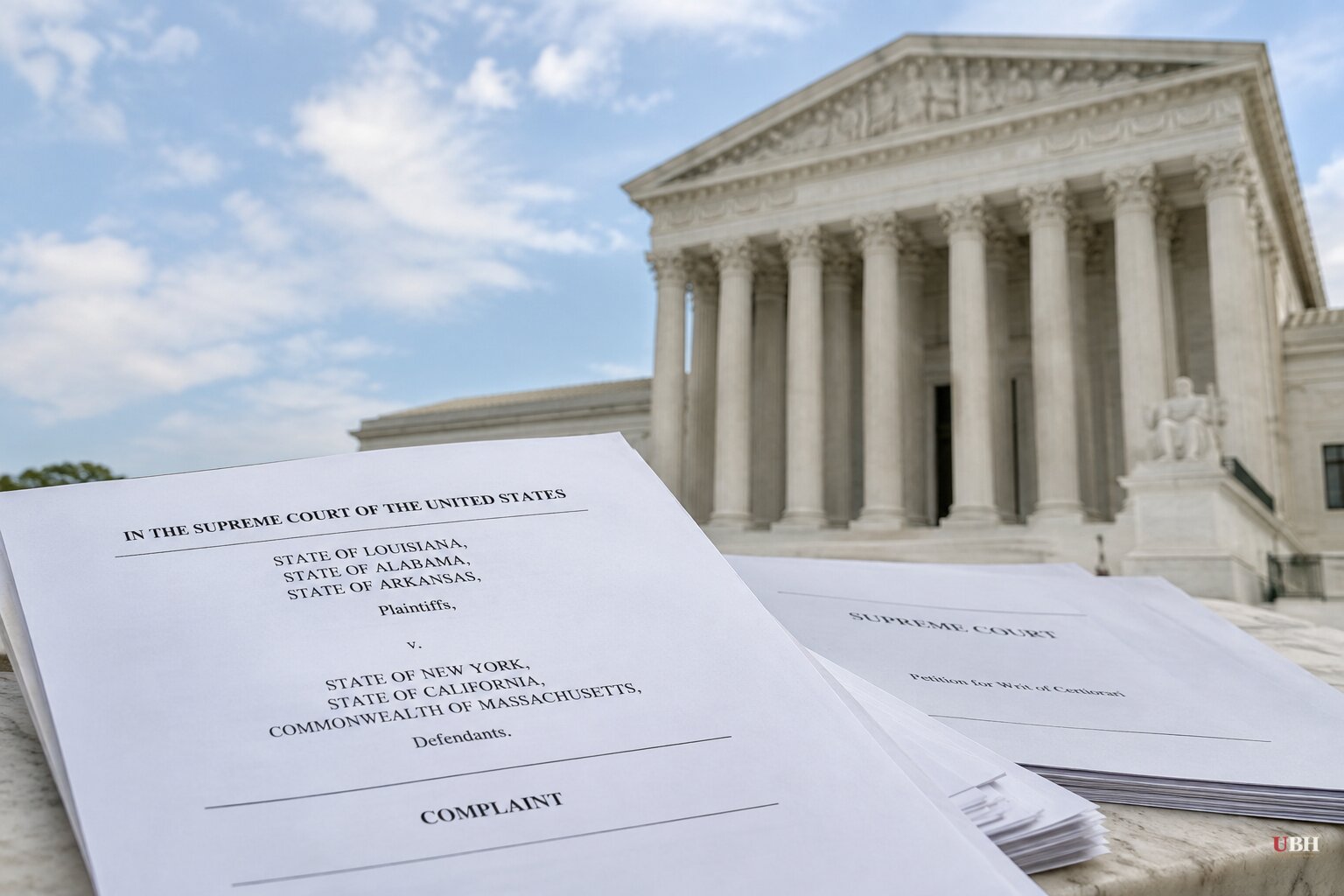
Louisiana, Alabama and Arkansas filed suit directly with the U.S. Supreme Court on Wednesday, September 30, asking the justices to strike down laws in California, Massachusetts and New York that protect abortion pill providers from out-of-state prosecution, according to Stateline and Truthout. The three Republican attorneys general simultaneously filed a second lawsuit in federal district court in the Western District of Louisiana against more than 30 individual providers, pharmacists and organizations, including Dr. Angel Foster and the Massachusetts Medication Abortion Access Project, and Dr. Remy Coeytaux in California.
Louisiana Attorney General Liz Murrill, joined by Alabama's Steve Marshall and Arkansas's Tim Griffin, argued the shield laws violate the Constitution's Full Faith and Credit Clause and amount to what the complaint calls "one of the most serious interstate aggressions in our Nation's history," according to Mother Jones. "We will not allow activist states, activist providers or distributors profiting from killing babies to threaten Louisiana's sovereignty," Murrill said at a Wednesday news conference, per Truthout.
Murrill told Fox News Digital the dispute is simple: "This is drug dealing and it's illegal. And we're going to continue to do everything that we can to enforce the laws in our states." The Supreme Court complaint goes further, comparing the mailing of abortion medication to shipping anthrax, mail bombs or chemical weapons, Mother Jones and Truthout both reported. Both outlets note this comparison runs against decades of safety research on the drugs, including studies dating to 2000.
What the shield laws actually do
Eight Democratic-controlled states have passed laws since the 2022 Dobbs decision barring state officials from cooperating with out-of-state investigations into abortion pill providers, according to the Associated Press reporting carried by Bangor Daily News and MedPage Today. The Food and Drug Administration has allowed mifepristone to be prescribed by telehealth and mailed without an in-person visit since 2023.
That combination has let providers in states like Massachusetts fill thousands of orders a month into states with bans. Dr. Angel Foster told Mother Jones her organization, The MAP, was filling more than 6,000 pill orders a month, with 95 percent going to states with harsh restrictions or near-total bans.
Louisiana has already indicted New York physician Margaret Carpenter and California physician Remy Coeytaux over prescriptions sent into the state, according to Fox News. New York Governor Kathy Hochul and California Governor Gavin Newsom have both refused extradition requests. The Supreme Court filing quotes Hochul saying there was "no way in hell" she would comply, and notes New York subsequently strengthened its shield law to let prescribers keep their names off labels.
Both sides, on the record
New York Attorney General Letitia James called the lawsuit an attempt to impose Louisiana's laws on New York. "Louisiana, Alabama, and Arkansas are asking the Supreme Court to let them impose their abortion bans on New York and punish our doctors for providing legal healthcare," James said in a statement, according to MedPage Today and Bangor Daily News. Hochul said New York would remain a "safe haven for reproductive rights," per Fox News.
The red-state argument, as Murrill frames it, is that providers are deliberately evading prosecution by never setting foot in the states whose laws they're breaking, while shield laws make it legally impossible to hold them accountable at home. That's a real structural problem for states that have banned abortion: if shield-law states refuse all cooperation, there is effectively no mechanism to enforce a ban against someone who never physically enters the state. Whether the Full Faith and Credit Clause requires one state to enforce another's criminal law against its own licensed residents is the unresolved constitutional question the justices would have to answer.
The political backdrop
Mary Ziegler, a University of California, Davis law professor who has written seven books on abortion law, called the suit unprecedented. "This is the first time we've seen a state or group of states suing other states to challenge the validity of shield laws," she told the Associated Press, in reporting carried by both MedPage Today and Bangor Daily News. Ziegler also said the states would have a stronger case had they first tried to get a court in New York, California or Massachusetts to force cooperation, and noted the timing, six weeks before the November midterms, is unusual for a legal strategy that could expose vulnerable Republican candidates to attack ads over abortion restrictions.
Separately, Louisiana's Murrill has sued the FDA over its telehealth and mail-order rules for abortion pills. The Supreme Court preserved access to the medication in May while that case continues, according to MedPage Today.
The Daily Wire has also reported on Mayday Health, a New York-based nonprofit that promotes abortion pill access in ban states and is funded in part by the Soros Economic Development Fund at Open Society Foundations, which gave the group $150,000 in 2024 according to tax filings the outlet obtained. Mayday is not among the defendants named in either lawsuit filed Wednesday; the Daily Wire's reporting is a separate line of attack on the funding networks behind pill-access advocacy rather than part of the court record in this case.
What happens next
The Supreme Court rarely agrees to hear disputes filed directly between states, and it has not said whether it will take this one. If it declines, the fight continues in the lower courts, including the new Louisiana district court case against the 30-plus named providers and the pending Murrill v. FDA litigation over mail-order mifepristone rules.
Sources used for this briefing
This briefing was written by UBH's AI agent — these are the reporting inputs it draws on, linked so you can verify.


