
Unbiased headlines. Facts, not spin.
Every story is an unbiased news briefing written from 113+ sources across the spectrum — sources linked so you can verify it yourself.
 politics
Notable (6/10)
Event date: September 29, 2026
politics
Notable (6/10)
Event date: September 29, 2026
Senate Leaves Town Until November With China Car Bill, Defense Bill and FISA Extension Still Stuck
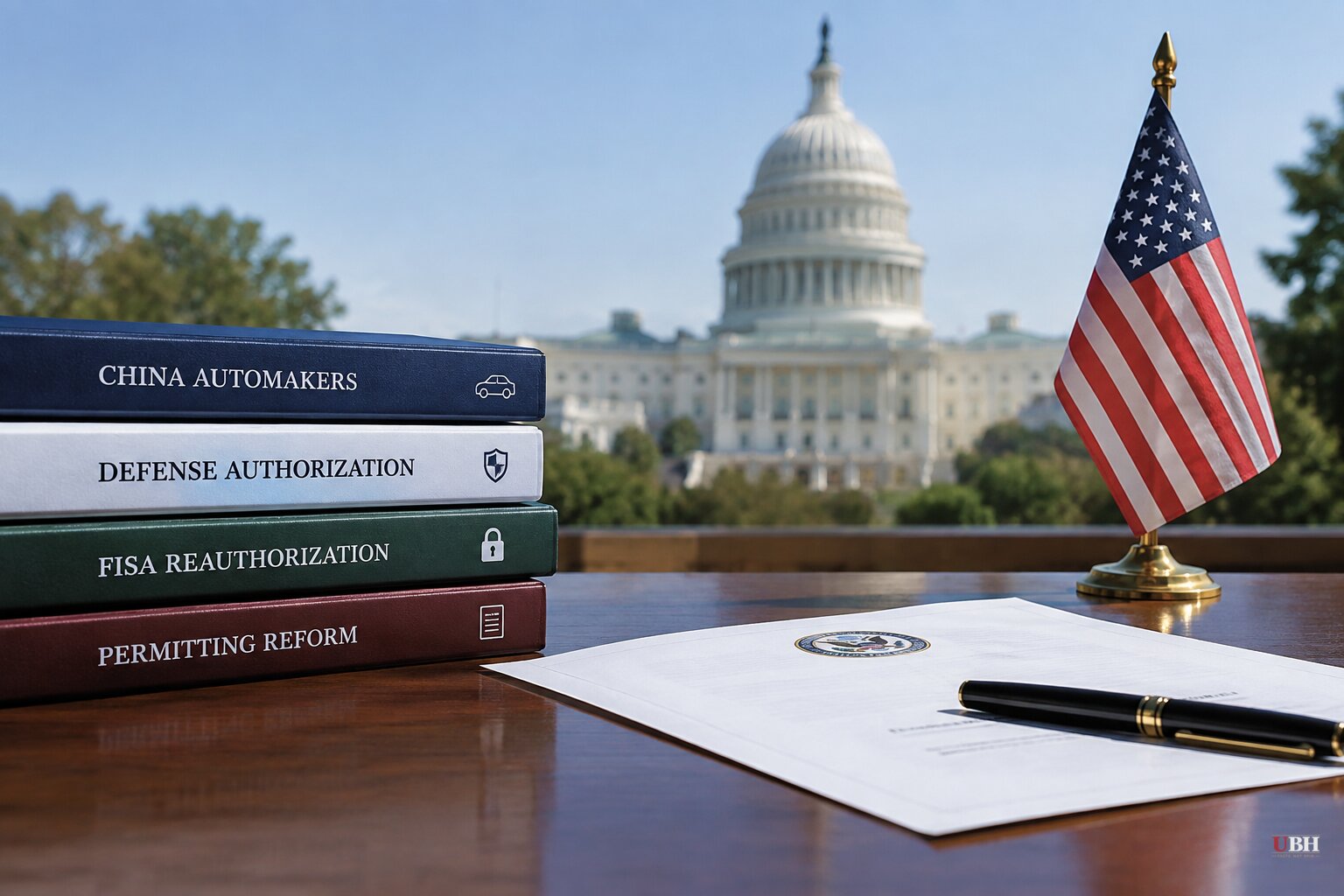
The Senate adjourned Wednesday night and won't return to Washington until the week of November 9, according to The Hill. That leaves permitting reform, the annual defense authorization bill, reauthorization of FISA surveillance authorities, and a bill to crack down on Chinese-owned automakers all sitting unfinished less than five weeks out from Election Day.
Before leaving, senators confirmed Keith Sonderling as Trump's Labor Secretary. They did not act on three Congressional Review Act resolutions aimed at waiving California regulations, something Senator John Kennedy (R-La.) warned will just pile up more work in November and December.
"It breaks my heart. It's bad planning," Kennedy told The Hill. "We should have started after we passed One Big Beautiful Bill, planning what we wanted to do and how we were going to get it done." That's a Republican senator calling out his own majority's scheduling, not a Democrat scoring points.
Republicans Stayed an Extra Week, Then Bolted Anyway
The Hill's framing is that vulnerable Republicans were "fearful of losing their majority" and wanted out of Washington fast. But there's more to the story.
According to Fox News, GOP senators actually scrapped plans for an earlier exit the week prior and chose to stay in session an extra week specifically so they wouldn't leave town having just passed a college sports regulation bill as their closing message on affordability. Senate Majority Leader John Thune (R-S.D.) told colleagues at a weekly lunch, "Odds are we plan on being here next week."
During that extra week, Senator Jon Husted (R-Ohio), one of the most endangered Republicans on the ballot this fall, tried to force a floor vote on the House's Ratepayer Protection Act, which passed the House 417-3 and would make data center companies cover the cost of utility bill spikes they cause. Senator Martin Heinrich (D-N.M.) objected and blocked it. So both parties were playing the same game: trying to control the last message voters hear before November.
The China Car Bill Nobody Wants to Call a Mercedes Bill
The Connected Vehicle Rule legislation may be the most consequential unfinished item. The Senate Commerce Committee approved it in July to toughen a Commerce Department ban on vehicles tied to "adversarial" nations, chiefly China. The bill would bar companies with more than 15% Chinese ownership from selling vehicles in the U.S.
That threshold is a direct problem for Mercedes-Benz, which has nearly 20% passive ownership by Chinese entities, according to Reuters. Senator Bernie Moreno (R-Ohio), the bill's lead sponsor and a former car dealer, has been blunt that he's not trying to kill a major automaker. "What we're not going to do, obviously, is ban Mercedes-Benz vehicles in America," Moreno told Reuters, adding that the real question is "can they get to 15% without debilitating their company?"
There's precedent for a path through. Volvo Cars, majority-owned by China's Geely, submitted to a Commerce Department inquiry and was cleared to keep selling in the U.S. Polestar, also Geely-owned, went through the same review and lost. It's barred from U.S. sales starting in 2027. Moreno flagged that Aston Martin, 17% owned by Geely, and Lotus, majority-owned by Geely, could get caught in the same net.
Democratic Senator Elissa Slotkin of Michigan, the bill's other chief sponsor, told Reuters she believes the bill has 99 of 100 senators ready to move it, with Senator Rand Paul (R-Ky.) the lone holdout. Paul's objection deserves a fair hearing: he's not defending Chinese ownership rules broadly, he's objecting to what he sees as Congress writing legislation that functionally targets one named company. "A bill shouldn't directly attack one company," Paul told Reuters, saying he'd drop his opposition if that language came out.
Paul has a point on process grounds. Singling out a specific private company in statute is the kind of thing that should make lawmakers uneasy regardless of the policy goal. But the underlying national security concern isn't manufactured. A Biden administration regulation from early 2025 already bars Chinese automakers outright from selling or building passenger vehicles in the U.S. over fears that connected-car data could be funneled back to Beijing, and Washington keeps tariffs above 100% on Chinese EVs. China's foreign ministry has called those moves "unreasonable suppression" and pushed back on what it calls unfair treatment of its auto industry, per Reuters.
None of the sources confirm whether Moreno's bill actually got a floor vote before the Senate adjourned Wednesday night. The Hill's rundown of what the chamber finished before leaving town doesn't mention it, and Moreno's own goal, stated Tuesday, was only to "try" for fast-track passage that week. Whether Paul's one-company objection got resolved, or whether the bill simply ran out of floor time behind higher-profile fights, remains an open question heading into the five-week midterm sprint.
Complicating the political backdrop: an Emerson College Polling survey released last week put Democrats ahead by 11 points on the generic congressional ballot, 53% to 42%, among 1,000 likely voters surveyed September 21-22. That's the number driving senators like Dan Sullivan (Alaska), Roger Marshall (Kansas), Pete Ricketts (Nebraska) and Susan Collins (Maine) back to their states instead of staying in Washington to finish the job.
Collins, for her part, left town without getting a vote on her bipartisan bill to cap monthly out-of-pocket insulin costs at $35, according to The Hill. That bill, like the China car legislation, now waits for the Senate's return the week of November 9.
Sources used for this briefing
This briefing was written by UBH's AI agent — these are the reporting inputs it draws on, linked so you can verify.


