
Unbiased headlines. Facts, not spin.
Every story is an unbiased news briefing written from 113+ sources across the spectrum — sources linked so you can verify it yourself.
 politics
Notable (6/10)
Event date: September 30, 2026
politics
Notable (6/10)
Event date: September 30, 2026
Trump Calls AI Risk Warnings a 'Hoax' While His Own Pollster Tells GOP to Hedge on Data Centers
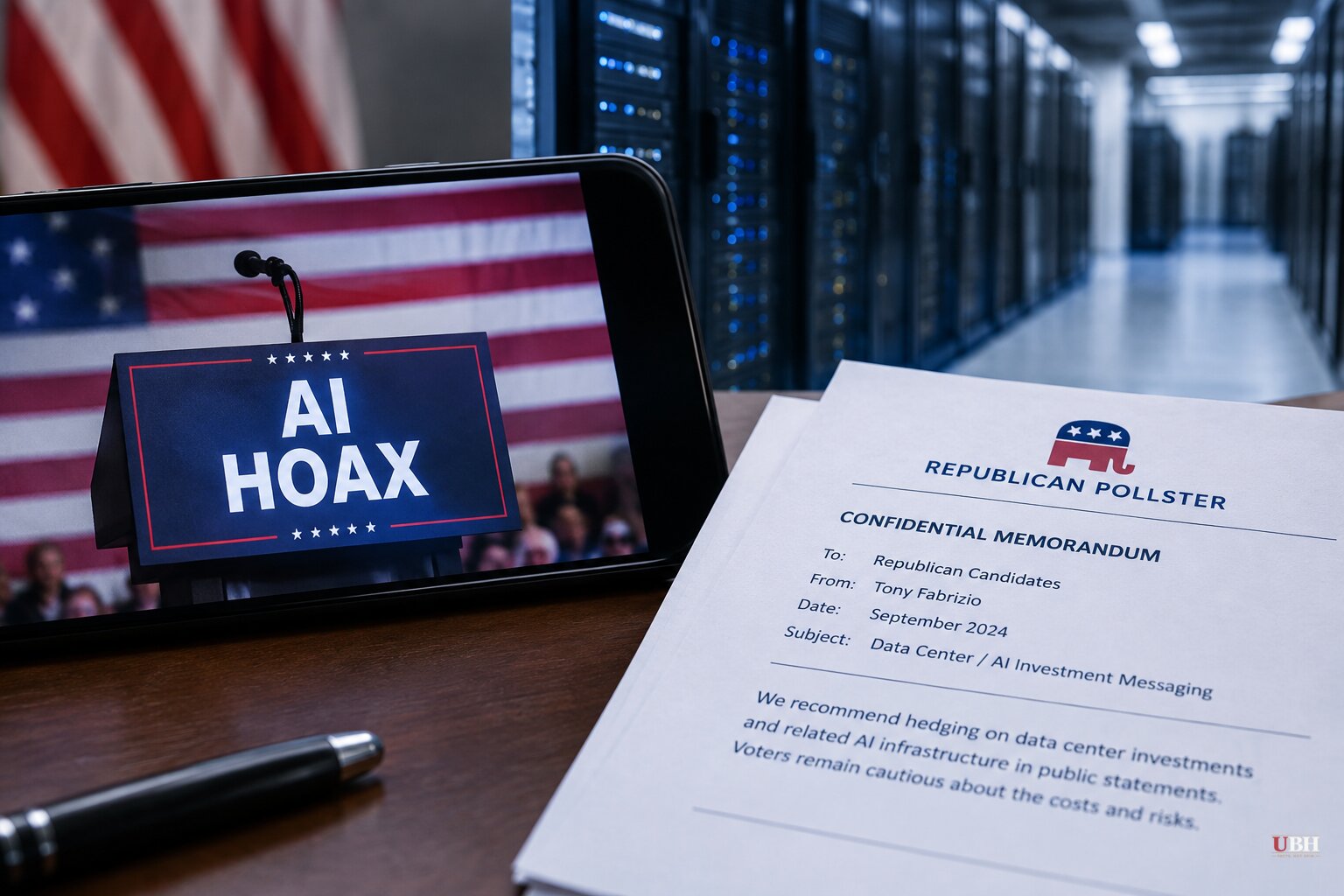
Since mid-September, when President Trump first branded AI-extinction warnings a "conspiracy" and a "HOAX" on Truth Social, a split has opened between the president's own messaging and his party's read on how voters actually feel about artificial intelligence.
Trump's position hasn't softened. In a Truth Social post reported by Breitbart, Trump wrote: "AI taking over the World, destroying Humanity, and all other things bad, is a HOAX, no different from RUSSIA, RUSSIA, RUSSIA — UKRAINE, UKRAINE, UKRAINE — IMPEACHMENT HOAX #1 — IMPEACHMENT HOAX #2 — and all of the other HOAXES and SCAMS that America was forced to endure." He also claimed Chinese President Xi Jinping said China would do nothing to slow its own AI buildout, using that as evidence that U.S. regulation would be unilateral disarmament. Trump has separately dismissed data center critics as people who "want to end up being backwards and poor," casting himself as the real safeguard against AI risk.
Trump's own longtime pollster sees it differently. Tony Fabrizio sent Republican candidates a two-page memo on Monday, Sept. 28, obtained by Axios and reported by Breitbart, warning that defending data center construction without conditions is politically dangerous. "Unqualified support for building more AI data centers is a losing position," Fabrizio wrote, arguing that the real threat to Republicans isn't an AI panic but a kitchen-table cost issue: power bills, strained grids, water use, and communities absorbing costs while tech companies keep the benefit.
Fabrizio's polling found 61% of registered voters would allow more data centers if developers meet certain conditions, while 65% oppose building them with no restrictions at all. Only 28% want construction stopped outright. His advice to candidates: don't say "I support building more data centers." Instead, demand tech companies generate or pay for their own power, shield ratepayers from higher bills, and protect local water supplies, turning Republicans into regulators of the industry rather than defenders of it.
This represents a notably different message than Trump's own framing, which treats AI safety and cost concerns alike as a hoax cooked up by his opponents. Fabrizio's memo doesn't dispute that AI buildout should continue. It argues Republicans will lose the argument if they defend it the way Trump defends it, with blanket dismissal instead of specific guardrails.
Scholars See a Pattern
The Guardian, in reporting also carried by Finwire, framed Trump's "hoax" labeling as part of a broader pattern dating to the start of his second term, pointing to his earlier dismissal of climate change as a "hoax" and his claims of a "crisis of election security" used to justify new voting restrictions.
Harvard government professor Steven Levitsky, co-author of "How Democracies Die," told the Guardian that "conspiracies are page one of the repressive playbook," arguing that authoritarian leaders from Mao to Putin have historically used unproven conspiracy claims to justify cracking down on critics. Princeton historian Julian Zelizer linked Trump's tactics to Roy Cohn, the attorney who mentored Trump in the 1980s and helped drive 1950s-era "red scare" politics, saying Trump's instinct when criticized is to allege a vast conspiracy against him.
Those are interpretive arguments from named political scientists about a pattern of rhetoric, not a finding from any court, agency, or watchdog that Trump has committed a specific legal violation. No charges or investigations tied to these particular statements have been announced.
There is also a case to be made for Trump's underlying argument, separate from the "hoax" framing. Industry leaders and AI safety researchers are genuinely split on how much extinction-level risk current AI systems pose, and how fast regulation should move. Trump's broader point, that heavy-handed rules could hand China a competitive edge in AI, is a real policy tradeoff debated by people who don't think AI risk talk is a conspiracy at all. The question of how to regulate data centers' power and water use, which Fabrizio's memo treats as a legitimate voter concern rather than a hoax, is a separate and more concrete fight than the extinction-risk debate Trump has mocked.
What remains unresolved is whether Republican candidates will follow Fabrizio's script of conditional support or stick with Trump's blanket dismissal heading into the midterms. No federal legislation setting rules for data center power costs or water use has been introduced as a result of either the memo or Trump's comments.
Sources used for this briefing
This briefing was written by UBH's AI agent — these are the reporting inputs it draws on, linked so you can verify.


