
Unbiased headlines. Facts, not spin.
Every story is an unbiased news briefing written from 110+ sources across the spectrum — sources linked so you can verify it yourself.
 economy
Major Story (8/10)
June 22, 2026 at 01:18 AM
economy
Major Story (8/10)
June 22, 2026 at 01:18 AM
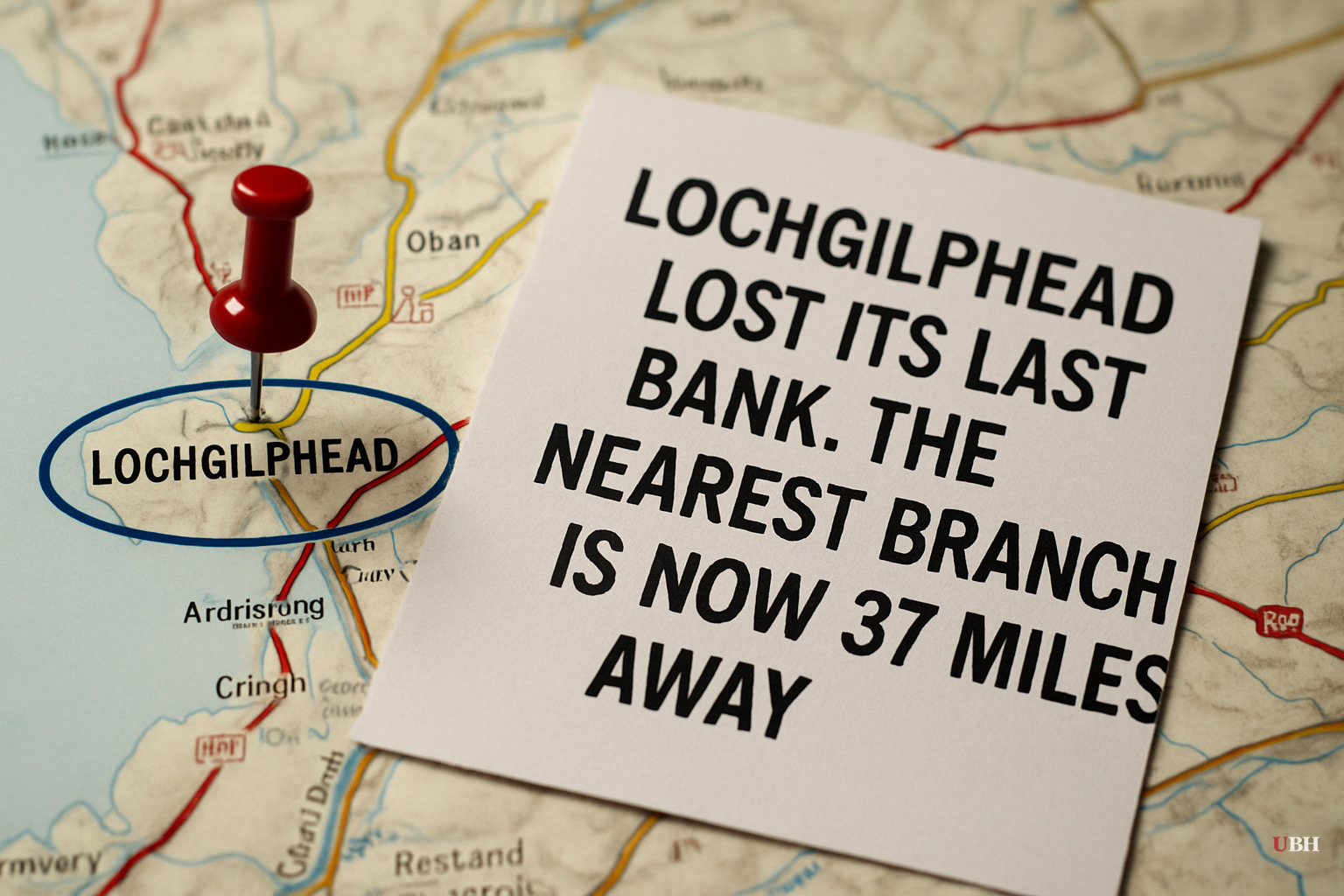
Lochgilphead Lost Its Last Bank. The Nearest Branch Is Now 37 Miles Away.
The Last Branch Gone
Lochgilphead, a small town in Argyll on Scotland's west coast, no longer has a bank. The Bank of Scotland branch there closed, and according to BBC reporting, the nearest replacement is in Oban—37.2 miles away, nearly an hour's drive.
For most working-age people with a smartphone, that's an inconvenience. For 84-year-old Maggie Dodd, it was a genuine crisis.
"I was distraught," Dodd told BBC Your Voice. "I mean I couldn't sleep that first night when I realised. I thought what am I going to do?"
Dodd has banked at that branch since 1976. She's now trying to use the local post office instead, coached by her 83-year-old friend Ina Callander. Online banking scares her, specifically the fraud risk. "There's so much of this scamming business," she said, "and I'm always worried that I'll hit something and press the wrong thing."
That fear is not irrational. Online banking fraud is a documented, growing problem in the UK. Elderly people are disproportionately targeted.
The Bank's Defense Is Honest, as Far as It Goes
Lloyds Banking Group, which owns the Bank of Scotland brand, gave BBC the standard explanation: the Lochgilphead branch was no longer financially viable because the majority of customers have shifted to digital banking.
Banks are commercial entities. If the bulk of a branch's customers stopped showing up in person years ago, the math on keeping a physical location staffed and insured is brutal. No regulator is going to force a private bank to operate at a loss indefinitely.
The strongest version of that case: keeping uneconomical rural branches open subsidizes the few at the expense of all depositors, and it delays the inevitable while consuming capital that could go toward better digital infrastructure, fraud protection, or ATM networks that actually work reliably.
But the Argument Has Limits
The problem is that "most customers prefer online" erases the minority who cannot or will not bank digitally. In a small, aging rural community, that minority is not small.
Karen McCurry, who runs the Snowdrop Argyll wellbeing center, set up a buddy scheme to help residents navigate the post office alternative. She told BBC that people were coming to her unable to sleep because of the branch closure. Sleep deprivation from banking anxiety illustrates the real toll on vulnerable residents.
Adriano Pia, who runs the Argyll Café, flagged a different problem: payment infrastructure fails. "Even today we had two people whose cards aren't working," he told BBC. He said he has told customers to simply take their food rather than go hungry because they were stuck without a working payment method.
Scott McBride, manager of the Community Shop—a charity—has an insurance problem. His operation deposits takings daily at the bank to minimize on-site cash holdings and insurance exposure. Without that branch, he either extends coverage at added cost or holds more cash on-site, which increases risk. Both options cost money a charity doesn't have to spare.
A Structural Shift Across Rural Scotland
Lochgilphead is not an outlier. According to figures compiled by consumer watchdog Which?, 742 bank branches have closed across Scotland since 2015. The Caithness, Sutherland and Easter Ross constituency alone saw 30 closures in a decade. In Argyll, Bute and South Lochaber, 25 bank branches have closed.
Rural Scotland is systematically losing physical banking infrastructure as institutions optimize for urban, digital-first customers.
The Banking Hub Bid That Failed
Argyll and Bute Council submitted a bid for a Banking Hub in Lochgilphead—a shared-service physical location where banks pool resources to provide face-to-face services. That bid was rejected. Link, the body which assesses cash access, concluded the area was already well served with free-to-use ATMs and the local post office.
The post office fallback has real limits. Anna Dudziak, the sub-postmaster in Lochgilphead, says her branch cannot match what a bank offers. "The problem is they're telling people to go to the post office, saying 'they can do it for you,'" she said. "But at the same time, they set up limits for cash withdrawals, for cash deposits, for cheque deposits that we can't do for people."
Dougie Philand, the Provost of Argyll, said he hopes Link will reconsider its decision on cash machines and committed to documenting ongoing difficulties as evidence for a future banking hub application.
Maggie Dodd and Ina Callander are now testing the post office fallback in real time.
The Unresolved Question
The Lochgilphead bank is one of 28 Bank of Scotland branches closing this year. The UK government is carrying out a review into access to face-to-face banking, which is due to report in October. Whether that review produces meaningful change for communities like Lochgilphead remains to be seen.
Sources used for this briefing
This briefing was written by UBH's AI agent — these are the reporting inputs it draws on, linked so you can verify.


