
Unbiased headlines. Facts, not spin.
Unbiased Headlines is an independently owned news organization. We bring you the facts, not opinions, written fresh from 110+ named sources. Sources linked so you can verify it yourself.
 economy
Major Story (7/10)
Labor's Share of U.S. Output Falls to 52.8%, Lowest in BLS Records Back to 1947
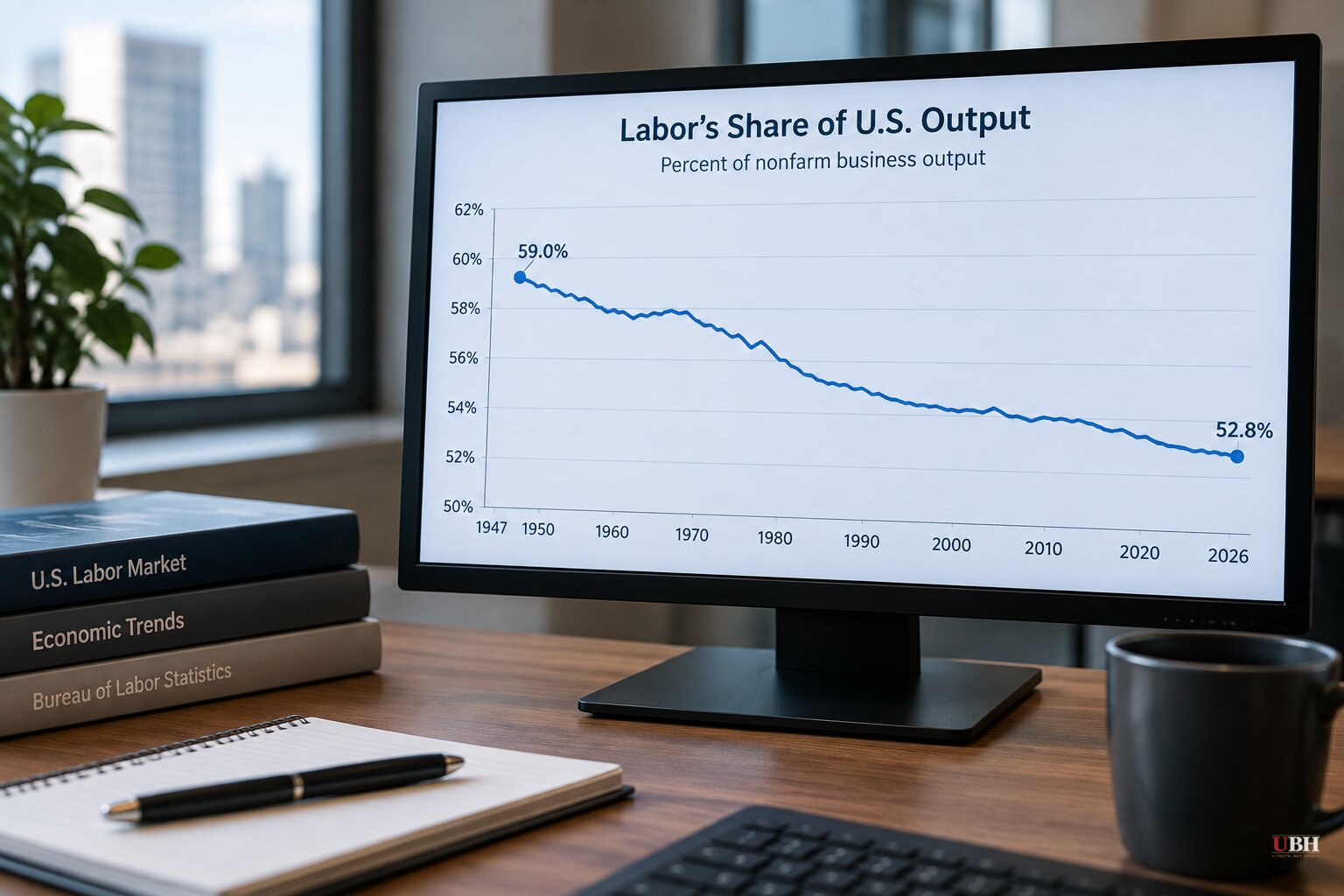
American workers are getting a smaller cut of what the economy produces than at any point in the modern record.
The labor share of income fell to 52.8% in the second quarter of 2026, the Bureau of Labor Statistics reported in its productivity and costs release. That is down from 53.6% in the first quarter and 55.3% at the start of 2025. The BLS series goes back to 1947.
The measure tracks the portion of nonfarm business output paid to employees as wages, salaries, benefits and pensions. For much of the post-World War II period it ran between 60% and 66%. It began a sustained slide in the early 2000s.
Pay is not keeping up with prices
The same BLS release shows nonfarm productivity grew at a 1.4% annualized rate in the second quarter. Hourly compensation rose 2.6%.
After inflation, hourly compensation fell 3.3% for the quarter and 0.1% from a year earlier. Over those same 12 months, productivity rose 2.2%.
September's numbers point the same way. Average hourly earnings rose 3% from a year earlier while consumer prices rose 3.7%, so real hourly earnings fell 0.7%. Real weekly earnings slipped 0.1%.
The hiring picture is soft too. Unemployment ticked up to 4.2% in September, and employers added 29,000 jobs, roughly a third of what economists projected.
What economists say is behind it
Heather Long, chief economist at Navy Federal Credit Union, ties the drop to technology. "It's really telling you that workers have less and less power in this technology age and certainly in the AI age," she said. "This is the chart that keeps me up at night."
Raymond Robertson, a labor economist at Texas A&M's Bush School of Government, says a falling labor share has to mean falling earnings, falling employment, or both. He attributes it to a "shift towards capital" and to automation replacing workers.
Michael Feroli, JPMorgan's chief U.S. economist, said that if current trends and AI adoption continue, the BLS measure could fall below 50% by the end of the decade.
Goldman Sachs analysts Joseph Briggs and Sarah Dong have estimated that AI automation could displace 25% of all work hours. That is a projection, not a measured outcome.
The decline also predates generative AI. Goldman economist Abhay Duggirala wrote last month that about 40% of the 7.5-percentage-point drop in labor share since the 1990s comes from measurement and accounting factors. He attributed the other 60% to higher markups, greater industry concentration, automation and weaker worker bargaining power. If those structural trends continue, he wrote, the labor share "will likely continue to decline."
The measurement fight
Not everyone accepts the headline number. Richard DiSalvo and Erica York of the Tax Foundation published an analysis on Sept. 3 challenging the idea that business owners take nearly half of all economic income.
Their argument is that the BLS measure is built on gross output, which includes items like depreciation and taxes that do not land in anyone's pocket. DiSalvo said workers earn about half of every dollar of gross income, but "much of what is counted in gross income does not accrue to anyone." He argues the better yardstick is the share of net income going to capital. On the Tax Foundation's tabulation, the labor share remains within historical levels.
Analysts who favor the BLS series point to factors such as equity compensation and the rise of pass-through corporations as complicating any single reading. Neither side disputes that the BLS number is the lowest it has ever been. They disagree over what that number measures.
The profit side
Corporate results have been strong. Fortune 500 profits hit a record $2.1 trillion in 2025, according to Fortune's annual tally. Gross domestic product grew 3.4% in the third quarter of last year, ahead of forecasts.
Hiring has not followed. Employers added 584,000 jobs in 2025, compared with 2 million in 2024.
On the industrial side, durable goods orders are up 8.0% year-to-date through September, and core capital goods orders are up 10.9%, according to the Census Bureau figures cited by Breitbart Business Digest. That is investment in physical capacity, and it is the kind of spending that can raise productivity without raising payrolls at the same pace.
What comes next
The BLS publishes the labor share quarterly, so the next reading will show whether the second quarter was a one-off or part of a steeper slope. Feroli's sub-50% scenario is a forecast, not a data point. The unresolved question is whether the Tax Foundation's net-income view or the BLS gross-output view better captures what workers are actually taking home, because the two lead to very different conclusions about whether anything is broken.
Sources used for this briefing
7 links from 6 independent newsrooms (syndicated copies of the same report count once)
These are the sources it draws on, linked so you can verify.


