
Unbiased headlines. Facts, not spin.
Unbiased Headlines is an independently owned news organization. We bring you the facts, not opinions, written fresh from 110+ named sources. Sources linked so you can verify it yourself.
 economy
Major Story (8/10)
Event date: October 27, 2026 ·
Meta Filing Says Zuckerberg Weighed Leaving California as Prop 40 Opposition Spending Passes $300 Million
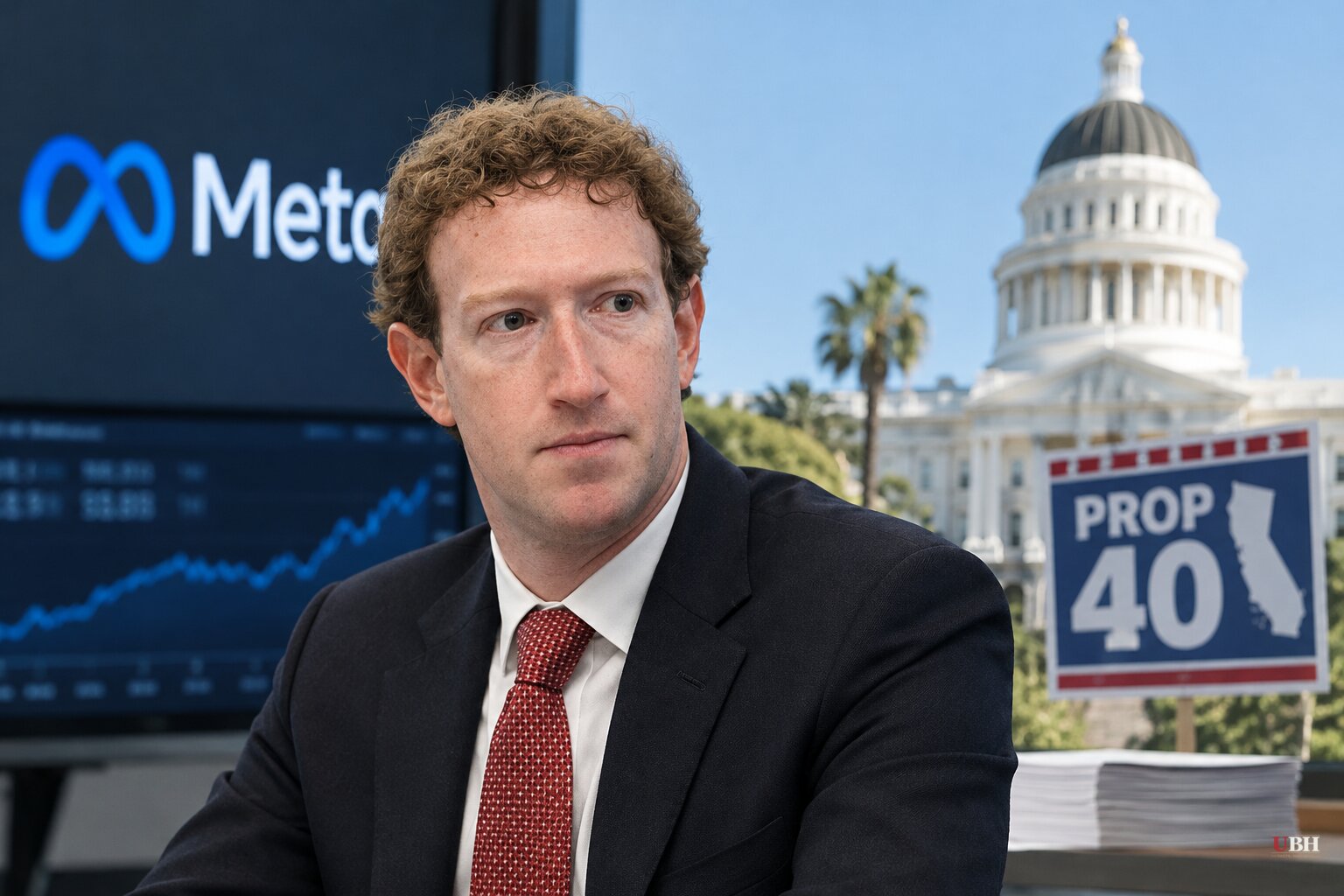
Ahead of the Nov. 3 vote on Proposition 40, the one-time 5% billionaire tax, a Meta filing with the SEC has put a number on how seriously one of the state's richest residents took the threat.
According to the filing, Mark Zuckerberg told the company's special committee he was evaluating moving his primary residence outside California. He also warned that any step toward leaving, including listing his California homes, would be public and "inevitably noted and commented upon by Company employees." The filing says that would raise questions for management going forward.
Meta's response was a financial incentive. Over eight years, the company would gradually lift restrictions on Zuckerberg's ability to sell certain shares. The benefit depends on him staying in a leadership role and based near the company's Silicon Valley headquarters.
The plan would also create a new class of shares letting him sell up to half his economic stake without giving up voting control. The filing states the goal: "to keep Mr. Zuckerberg continuing to lead the Company from California and in close proximity to Meta Superintelligence Labs."
The filing also acknowledges the exposure. It warns of a "significant, multi-billion dollar tax payment" given the ballot measure.
DoorDash CEO Tony Xu, who sits on Meta's special committee, is among the tech figures who oppose the measure.
What Prop 40 would do
The measure would tax the net worth of billionaires who were California residents on Jan. 1, 2026. Wealth would be measured at the end of 2026, with payment due in 2027. Taxpayers could pay over five years, but doing so would cost more. Real estate, pensions and retirement accounts would generally be exempt.
Supporters say it is meant to cover a roughly $100 billion shortfall left by healthcare cuts in last year's One Big Beautiful Bill Act. Dave Regan, president of SEIU-United Healthcare Workers West and the measure's architect, says more than 3.4 million Californians could lose coverage when the law's provisions take effect in January. "To us, what's crazy is doing nothing and watching millions of people lose coverage," Regan said.
California's official voter guide says 90% of any revenue must support public healthcare services.
The money fight
The campaign against the tax is one of the most lopsided in state history. A Capital & Main analysis of state records found the billionaire-funded committee Building a Better California had spent more than $304 million through Oct. 20. That included $118.5 million to a committee opposing Prop 40 and $186 million backing Propositions 41 and 42, which the Legislative Analyst's Office says could nullify Prop 40 if they get more votes.
Opponents have outraised supporters by more than 9 to 1 across the three measures, the analysis found. The fight accounts for nearly half of all ballot-measure spending this cycle. Google co-founder Sergey Brin has given $102 million.
The Guardian puts tech-billionaire spending into super PACs at upwards of $356 million. A Los Angeles Times analysis counted $293 million through Oct. 16, covering money against Prop 40 and for Props 41 and 42. These totals differ because they cover different dates and different sets of committees.
The Times also examined about 260 people identified from Forbes data and found 30 billionaires, or their spouses, had contributed. That is approximately 12% of the group. Eric Schmidt gave about $40.2 million and John Doerr $40 million.
Building a Better California spokesperson Abby Lunardini said the group stands with "doctors, teachers, firefighters, Planned Parenthood, Gov. [Gavin] Newsom" in opposing the measure. She argued it "will devastate the state's budget, tax base, and economy" and would make healthcare funding worse. Opponents also say the measure lacks oversight to ensure the money reaches families rather than insurers.
Not every billionaire is opposed. Nvidia CEO Jensen Huang has said he wouldn't mind paying.
How much it would raise
The revenue estimates are far apart. The Los Angeles Times, using Forbes wealth figures from Oct. 16, put the total liability at about $107 billion. Brin, Huang, Larry Page and Zuckerberg would account for about 40%, or roughly $42.8 billion. No tax has been assessed.
That $107 billion draws on research by economists Jasper Boll, Emmanuel Saez and Gabriel Zucman. Saez and Zucman helped develop Prop 40.
Stanford economists Benjamin Jaros and Joshua Rauh estimate it will raise only about $30 billion. They also estimate departures will cost the state $1 billion to $3.5 billion a year in lost income tax revenue, according to a USA Today opinion column.
That column says seven billionaires have publicly left California, taking roughly $540 billion, or 30% of the group's wealth. It cites IRS data showing departing residents took a net $91.4 billion in income out of the state between 2019 and 2023.
The Los Angeles Times analysis counts Brin, Page and Zuckerberg among those facing the tax. Share prices, exemptions and residency determinations could affect any eventual bill, and owning property outside California would not, on its own, settle a person's residency.
The Guardian describes the split as unusual: Democrats against Democrats, with progressive politicians and tech billionaires on the same side, and critics even within the party objecting to a one-off tax that funds only certain programs.
What happens next
Voters decide Prop 40, and Props 41 and 42, on Nov. 3. If Prop 40 passes and the competing measures win more votes, the Legislative Analyst's Office says they could cancel it. Courts could also become involved if Props 41 or 42 receive more Yes votes and are found to conflict with Prop 40. If Prop 40 survives, billionaire net worth would be measured at the end of 2026, with payment due in 2027, when residency, valuation and exemptions would all be tested.
Sources used for this briefing
6 links from 6 independent newsrooms (syndicated copies of the same report count once)
These are the sources it draws on, linked so you can verify.


