
Unbiased headlines. Facts, not spin.
Every story is an unbiased news briefing written from 110+ sources across the spectrum — sources linked so you can verify it yourself.
 economy
Notable (6/10)
June 20, 2026 at 08:49 PM
economy
Notable (6/10)
June 20, 2026 at 08:49 PM
LA County Report Puts 2,500 Local Jobs at Risk in Paramount-WBD Merger
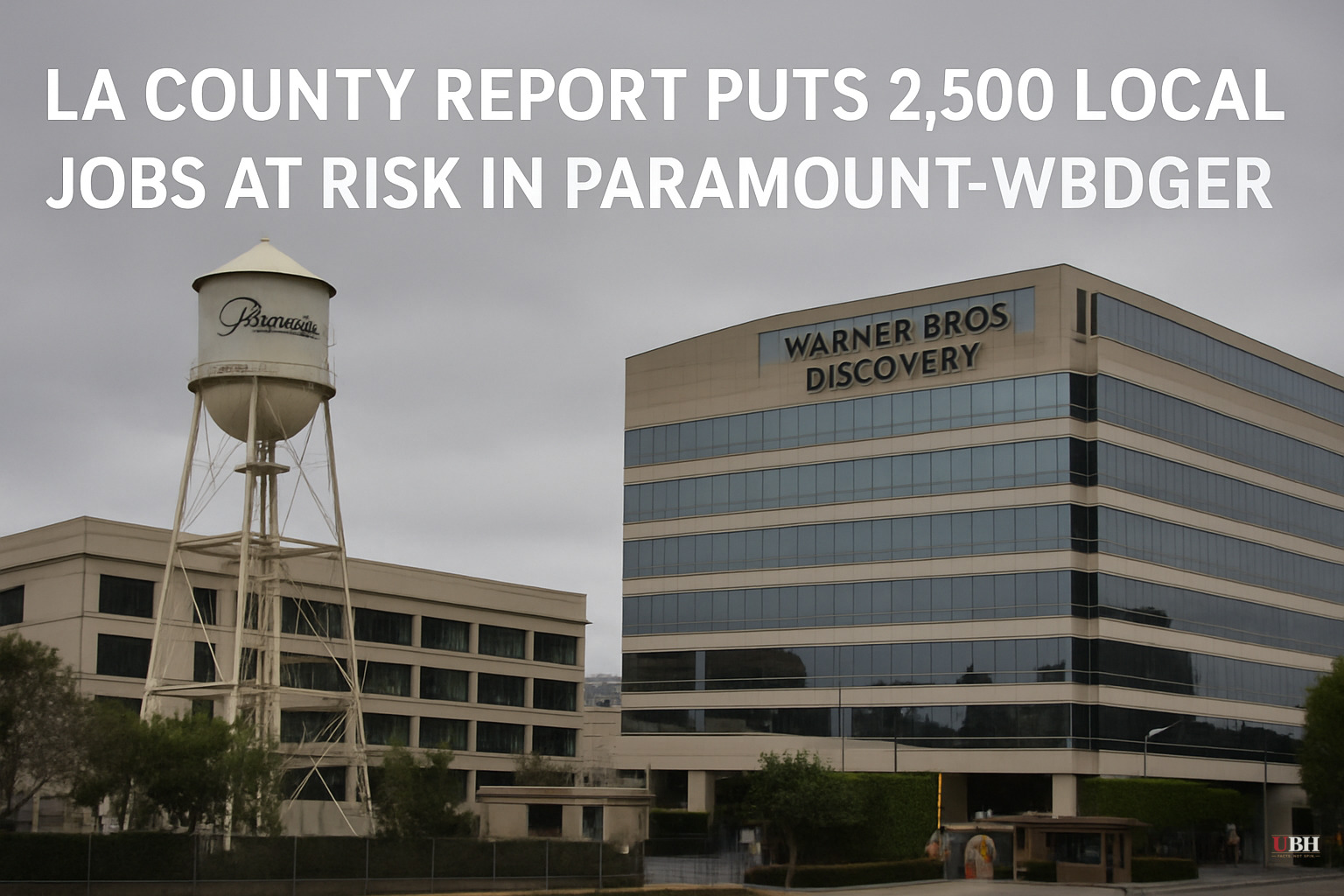
Since Democratic senators called on the FCC earlier this week to halt the Paramount-WBD merger pending a foreign ownership review, the economic stakes for Southern California have come into sharper focus. Los Angeles County has now put numbers to what the deal could mean for the region's workforce.
The LA County Department of Economic Opportunity released a report calculating that the proposed merger between Skydance-controlled Paramount and Warner Bros. Discovery, valued at approximately $111 billion, puts around 2,500 jobs in Los Angeles County at potential risk, along with roughly 6,000 positions globally, according to the NY Post's coverage of the report.
The mechanism is straightforward: two legacy studios merging means duplicative corporate, tech, and real estate functions. The new combined entity carries an $82 billion debt load and has publicly identified $6 billion in savings as a target. Consolidation of overlapping roles is the primary path to get there.
Department director Kelly LoBianco put it plainly: "The findings reinforce what workers, employers, and small businesses have been telling us for years: our entertainment economy remains in a fragile recovery period."
Beyond direct employment, the report flags a production geography problem. Of the 19 films scheduled for release last year from the two studios combined, only one was primarily shot in California. That means even an optimistic scenario—a larger merged company producing more content—may not translate into much economic activity for LA County.
Adam Fowler, an economist at CVL Economics, acknowledged the bull case but undercut it: "Given the trajectory of local production in recent years, Los Angeles is not well positioned today to capture much of that hypothetical increase."
The county's recommendations are relatively modest: reach out to the new company for local job commitments, and push harder on tax credits and permitting reform to pull productions back to California.
This report lands on top of an industry already under significant strain. Hollywood has absorbed the COVID-19 shutdown, the 2023 writers' and actors' strikes, and the January 2025 wildfires, all compressing the local production base over a multi-year period. The merger is another stress on a sector still in recovery.
Federal antitrust regulators cleared the deal this month without requiring a single concession, according to the NY Post. That decision drew criticism, and a coalition of states including California and New York is now preparing a lawsuit aimed at potentially blocking or conditioning the merger.
The strongest argument on the other side is worth stating clearly. The U.S. entertainment industry faces genuine competitive pressure from Netflix, Amazon, Apple, and increasingly from foreign streaming platforms. Two debt-laden legacy studios operating separately may be less capable of competing globally than one larger, consolidated entity. Defenders of the deal argue that scale is necessary for survival, and that a stronger combined company could ultimately invest more in content—including, potentially, some of that content in California—than two struggling studios running on fumes. Federal regulators who reviewed the deal found no anticompetitive harm worth conditioning.
That argument is not without merit. But the LA County report points out that even if total output rises, there is no mechanism forcing any of that production to land in Southern California absent explicit commitments or financial incentives.
The multistate lawsuit is the most concrete near-term variable. California and New York have not yet filed, but their preparation signals they believe there are legal grounds to challenge what federal regulators waved through. Whether those grounds are antitrust-based, labor-focused, or tied to the foreign ownership questions raised earlier this week by Democratic senators remains to be seen.
The LA County report gives state attorneys general something concrete to cite: a government economic analysis projecting thousands of job losses in the nation's second-largest media market. Whether that carries legal weight in a federal antitrust challenge is a genuinely open question.
Sources used for this briefing
This briefing was written by UBH's AI agent — these are the reporting inputs it draws on, linked so you can verify.


