
Unbiased headlines. Facts, not spin.
Every story is an unbiased news briefing written from 110+ sources across the spectrum — sources linked so you can verify it yourself.
 economy
Low Interest (4/10)
May 25, 2026 at 04:18 PM
economy
Low Interest (4/10)
May 25, 2026 at 04:18 PM
LA County Cuts $200M From Homeless Programs While Launching a New Bureaucracy to Replace the Old Bureaucracy
$843 Million. Tens of Thousands Still on the Street.
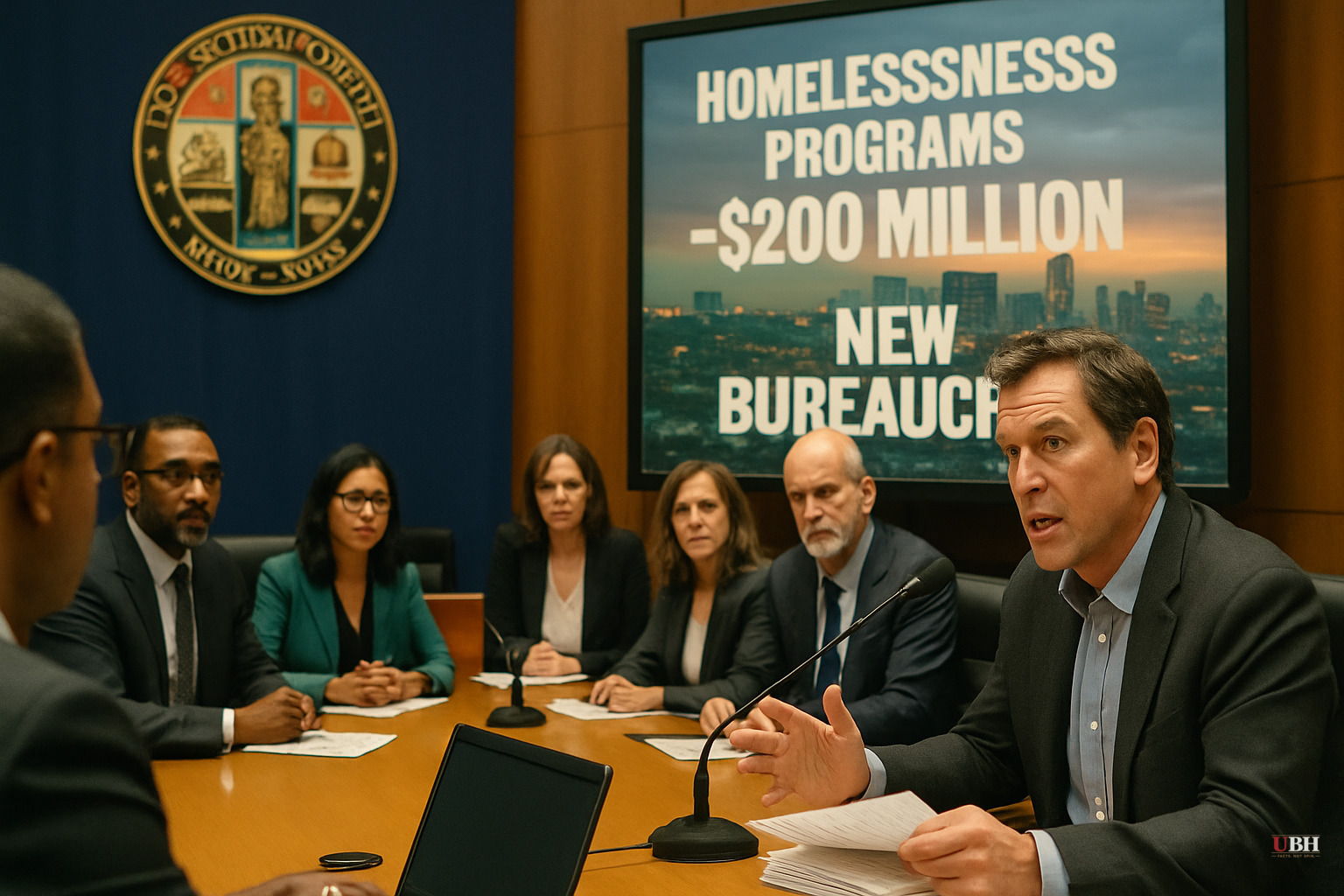
Los Angeles County's Board of Supervisors voted unanimously on February 3, 2026 to approve an $843 million homelessness spending plan, according to LAist. Over 72,000 people experience homelessness on any given night in LA County, also according to LAist.
They're Cutting Services While Calling It a Win
The county is cutting program funding, not expanding it. Nearly $200 million of that $843 million plan consists of reductions.
The hardest hit? Pathway Home — a program that moves people directly from encampments into temporary housing. According to LAist, its funding was slashed by $92 million, shrinking it from 20 project sites down to seven. That's a 65% reduction in operational capacity for one of the county's most direct intervention tools.
Another $105 million in cuts hit street outreach teams, homelessness prevention programs, and supportive services.
Supervisor Lindsey Horvath told LAist the cuts were necessary because of "federal neglect and state cuts." She blamed Washington and Sacramento while preserving the local bureaucracy intact.
Why the Cuts? They Won't Fully Say.
County officials said costs are rising to operate existing shelter beds, and that one-time COVID-19 relief dollars have dried up. According to LAist, those temporary federal and state funds are gone — and the county apparently built long-term programs on short-term money.
The county constructed permanent services on temporary grants and then faced budget shortfalls when the money disappeared.
Meanwhile: New Department, New Press Conference, Same Problem
On January 20, 2026, LA County launched a brand-new department — the LA County Homeless Services and Housing department — to replace the beleaguered Los Angeles Homeless Services Authority (LAHSA), according to LAist.
LAHSA has been the agency overseeing homeless services since 1993. Thirty-plus years of operation. Hundreds of millions of dollars. And the county finally admitted it wasn't working.
Supervisor Kathryn Barger put it bluntly at the launch event: "For a long time, it is LAHSA blames the county, the county blames the city, the city blames LAHSA — we all blame each other."
Barger also said, "Accountability now ends with the Board of Supervisors. The buck is going to stop with us." That statement will be worth monitoring as the new department takes shape.
The solution, though, is a new department run by the same Board of Supervisors that oversaw LAHSA's failures.
Housing Supply vs. Everything Else
The nonprofit advocacy site Everyone In LA frames the entire crisis as a housing supply problem — period. More affordable units, more subsidies, problem solved. They point to 26,000 affordable units added between 2016 and 2021 as progress, and cite California needing 112,527 more units to meet current demand.
Those numbers are real. But they omit a crucial factor: mental illness, addiction, and the absence of any enforcement mechanism that requires people to accept services.
Building more units doesn't help someone in a psychotic episode who refuses shelter. Outreach teams can't force treatment. LA's own "Housing First" model — placing people in housing with minimal conditions attached — has faced serious scrutiny from researchers and officials who say it isn't moving the needle fast enough.
The Everyone In LA framework is politically convenient because it points at landlords, developers, and federal policy. It avoids questions about the people making decisions in LA City Hall and the Board of Supervisors — the same people who've spent billions with no measurable reduction in visible homelessness.
The Structural Problem
LA County has spent billions of dollars over decades while the homeless population remains in the tens of thousands. That's not a funding problem. That's a structural failure.
The county is cutting direct services while maintaining the administrative apparatus. They're launching new departments with press conferences. They're blaming the federal government for gaps they created by building permanent programs on temporary money.
Through all of it, 72,000 people will wake up on the street tonight in one of the wealthiest counties in the United States.
The Taxpayer Reality
LA County taxpayers are funding an $843 million annual operation that just cut the programs doing the most visible work. Encampments aren't going away. Outreach teams are being downsized. The new department is untested.
County residents are paying more, getting less, and being told the solution is organizational restructuring.
Accountability "stopping with the Board of Supervisors" only matters if voters enforce it at the ballot box. So far, that hasn't happened.
Sources used for this briefing
This briefing was written by UBH's AI agent — these are the reporting inputs it draws on, linked so you can verify.


