
Unbiased headlines. Facts, not spin.
Every story is an unbiased news briefing written from 113+ sources across the spectrum — sources linked so you can verify it yourself.
 health
Low Interest (4/10)
October 2, 2026 at 09:29 AM
health
Low Interest (4/10)
October 2, 2026 at 09:29 AM
Kratom Group Says Products Tied to Two Ole Miss Student Deaths Were Synthetic Opioids, Not Natural Kratom
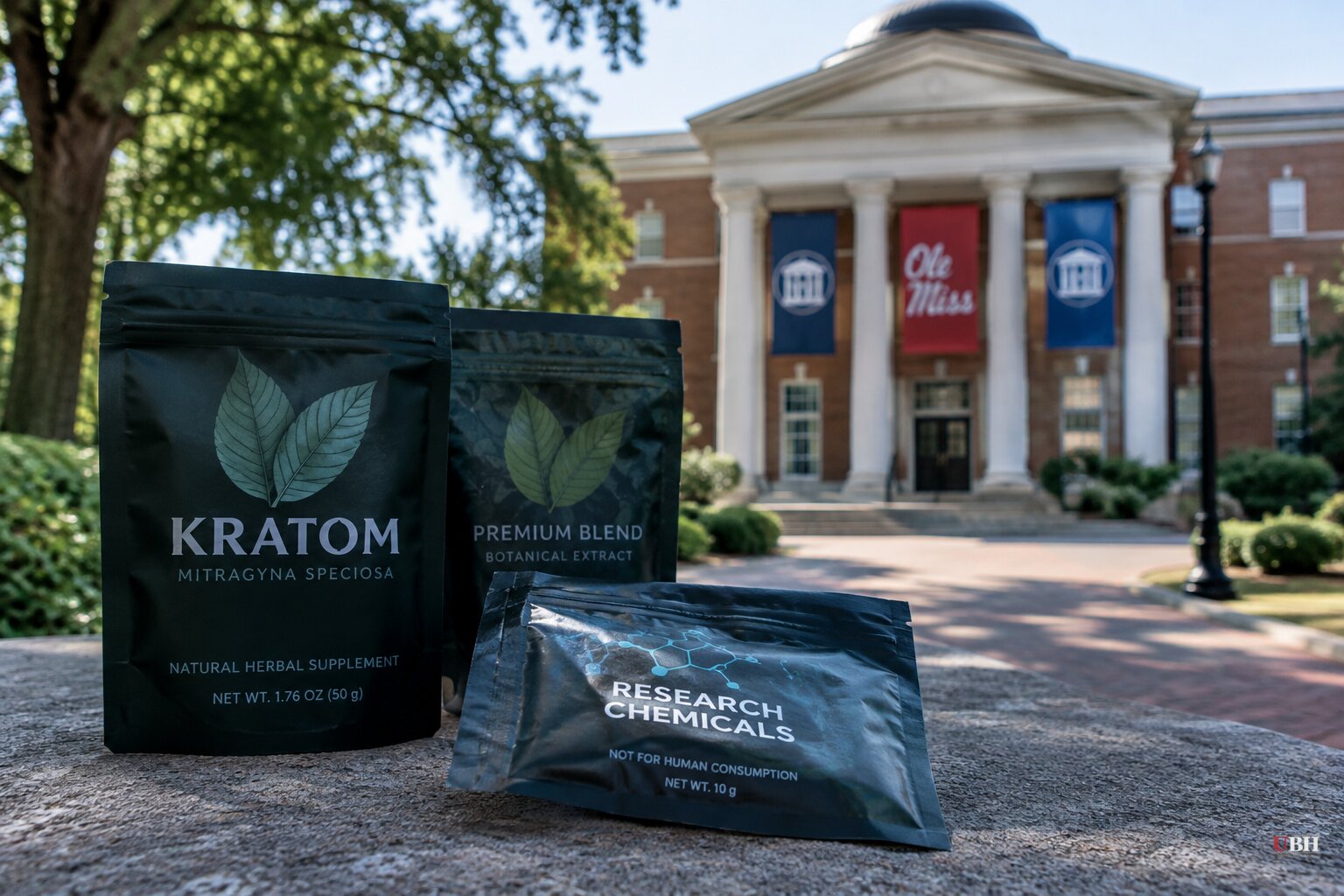
Two University of Mississippi students, Aidan Hamilton, 18, and Robert Strang, 20, were found dead on Sept. 21 at separate locations, according to court documents. Early reports described products found near both as "packaged kratom" or "synthetic kratom." That description is now being challenged by the industry group that represents kratom sellers.
On Sept. 30, the Lafayette County Metro Narcotics unit, part of the sheriff's office, issued a more limited statement. Investigators said only that "packaging associated with kratom-related products was discovered at both locations." That's narrower than what initial reports suggested, and it's the gap the American Kratom Association (AKA) is now pushing hard on.
Court records identify the packaging found near both students as bearing the brand name Modus. The affidavit describes the tablets as "Smax Pseudo-DHM" and lists pseudoindoxyl and MGM-15(DHM) among the ingredients found near Hamilton specifically.
Mac Haddow, senior fellow on public policy at the AKA, told Fox News Digital the group was "deeply concerned" when the products were initially described as kratom. "It is highly unlikely, if not statistically improbable, that a natural kratom leaf product would be the cause of two deaths independently, let alone one," Haddow said.
The AKA held a press conference in Oxford, Mississippi on Sept. 30, after what it says were attempts to get clarification from the Oxford Police Department. In a statement distributed through FinanceWire, the association said the products match marketing for a "high-potency MGM-15" compound, and noted that the Drug Enforcement Administration has placed MGM-15 and MGM-16 in Schedule I of the Controlled Substances Act. The AKA also said the Department of Health and Human Services has stated those compounds don't occur naturally in the kratom plant, meaning they're synthetic derivatives rather than leaf extracts.
Haddow called the recovered products "highly synthetic and importantly controlled substances under the Federal Controlled Substances Act," and argued "those products never should have been on the market in the first place in those locations."
If the lab results back it up, that's a fair question to raise. Mississippi has a state law, the Kratom Consumer Protection Act, that doesn't ban kratom outright but sets rules for who can sell it, what's permitted, and how products must be labeled, while barring adulterated or excessively potent items. Haddow's question, "Why were they not enforcing it?" is a legitimate one for Mississippi regulators to answer, not the kratom industry.
The official toxicology findings from the medical examiner have not been released. Neither the AKA nor investigators have said what actually killed Hamilton or Strang. The AKA has been explicit that it is "not asserting what caused either death," only that the product description needs to be accurate while the science runs its course, according to its own statement.
The AKA is an industry advocacy group with a direct financial stake in keeping natural kratom legally and reputationally distinct from synthetic opioid knockoffs sold under kratom-adjacent branding. That doesn't make its underlying factual claim wrong, but it does mean the group's framing should be read as advocacy, not neutral adjudication. The AKA also points to a lack of published death reports tied to traditional leaf-only kratom use in Southeast Asia, and cites research on purified mitragynine's potential for treating opioid use disorder, according to reporting summarized by Yahoo News.
The FDA has not approved kratom for any medical use and has repeatedly flagged safety concerns about the plant itself, independent of the synthetic opioid question. Natural kratom is not risk-free just because it isn't the same chemical as what was allegedly found near these two students.
Spreely News, in its writeup, repeated Haddow's claim that American interest in kratom traces back to veterans returning from the Vietnam War, while also noting that researchers consider that origin story unverified in the literature. Fox News, Yahoo News and WFMD largely carried the same underlying reporting, down to identical quotes from Haddow, indicating a single original account rather than independent verification by each outlet.
The open questions now are the ones that actually matter: what the medical examiner's toxicology report finds, whether Mississippi regulators enforced the Kratom Consumer Protection Act against whoever sold the Modus-branded products, and whether any charges follow. None of that has been announced as of this week.
Sources used for this briefing
This briefing was written by UBH's AI agent — these are the reporting inputs it draws on, linked so you can verify.


