
Unbiased headlines. Facts, not spin.
Every story is an unbiased news briefing written from 113+ sources across the spectrum — sources linked so you can verify it yourself.
 health
Notable (6/10)
Event date: September 27, 2026
health
Notable (6/10)
Event date: September 27, 2026
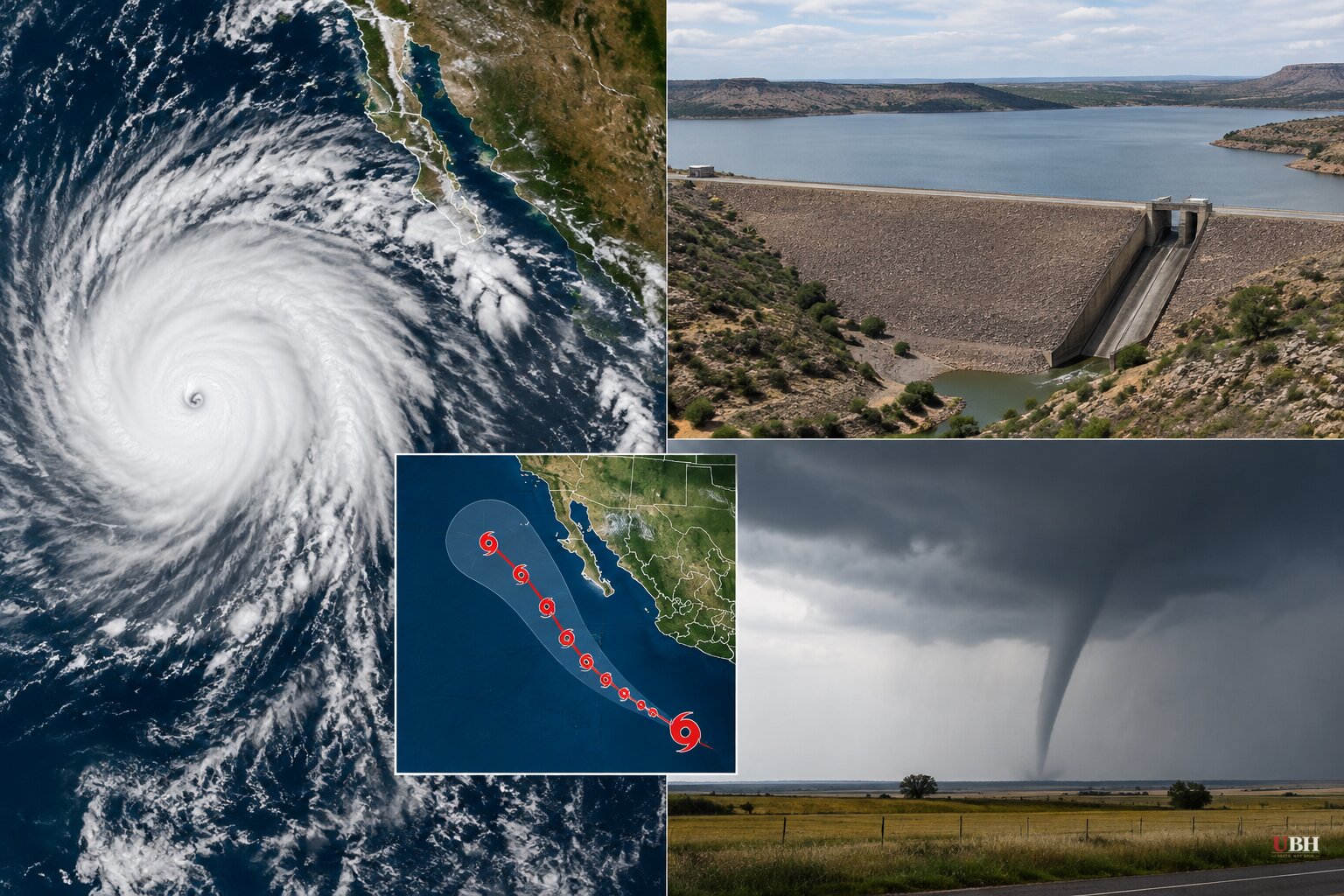
Hurricane Rachel Forms Off Mexico as New Mexico Dam Holds and Tornadoes Hit the Plains
Dam holds, but the chile crop didn't
The earthen flood-control structure in Dona Ana County, New Mexico, that came close to overtopping after Hurricane Polo's remnants dumped record rain on the state has held without failing, county officials said, according to the Associated Press. Water stopped spilling over the structure as the weather cleared, and most of the roughly 100 people who sought shelter from potential flooding were back home by midweek.
Acting Gov. Howie Morales declared a state of emergency that freed up $3.75 million in state funds for local governments to cover temporary housing, healthcare, food and transportation for people affected by the flooding.
The rain that nearly breached the dam also wrecked New Mexico's signature red chile crop right at harvest time. "There will be nobody picking chile for at least five or six days," said Preston Mitchell, a board member of the Hatch Chile Association. "All these growers whose fields were flooded, everything's toast. Everything that's out there is done." National Weather Service meteorologist Greg Lundeen said standing water remained in fields and near homes even after the storm moved on, and the long-dry Rio Grande was running over its banks through parts of the state.
A third hurricane, Rachel, spins up
Forecasters announced Hurricane Rachel this week, the latest in a string of East Pacific storms this season. Rachel is expected to intensify rapidly and could become a major hurricane with sustained winds above 111 mph, according to the National Hurricane Center. As of midweek the storm sat roughly 200 miles west-southwest of Cabo Corrientes, Mexico, and posed no immediate threat to land, though authorities in the Mexican states of Michoacán, Colima and Jalisco remained on alert. Schools were closed in 30 municipalities in Jalisco as a precaution.
Rachel follows Hurricane Polo, which made landfall on the Baja California peninsula as a Category 3 storm before pushing remnant moisture deep into the U.S. Southwest and Plains, and Hurricane Nolo, which earlier threatened Hawaii's Big Island with rainfall forecasts as high as 25 inches before President Trump approved a federal emergency declaration for the state.
Tornadoes and flash floods hit the Plains
The tropical moisture feeding into the central U.S. triggered an outbreak of flash floods and tornadoes this week, CBS News reported, with meteorologist Rob Marciano noting more thunderstorms were expected to follow Wednesday's outbreak. A storm in Amarillo, Texas, flooded streets and spawned a tornado, with storm totals topping 3.5 inches in the area, according to the Associated Press. Parts of Colorado, the Great Plains and Iowa saw up to 2 inches of rain in a single day.
Meteorologist John Baranick of DTN said the remnants of Polo were forecast to merge with a cold front and track northeast through the Midwest, bringing 2 to 4 inches of rain in a band stretching from Texas and Kansas to the Ohio Valley, with heavier totals possible under embedded thunderstorms. Baranick said the rain could offer drought relief in some areas but also carries serious flash-flood risk where ground is already saturated.
Farther west, remnant moisture from yet another storm, Hurricane Odalys, was expected to bring brief showers to San Diego and Orange counties in Southern California, according to independent forecaster Daniel Swain, though he said hurricane remnants should largely stay clear of California over the next week.
Is this really a record season, and does the scale need a Category 6?
2026 has been historically active in the East Pacific. Swain's analysis puts the basin's accumulated cyclone energy, a measure of combined storm strength and duration, at about 230% of the average for the calendar date, which he called a record. Three hurricanes, Lala, Lowell and Nolo, passed within 50 miles of Hawaii this season, the first time that has happened twice or more in recorded history, Swain's analysis found.
This activity revived a debate, highlighted by Breitbart's reporting, over whether the five-category Saffir-Simpson scale still captures what storms like Polo are capable of. Polo hit Category 5 strength three times, becoming the first recorded Eastern Pacific storm to do so, and one meteorologist told the Daily Mail "if there will ever be a Category 6, then you're looking at it now." NASA atmospheric scientist Gary Partyka described Polo's intensification as "RAPID, rapid intensification."
The National Hurricane Center has not proposed adding a sixth category, and the current scale already labels Category 5 storms as capable of "catastrophic damage," the top practical warning level regardless of exact wind speed. Critics of expanding the scale argue it wouldn't change evacuation orders or building codes, since Category 5 already triggers the strongest public warnings; proponents counter that a storm with 180 mph winds, as Polo reached at its peak, communicates a different level of danger to the public than one barely over the 157 mph Category 5 threshold. No change to the official scale has been announced.
Rachel's track and strength remain uncertain, and the National Hurricane Center has not yet issued a landfall forecast. Mexican officials in Jalisco, Colima and Michoacán are watching the storm's development through the end of the week.
Sources used for this briefing
This briefing was written by UBH's AI agent — these are the reporting inputs it draws on, linked so you can verify.


