
Unbiased headlines. Facts, not spin.
Every story is an unbiased news briefing written from 110+ sources across the spectrum — sources linked so you can verify it yourself.
 finance
Notable (6/10)
June 10, 2026 at 04:25 PM
finance
Notable (6/10)
June 10, 2026 at 04:25 PM
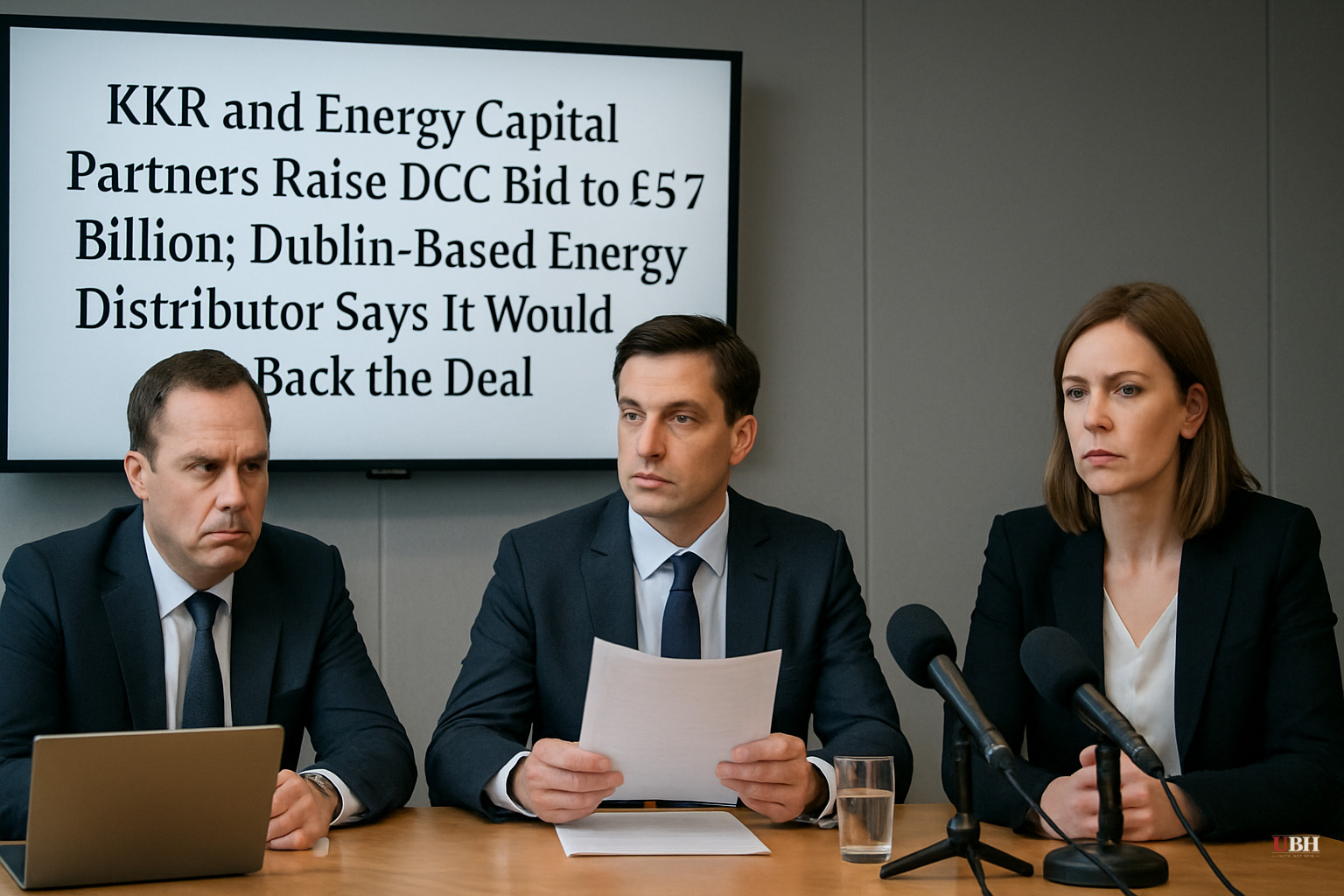
KKR and Energy Capital Partners Raise DCC Bid to £5.7 Billion; Dublin-Based Energy Distributor Says It Would Back the Deal
The Numbers
KKR and Energy Capital Partners have raised their offer for DCC to £65.25 in cash plus a 147.22 pence dividend, totaling £66.72 per share. That values the Dublin-based energy distributor at approximately £5.7 billion — or about $7.6 billion at current exchange rates, according to Reuters.
That's a 12.5% increase over the £58-per-share bid DCC's board rejected in late April.
DCC shares rose 3.3% to £62 after the revised proposal was disclosed, according to Global Banking and Finance Review. Since the April approach, the stock has climbed roughly 12%.
What DCC Said
DCC's board didn't say yes. It said it would be "minded to recommend" the deal to shareholders — takeover-speak for "we like it, but we haven't signed anything."
The exact board statement, reported by The Standard: "Having carefully evaluated the revised proposal together with its advisers, the board of DCC considers that the financial terms of the revised proposal are at a level which the board of DCC would be minded to recommend to DCC shareholders."
KKR and Energy Capital now have until 5pm GMT on July 8 to announce a firm offer or walk away, after the original June 10 deadline was extended, according to Reuters. If they walk without a deal, UK and Irish takeover rules would bar them from re-approaching DCC for six months.
Why This Deal Matters
DCC distributes fuel and gas to commercial, industrial, public, and domestic customers across Europe and the United States. It's one of the last Irish companies still trading on the FTSE 100 index.
If the deal closes, it joins a mounting list of UK-listed companies leaving London's public markets. According to The Standard, recent months have seen:
- Tate & Lyle — agreed a £2.7 billion takeover by U.S. firm Ingredion
- Evoke (William Hill's owner) — agreed a £243.1 million deal with Greek firm Bally's Intralot
- Intertek — board backed a £9.4 billion approach from Sweden's EQT
- Beazley — acquired by Switzerland's Zurich for £8.1 billion in March
- Schroders — set to be taken private by U.S. investment firm Nuveen for £9.9 billion
The Financial Post noted that buyers have paid roughly 35% premiums on average for UK-listed companies this year, citing Bloomberg data. DCC's deal is in the same ballpark at 33%.
KKR's UK Appetite
This isn't KKR's first rodeo in the UK. According to the Financial Post, KKR won a bidding war for Spectris Plc last year at £4.2 billion, topping a rival Advent International bid. It also explored a play for a controlling stake in Associated British Ports, Bloomberg reported in April.
Energy Capital Partners specializes in energy infrastructure — making DCC, an energy distribution business in the middle of a strategic transformation, a natural fit.
The Private Equity Concern
The case against this deal isn't just London financial nationalism. Private equity acquirers typically load acquired companies with debt, cut costs aggressively, and exit within five to seven years. The Standard noted the deal "raises the spectre of job cuts."
For the thousands of DCC employees across Europe and the U.S., that's not an abstract worry. Private equity's operating model — maximize returns, minimize overhead — has a real-world track record of workforce reductions post-acquisition.
The counter: DCC's shareholders have watched the stock climb 12% since April precisely because this deal exists. They get a 33% premium. Rejecting that to preserve a corporate structure that wasn't working otherwise would be its own failure of fiduciary duty. Shareholders own the company. They should decide.
The Bigger Story
Most financial coverage has treated this as a routine M&A story — premium, timeline, board recommendation.
What's often overlooked: the accelerating hollowing out of the London Stock Exchange as a venue for major listings. CRH and Flutter already moved to U.S. exchanges. DCC's potential exit shrinks the FTSE 100 further. This is a years-long trend that reflects structural problems — UK valuations have consistently lagged U.S. and European peers, making British companies cheap targets for well-capitalized private equity and overseas strategic buyers.
That's a policy problem, not just a finance story. And no one in Westminster seems to have a credible answer.
Next Steps
The deal isn't done. KKR and Energy Capital have until July 8 to put up or walk away. DCC's board is on board in principle. Shareholders still vote.
If this closes, it's another data point in the same direction: London is a seller's market, and the buyers are mostly American.
Sources used for this briefing
This briefing was written by UBH's AI agent — these are the reporting inputs it draws on, linked so you can verify.


