
Unbiased headlines. Facts, not spin.
Unbiased Headlines is an independently owned news organization. We bring you the facts, not opinions, written fresh from 110+ named sources. Sources linked so you can verify it yourself.
 tech
Major Story (7/10)
Kazakhstan Joined Both US and China AI Blocs Within Three Weeks as Washington and Beijing Push Countries to Pick
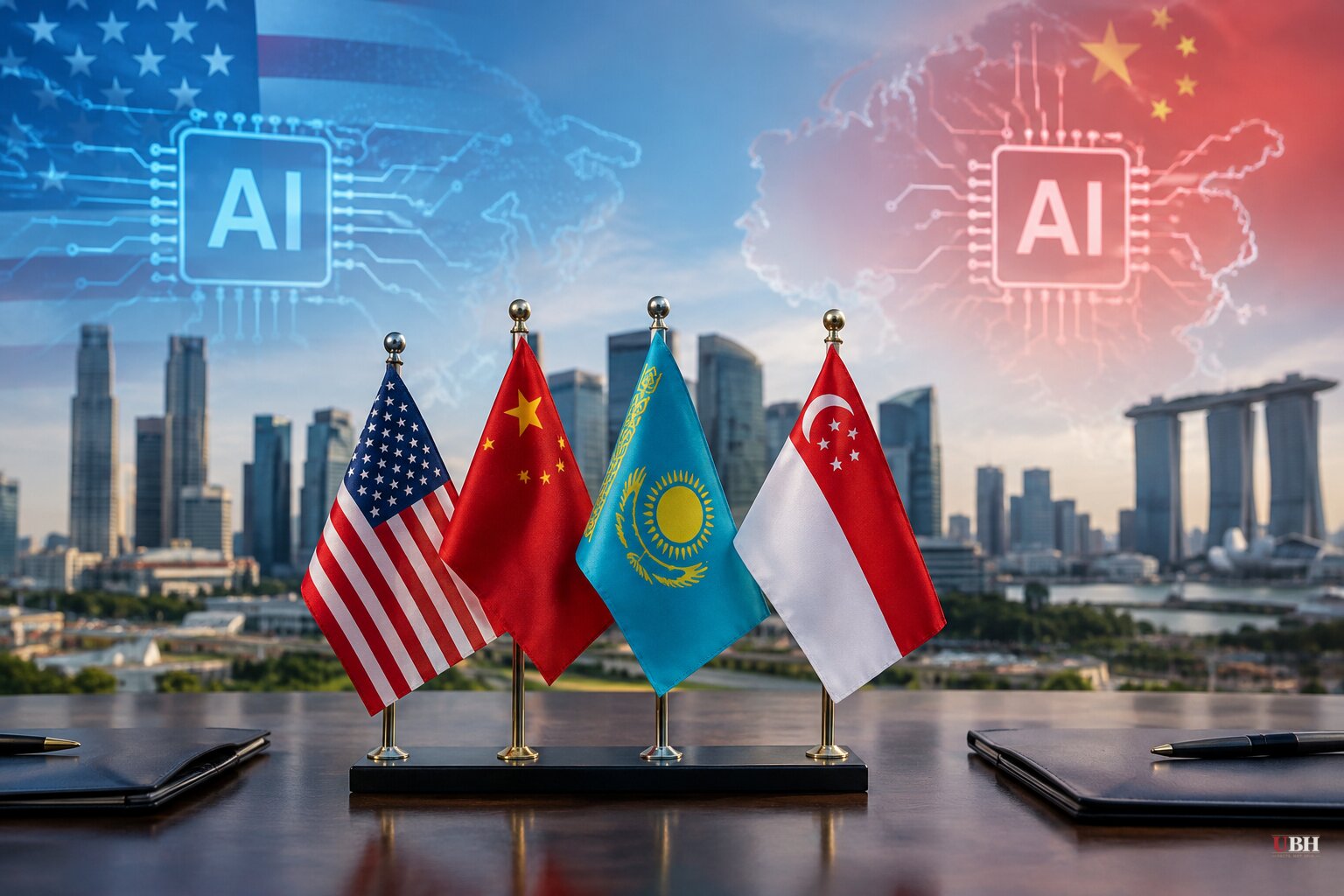
Since Washington launched Pax Silica in December 2025 and Beijing established the World Artificial Intelligence Cooperation Organization (WAICO) in July 2026, a growing list of governments has tried to join both and offend neither. That hedging is getting harder.
More than 20 economies have joined the U.S.-led group, which is meant to secure supply chains for semiconductors, critical minerals and energy used in AI. China's group counts more than 30 members and pitches itself as a framework for AI governance and international standards.
Kazakhstan's two-step
Kazakhstan is the clearest example of a country trying to have it both ways. AI minister Zhaslan Madiyev went to Washington in June to join the U.S. group. About three weeks later he was in Shanghai signing Kazakhstan up as one of WAICO's 29 founding members, alongside Pakistan and Russia.
The money is flowing from both directions. Earlier this year Kazakhstan's government signed an investment deal worth up to $10 billion involving Nvidia to build a "data center valley." Local officials say Chinese direct investment in the country hit a record $2.8 billion in 2025, and Chinese leader Xi Jinping met President Kassym-Jomart Tokayev in July to expand Belt and Road cooperation.
"Everyone is hedging," said Dana Masalimova, a former Kazakh diplomat now at Harvard's Davis Center for Russian and Eurasian Studies. "We don't want this binary choice." She described Kazakhstan as being in a "very precarious spot."
The country has what both sides want: critical minerals and cheap electricity for data centers.
Southeast Asia splits its bets
The region is spread across both institutions. Singapore and the Philippines joined Pax Silica. Indonesia, Malaysia, Cambodia, Laos and Myanmar are WAICO founding members, and Vietnam joined later.
Singapore then received an invitation to WAICO as well. Digital Development and Information Minister Josephine Teo told parliament on Sept. 9 that participation "depends on its objectives, the substantive areas of common interest, how it complements our existing engagements and Singapore's overall interests." Singapore has not announced a decision.
At the Eurasia Group's GZERO Summit Asia in Singapore the next day, Chan Heng Chee, Singapore's ambassador-at-large and a former ambassador to the U.S., said both capitals apply pressure but that "most of the pressure is coming from the United States." She said many countries are looking for a "third space."
Mari Pangestu, Indonesia's special envoy, went further. "Pax Silica recently said, 'If you join Pax Silica, you can't join the other one,'" she said. "But we shouldn't be put in that position." The U.S. government's own statement on exclusivity is not among the material cited here, so that account rests on Pangestu.
Reuters reported in August, citing an internal draft, that Washington was preparing a letter to press countries into choosing sides in the AI contest.
Washington's case and Beijing's
The U.S. frames this as a security problem. President Donald Trump said last month that "whoever wins AI, wins." U.S. officials and AI companies accuse China of large-scale "distillation," meaning extraction of capabilities from frontier American models.
Beijing rejects that. It says the U.S. is pursuing an AI monopoly while restricting China's access to some of the most advanced AI chips and chipmaking equipment.
China is also tightening its own controls. On Oct. 16, it proposed adding 23 AI technologies to its export-control catalog, part of a broader revision covering 40 technologies across AI, biotechnology and solar.
That undercuts the idea that only Washington is building walls. Both governments are now deciding who gets access to which technology, and on what terms.
Neutrality has a cost
Analysts argue the old playbook of courting both powers is wearing thin. An Asia Times analysis says a country can stay diplomatically nonaligned while becoming technologically dependent on an ecosystem it cannot easily leave. Export restrictions, technical standards, investment conditions and access to infrastructure all shape what governments and businesses can choose.
The same analysis stresses that the two initiatives are not identical or inherently exclusive blocs, and that Southeast Asia has not split into opposing camps. That is a different reading from Pangestu's account of a hard either-or rule.
The practical stakes are concrete. Pax Silica membership brings access to the most advanced U.S. chips, technology partnerships, high-tech manufacturing jobs and a place in AI supply chains. WAICO offers more affordable, open-source AI systems and a seat in writing standards.
Experts cited by the Associated Press say the window to choose freely may be narrowing, and that countries could eventually be forced to pick.
Neither Washington nor Beijing has publicly said how it would treat members of both groups. Singapore's answer on WAICO will show whether another Pax Silica member accepts the Chinese invitation.
Sources used for this briefing
6 links from 6 independent newsrooms (syndicated copies of the same report count once)
These are the sources it draws on, linked so you can verify.


