
Unbiased headlines. Facts, not spin.
Unbiased Headlines is an independently owned news organization. We bring you the facts, not opinions, written fresh from 110+ named sources. Sources linked so you can verify it yourself.
 tech
Notable (6/10)
Event date: September 30, 2026 ·
Tech Billionaires Gained $845 Billion Through September While All Other Top-500 Fortunes Lost $62 Billion
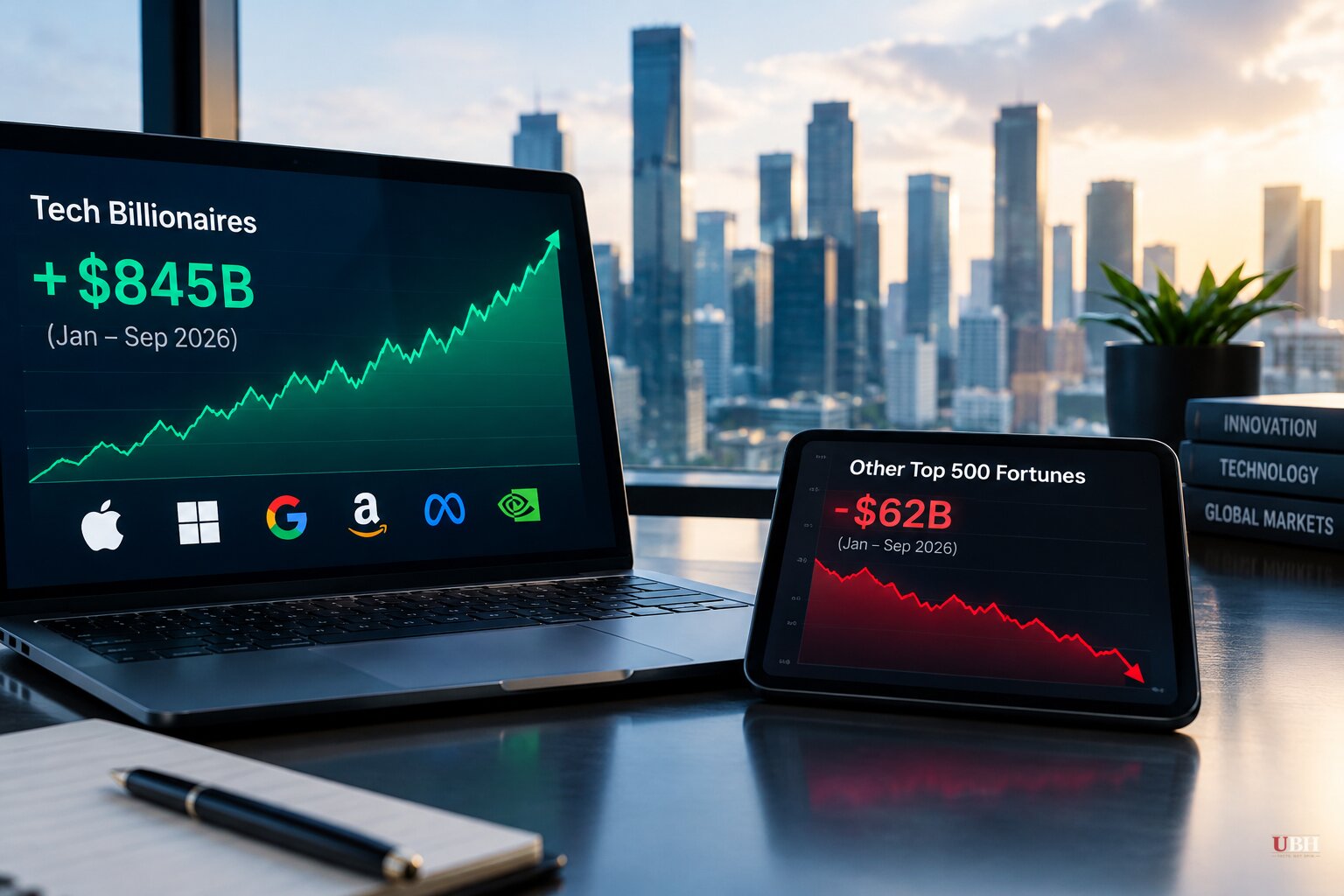
The AI boom has made the richest people in the world richer at a pace the Bloomberg Billionaires Index has never recorded. About 100 tech billionaires in the global top 500 gained a combined $845 billion from January through September 30, 2026, the most ever for that period.
Everyone else on the list went the other way. Fortunes outside tech shrank by a combined $62 billion.
Where the money went
Tech fortunes on the index now total about $4.6 trillion. That is 36% of the wealth of the top 500, even though tech founders make up only about a fifth of the group.
Elon Musk is the biggest winner by a wide margin. Bloomberg's data show his net worth rose $310 billion from January through September, roughly 40% of the total gain among the top 500. He sat at $977 billion in October. After the merger of SpaceX with xAI and the SpaceX IPO, he briefly became the first trillionaire.
Michael Dell posted the second-largest dollar gain behind Musk, $89.1 billion, riding demand for data-center hardware. His fortune is up 81% this year.
Mark Zuckerberg added $23 billion after Meta's stock jumped 27% in September following the launch of its AI assistant, Muse.
Americans captured 94% of the net gains. For the first time since Bloomberg began tracking in 2012, all ten of the world's richest people are based in the US.
Not every AI bet is paying
Larry Ellison has lost $196 billion within a year, after briefly becoming the world's richest person in September 2025. Investors are worried about Oracle's debt-financed AI infrastructure spending, and the cost of credit default swaps on Oracle bonds is near a record high. Oracle cut thousands of jobs this spring as the investment pressure built.
The party has also cooled. The combined wealth of the 500 richest people peaked at $13.4 trillion in mid-June and has since fallen 6% to $12.6 trillion.
The new AI fortunes
Bloomberg's data also show 17 newcomers to the global rich list from AI in the US and China. Their combined wealth rose $87 billion in the first nine months to $221 billion.
Twelve Americans account for $132 billion of that, up $44 billion. Seven of them are Anthropic co-founders. The company was valued at about $965 billion in a June 2026 funding round.
Five Chinese entrepreneurs added $43 billion for a cumulative $89 billion. They include Yan Junjie of MiniMax and Liang Wenfeng of DeepSeek. The Chinese group is less than half the size of the American one, yet its gains came within a billion dollars of matching it.
That should get attention in Washington. China is the main strategic rival in AI, and these figures show its model builders are being rewarded on nearly the same scale.
The wealth also reaches beyond the model labs. Lin Tsung-chi, founder of Taiwanese server supplier King Slide, has joined the billionaires' club on the AI hardware buildout.
Money and politics
The same class is spending heavily on the 2026 midterms. Top 15 donors have supplied more than $1.5 billion to this cycle, according to an AFP analysis of FEC data. The cycle is on track to be the most expensive midterm in US history.
Musk leads individual donors. The Hill, citing America PAC and FEC data, put his giving at about $366 million as of mid-October. Other tallies run higher, with Futurism putting it above $445 million for Republican campaigns. Later filings could move the number.
Leading The Future, a super PAC backed by OpenAI and Palantir co-founders and venture capitalists including Marc Andreessen, has amassed $140 million to support pro-AI candidates.
Billionaire giving is not one-sided. Americans for Tax Fairness estimates about $1.7 billion in 2026 spending from billionaire families, with roughly 69% going to Republican candidates or causes. That is the advocacy group's own estimate, and its methodology has not been independently confirmed.
Voters are not buying it
Public opinion is running the other way. A July POLITICO poll by Public First of 2,061 US adults, with a margin of error of about 2.16 points, found more than half believe billionaires should pay substantially more in taxes.
A separate POLITICO/PF Global poll found voters favor ending AI data-center tax incentives over creating new ones by roughly two to one. It also found 47% of voters associate Republicans with technology tax breaks, against 21% who say the same of Democrats. That reflects voter perception, not a count of which party has enacted more of them.
Guardrails Action, an AI accountability advocacy group, surveyed more than 3,000 likely voters in Iowa, Michigan and Ohio, where close Senate races are underway. Three quarters said they would be less likely to back a candidate who took money from an AI super PAC. A quarter said they would switch parties to vote for a candidate who took a strong stand against AI companies and data-center construction.
"We found that the AI Super PACs were more toxic with voters than Wall Street, cryptocurrency or AIPAC," said Charles Blaettler, political director of Guardrails Alliance, the group's PAC arm. Guardrails is an advocacy organization with a stake in the issue, so its numbers are its own.
The tax fight
The wealth is drawing legislative attention. California voters will decide a wealth tax on billionaires in November. Washington, New York, Illinois and Rhode Island have debated similar proposals.
James Mazeau, an economist at UBS, points to the other side of the ledger: many of the largest fortunes belong to relatively young tech entrepreneurs, whose wealth could keep compounding for decades.
The dollar figures here are paper wealth tied to share prices and private-round valuations. Bloomberg's own data show the top 500 are already down 6% from their June peak. The California vote in November is the first test of whether voters will turn their stated appetite for taxing that wealth into law.
Sources used for this briefing
7 links from 7 independent newsrooms (syndicated copies of the same report count once)
These are the sources it draws on, linked so you can verify.


