
Unbiased headlines. Facts, not spin.
Unbiased Headlines is an independently owned news organization. We bring you the facts, not opinions, written fresh from 110+ named sources. Sources linked so you can verify it yourself.
 tech
Notable (6/10)
Event date: October 23, 2026 ·
Tesla Says It Needs 10,000 to 20,000 Optimus Robots to Train Themselves, Starts Fremont Production
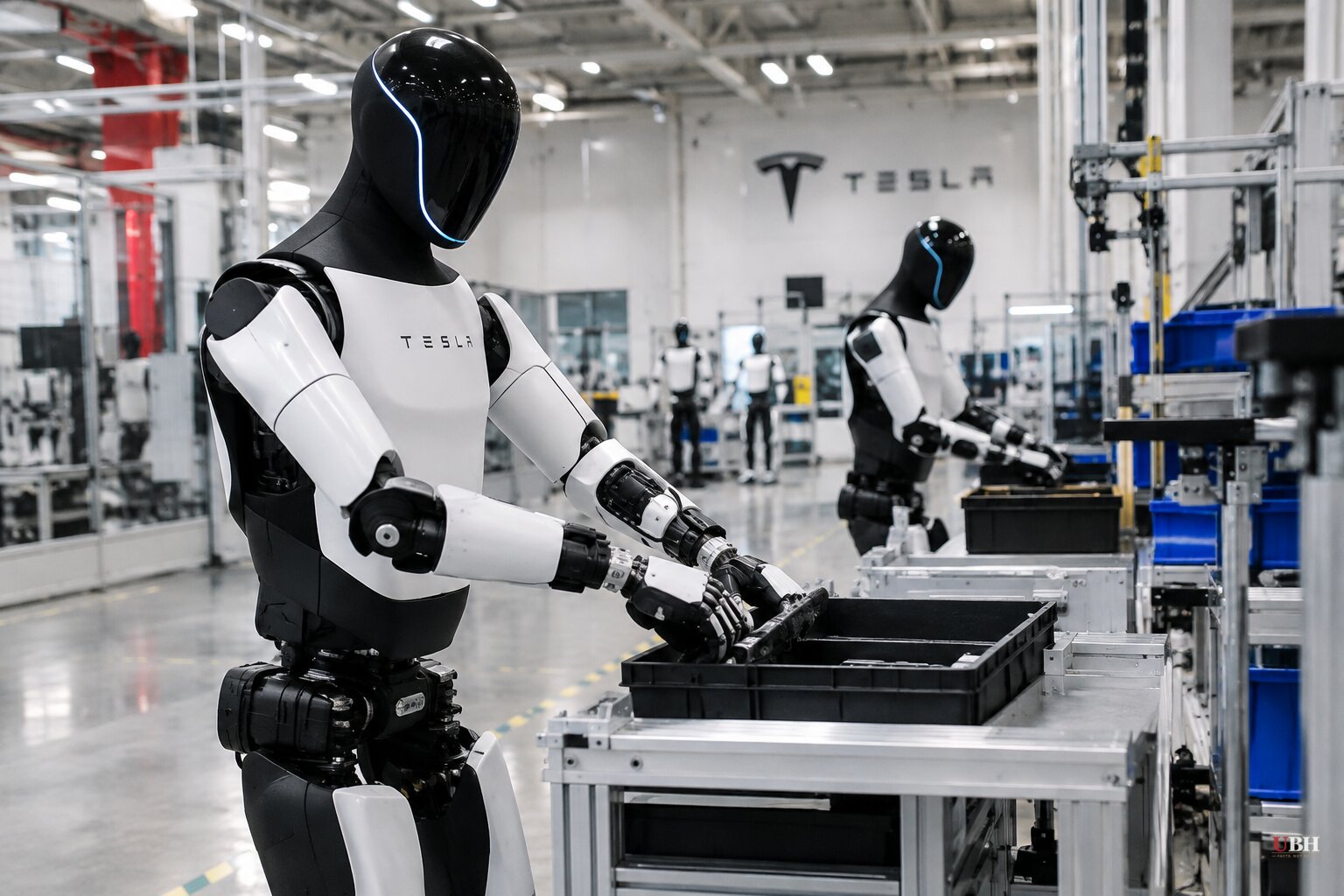
Tesla has a data problem with its humanoid robot, and its answer is to build a small army of them.
On the company's third-quarter earnings call on Wednesday, Oct. 21, Elon Musk described an "Optimus Academy." The idea: thousands of Optimus units practice a wide range of tasks, and what they learn goes into the next version of the AI.
"For Optimus to get the training data we need, we actually need to make a lot of Optimi," Musk said. "So we need to make, I think, on the order of 10,000 or 20,000 bots and then have them do self-play."
Why Tesla needs a school
Tesla's driving software learns from millions of cars on the road. Optimus has no such fleet.
"A big difference with Optimus versus the cars is we don't have this vast fleet of cars from which we can gather training data," Musk said. Ashok Elluswamy, who leads Tesla's AI software team, said the robots will first learn by watching humans do tasks. "We have to bootstrap it by making the robots and having them do self-play, which is really how a human learns to navigate the world," he said.
Musk compared it to raising a toddler, with a crude example about potty training. "They learn this by playing," he said. "And we actually need Optimus to play at scale in order to have it be really good at tasks in the real world."
Tesla is not alone in this. Texas-based Apptronik has set up its own "data factories" where robots load conveyor belts and sort objects to generate training data.
Business Insider reported earlier this month, citing people familiar with the matter, that trainers at Fremont wear camera-equipped helmets to record tasks for Optimus to learn from. Tesla has not publicly addressed that report.
Production has started, slowly
Tesla says it has begun building Optimus on a high-volume line inside its Fremont, California factory. The space built the Model S and Model X until this spring.
"The bots coming off this line are the first production-quality bots that we have manufactured," Tesla wrote in its third-quarter shareholder letter. The company added that it has proven the current manufacturing process is suitable for a commercial product.
The line is sized for one million robots a year, and Musk said most of the equipment is already in Fremont. He described the ramp as an S curve with a shallow start. "The growth of Optimus is an S curve, but the initial curve is a shallow slope," he said.
Reaching 20,000 robots a week is a separate and far bigger number than the 10,000 to 20,000 Academy fleet. Musk said that rate will take at least another year because parts of the design are still being refined. Tesla has not said how many Optimus units have come off the Fremont line so far.
Musk was frank about the difficulty. "There's like 10,000 things that have to go right for production of the robot, and it'll move as fast as the slowest, least likely of the 10,000," he said. He called production "somewhat bumpy."
The hand problem
The hardest piece is the hand. "It's hard to make a hand that can handle lots of wear and tear but is still squishy enough to pick up delicate objects," Musk said. He also listed AI capable of handling open-ended tasks among the main hurdles.
The near-term hardware timeline:
- Tesla plans to put its AI5 chip into Optimus around April 2027. Musk said it should offer roughly 10 times the computing power of the current AI4.
- A new video showing Optimus doing AI-driven tasks rather than preprogrammed motions is expected within one to two months. Musk said rival humanoid demos that run only scripted routines would not hold up in the real world.
- Tesla targets deliveries to outside companies by the end of 2027, for dangerous, repetitive and round-the-clock jobs.
- A larger Optimus factory is under construction at Giga Texas. Musk has put its long-term target at 10 million robots a year.
Tesla executives also said Optimus production costs are trending toward the expected manufacturing cost of the Cybercab. In September, Tesla certified Tuopu, Joyson and Sanhua as mass-production partners for Optimus components.
What is promised and what is proven
The 10,000-to-20,000 figure is an estimate, not a firm commitment. TradingView's analysis of the call described it as "not a production target or confirmed prerequisite for deployment," and said Musk's comments "outline a proposed approach, not proof it already works at scale." Tesla itself said the production ramp is at an early and challenging stage.
That leaves the plan resting on a loop that has not yet been shown. Robots have to be built in volume, practice tasks usefully, and produce data that measurably improves the next model. Tesla has so far offered Musk's description of that loop, not results from it.
The next checkpoint is the AI-driven task video Musk said should arrive within one to two months of the call. It will show whether Optimus can do work that was not scripted in advance.
After that comes the AI5 chip integration in April 2027, then the end-of-2027 target for the first deliveries to outside customers.
Sources used for this briefing
7 links from 7 independent newsrooms (syndicated copies of the same report count once)
These are the sources it draws on, linked so you can verify.


