
Unbiased headlines. Facts, not spin.
Unbiased Headlines is an independently owned news organization. We bring you the facts, not opinions, written fresh from 110+ named sources. Sources linked so you can verify it yourself.
 tech
Notable (6/10)
Event date: October 23, 2026 ·
Shapiro Signs Pennsylvania AI Ad Disclosure Law; Key Terms Left Undefined
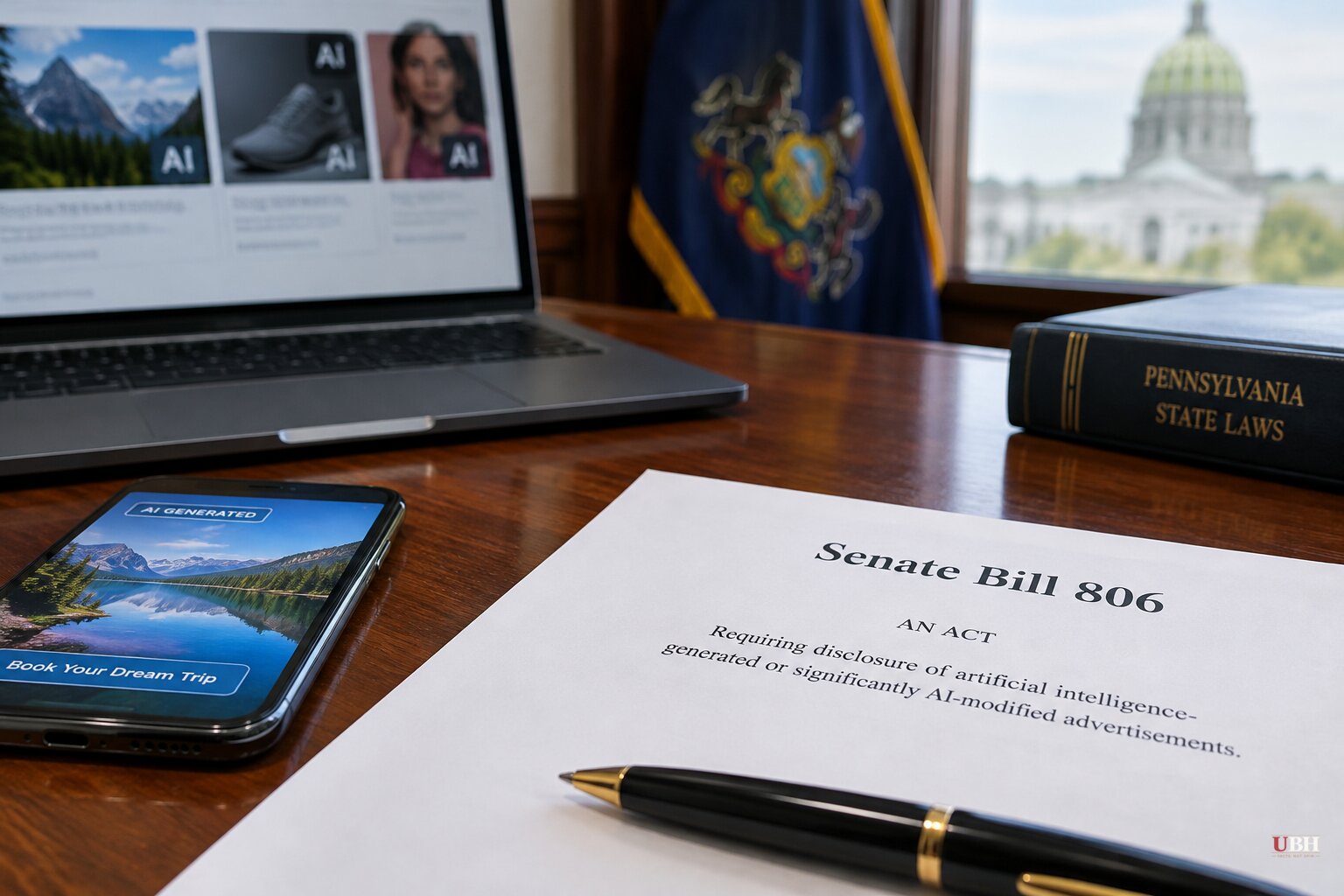
Pennsylvania now has a law requiring disclosure of AI in advertising. It is also a law whose own sponsors describe it in different ways.
Gov. Josh Shapiro signed Senate Bill 806, the Artificial Intelligence Deceptive Advertising Act, on Thursday, Oct. 22. It was one of 58 bills he signed that day. The law takes effect 60 days after signing.
What the law says
The core rule is one sentence. An advertiser "may not create and disseminate or cause to be created and disseminated an advertisement that uses synthetic content in a manner that creates a false consumer perception about the nature, origin or authenticity of the goods or services being advertised, without clear and conspicuous disclosure."
The disclosure must state that the ad contains content modified or generated using artificial intelligence. The law covers still images, video, audio and text that have been "significantly modified or generated by artificial intelligence," with the label in the same format as the ad.
It applies to anything shown in Pennsylvania, even if it was made elsewhere. That means national TV spots could carry labels because they air in the state.
Exemptions cover "parody, satire, commentary or criticism" and material that is "evidently fictional." Sen. Nick Pisciottano, the Allegheny County Democrat who sponsored the bill, said political ads are not covered.
Who enforces it
The Attorney General and county district attorneys can seek injunctions and bring civil actions. A court can impose a civil fine of up to $3,000 per violation and award attorney fees and costs, according to the bill's terms. There is no separate private lawsuit for consumers.
Pisciottano told CBS Pittsburgh's KDKA that penalties include a fine "and even potential jail time." The bill's enforcement section, as summarized by the Ginsburg Law Group, describes civil remedies. The statute puts the duty on "an advertiser." Pisciottano said punishment would fall on companies, not individual users.
The law also states that a disclosure does not limit any other legal remedy. A label is not a shield.
Broad pitch, narrow text
Pisciottano has described the law broadly. On the Senate floor he said Pennsylvanians "deserve to know whether the ad they are hearing or viewing was created by a person or generated by AI." He told KDKA that an AI-generated ad on Facebook must carry a disclaimer.
His office's press release used an example of an AI image "that could lead consumers to believe they are seeing an actual product." He said consumer groups representing older residents told him seniors were being scammed by fake AI advertising.
The enacted language is narrower. Disclosure is triggered only when synthetic content creates a "false consumer perception." A co-sponsor described the standard as aimed at AI content that makes a product "appear better than it is."
Another senator objected on the floor that the bill "does not tell us false as compared to what," according to the law firm Loeb & Loeb. Neither chamber amended the language.
The vagueness problem
Loeb & Loeb says the text leaves open whether a label is required any time AI depicts a product, or only when the ad otherwise misrepresents it. The firm notes that a misleading ad is likely already illegal under Pennsylvania's Unfair Trade Practices and Consumer Protection Law and Section 5 of the FTC Act, with or without AI, and that a label wouldn't cure it.
The Verge's Terrence O'Brien raised the same objections. "Significantly modified" is subjective, "evidently fictional" is unclear, and the text does not say who decides what counts as false.
The breadth cuts both ways for business owners. The sponsor's framing suggests that a restaurant posting an AI-generated photo of its wings could need a label. The statutory text suggests only a misleading depiction would. Anyone running ads in Pennsylvania has to guess which reading the Attorney General will adopt.
A violation also carries a risk at the other end. Under the law, a label doesn't stop other liability. A company that labels everything and still misleads customers remains exposed.
Politics and what comes next
The bill passed the Senate 48-2 in June and the House 163-40 on Oct. 7, so it had broad support from both parties. KDKA said it reached out to a Republican co-sponsor and did not hear back.
Pisciottano said the state moved fast. "There's only a couple other states that have these kind of requirements right now," he said, predicting that the federal government or many states will follow. Loeb & Loeb says the law follows similar New York and California statutes, though those concern "synthetic performers." Pennsylvania's reaches images, video and audio.
Shapiro framed the signing as a first step. "This was an important step in our effort to rein in this technology, but we need to do more," he said, citing worries about jobs, children's safety and elections. He called for "real guardrails" in law.
Pisciottano called the law a "major step for consumer protection" that "sets a commonsense transparency standard" while still letting businesses use the technology.
What is settled: the law takes effect in late December, and the Attorney General's office and county DAs will hold the enforcement power. What is not settled is the meaning of "false," which the legislature chose not to define. Pisciottano's office did not immediately respond to The Verge's request for comment on that point.
Sources used for this briefing
7 links from 7 independent newsrooms (syndicated copies of the same report count once)
These are the sources it draws on, linked so you can verify.


