
Unbiased headlines. Facts, not spin.
Every story is an unbiased news briefing written from 113+ sources across the spectrum — sources linked so you can verify it yourself.
 health
Notable (6/10)
September 22, 2026 at 01:49 PM
health
Notable (6/10)
September 22, 2026 at 01:49 PM
Karolinska Study of 3.7 Million Swedes Links Rare Womb Infections to Higher Autism and Intellectual Disability Risk
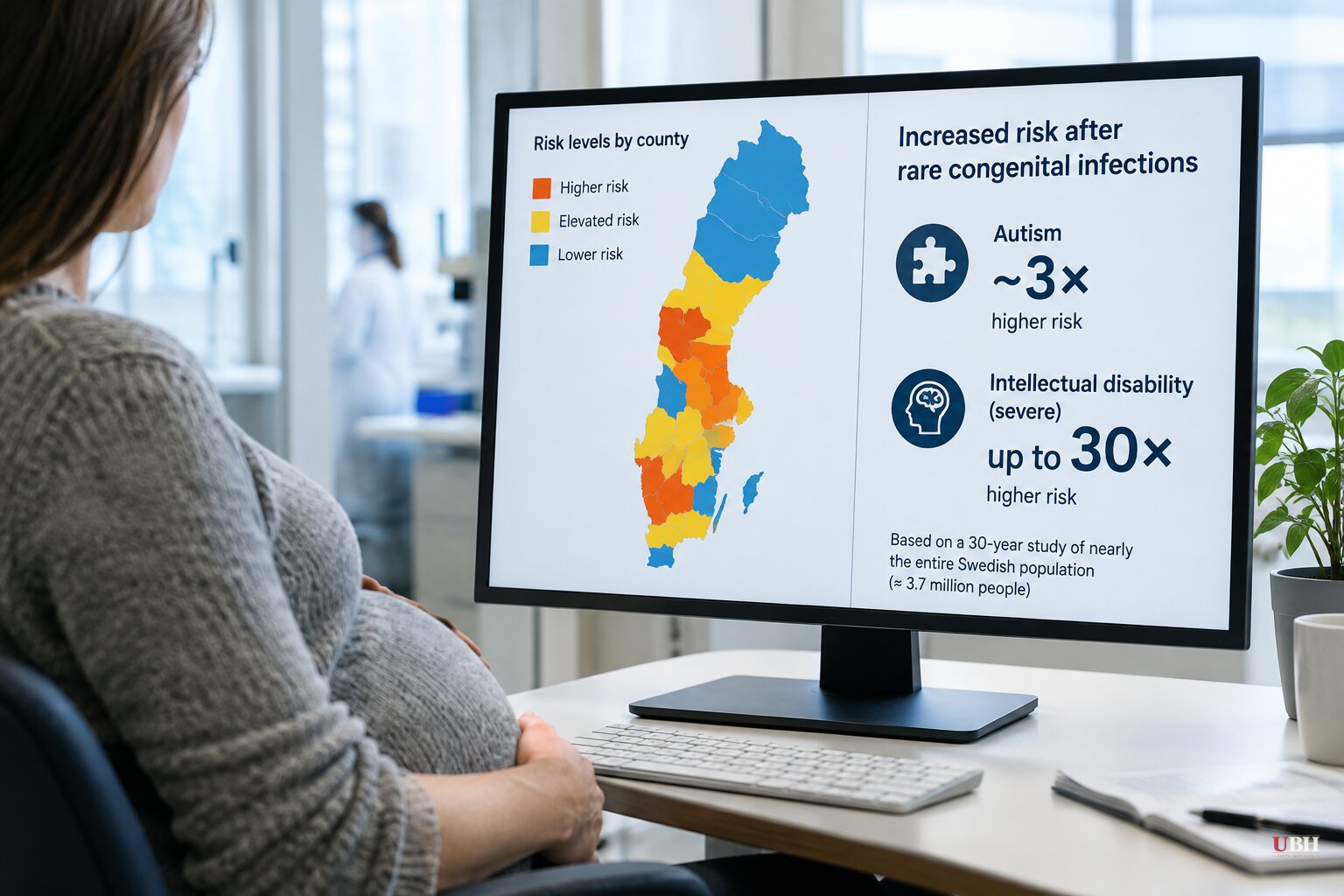
Researchers at Sweden's Karolinska Institutet tracked 3.7 million people born between 1987 and 2021 and found that children infected in the womb with a group of pathogens known as TORCH infections face dramatically higher odds of autism and intellectual disability later in life. The study was published in JAMA Pediatrics.
TORCH is a medical acronym for Toxoplasma gondii, Others (including syphilis), Rubella, Cytomegalovirus and Herpes simplex virus. These pathogens can cross the placenta and infect a fetus directly, something most everyday infections a pregnant woman picks up cannot do.
Of the 3.7 million people in the study, 975 were diagnosed with a congenital TORCH infection at birth. Researchers followed them, and everyone else in the cohort, for up to three decades using Sweden's national health and education records.
The Numbers
Children born with a TORCH infection were about three times more likely to be diagnosed with autism and more than seven times more likely to be diagnosed with an intellectual disability, compared to children without the infection, according to the study. For the most severe cases, profound intellectual disability, the risk was up to 30 times higher.
The researchers estimate roughly one in five children born with a TORCH infection will later develop autism. Even kids who never got an autism or intellectual disability diagnosis showed the effects: 420 people in the study had a TORCH infection and performed poorly in school without either diagnosis, according to the study authors.
"It is important to emphasise that it is unusual for these infections to be transmitted from mother to child," said Reneé Gardner, a researcher at Karolinska Institutet's Department of Global Public Health and study co-author. "They account for a very small proportion of all cases of autism in the population, but for those children who are actually affected, we see a clearly elevated risk of both autism and intellectual disability."
Big Relative Risk, Tiny Population Impact
Because congenital TORCH infections are rare to begin with, they explain very little of the total autism and intellectual disability burden across Sweden. The researchers estimate TORCH infections account for about 1.2% of all severe intellectual disability cases nationwide and roughly 0.034% of all autism cases in Sweden.
A threefold or thirtyfold relative risk sounds terrifying, but if the underlying condition affects fewer than 1,000 people out of 3.7 million, the population-wide effect is small. Both things are true at once. The individual risk for an infected child is real and serious. The overall public health footprint of these infections is narrow because they're rare.
Ruling Out Other Explanations
To check whether genetics or home environment, not the infection itself, were driving the results, the researchers compared infected children directly against their own uninfected siblings. Hugo Sjöqvist, the study's lead author and a doctoral researcher at Karolinska Institutet, said the elevated risks held up in that comparison too, which points to the infections themselves as the driver rather than shared family background.
"It has long been known that these infections can cause intellectual disability," Sjöqvist said. "However, the link to autism has been less clear in previous research, which has often been based on small patient groups. This study is the largest to date in this field and is based on national register data covering almost the entire population of Sweden."
Prevention Is the Actual Headline
The most useful fact in this whole study: some of these infections are already preventable. Rubella is largely controlled in countries with routine childhood vaccination. Toxoplasmosis and CMV exposure can be reduced through basic hygiene and food-safety guidance during pregnancy. Syphilis is treatable with antibiotics if caught early.
Congenital CMV is the most common of the group globally, affecting about one in every 150 newborns, with a far heavier burden in low- and middle-income countries where prenatal screening is less available, according to the study authors.
The researchers also flagged a gap: even Sweden's health system, one of the most comprehensive in the world for tracking population health, likely misses asymptomatic TORCH cases at birth because universal newborn screening for these infections isn't standard practice. That raises an open question for health systems everywhere, including the United States, where routine universal newborn TORCH screening is not standard either. How many cases are going undetected, and would broader screening catch developmental risks early enough to matter for treatment or family planning?
Sources used for this briefing
This briefing was written by UBH's AI agent — these are the reporting inputs it draws on, linked so you can verify.


