
Unbiased headlines. Facts, not spin.
Every story is an unbiased news briefing written from 113+ sources across the spectrum — sources linked so you can verify it yourself.
 health
Notable (5/10)
September 22, 2026 at 02:55 AM
health
Notable (5/10)
September 22, 2026 at 02:55 AM
USC Study Finds Alcohol Use Fell in 2024, But Heavy Drinking Among 50-64 Year-Olds Jumped 36% Since 2018
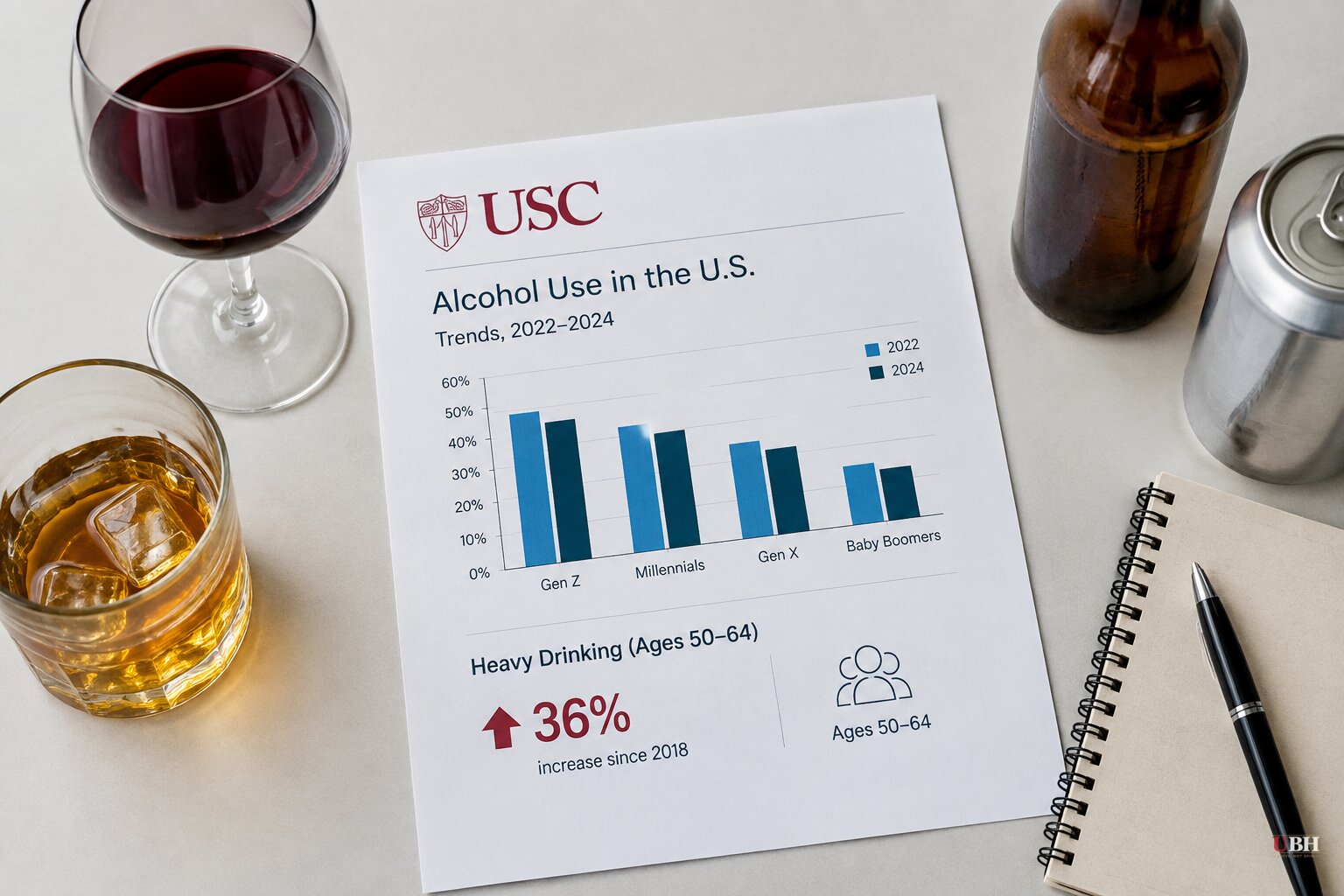
Americans, as a whole, drank a little less alcohol in 2024 than they did in 2022. That's the headline finding from a study published Monday, September 21, in the Annals of Internal Medicine, led by Dr. Brian P. Lee, a hepatologist and liver transplant specialist at Keck Medicine of USC in Los Angeles.
It's the first recorded dip in alcohol use since the Covid pandemic hit in 2020, according to Keck Medicine's own release on the study. Rates are still higher than they were before the pandemic, and one age group is drinking heavily at a rate that stands out in the data.
The Numbers
Lee's team pulled data from more than 114,000 respondents to the National Health Interview Survey, a CDC-run survey, across four years: 2018, 2020, 2022 and 2024.
From 2022 to 2024, any alcohol use dropped by nearly 2%, and heavy drinking fell more than 8%, according to Keck Medicine's release and CNN's reporting on the study. Men saw a bigger drop in any alcohol use than women (2.4% versus 1.1%), while women saw a bigger drop in heavy drinking than men (9% versus 7.7%).
Heavy drinking, per the study's definition, means five or more drinks a day or 15-plus a week for men, and four or more a day or eight-plus a week for women.
Gen Z, ages 18 to 29, posted the largest decline in any alcohol use, more than 5%, from 2022 to 2024. Millennials, ages 30 to 49, posted the steepest drop in heavy drinking, 17%, over the same span. Both generations, however, are still drinking slightly more than they were in 2018, before the pandemic.
The Group Going the Wrong Way
Adults ages 50 to 64 are the outlier, and Lee called it the most concerning part of the whole study. Any alcohol use in that age bracket rose nearly 4% from 2018 to 2024. Heavy drinking rose more than 36% over the same period, according to Keck Medicine's release.
"This 30% increase, that's about a million people drinking heavily in that age group alone," Lee told NBC News, using a rounded figure for the six-year climb.
Older livers don't bounce back the way younger ones do. "The average age of developing cirrhosis is in the 50s, and we know someone with a 50-year-old liver is more likely to develop liver scarring with the same quantity of alcohol as a 20-year-old liver," Lee said, according to NBC News. Alcohol-related liver disease is now the leading cause of liver transplants in the U.S., and yearly cancer deaths tied to alcohol have doubled over the past three decades.
Dr. Michael Siegel, a public health professor at Tufts University School of Medicine, told NBC News that heavy drinkers in their 50s and 60s have typically been drinking for years, which compounds the damage.
An Honest Caveat
Not everyone is ready to call this a turning point. Dr. Jagpreet Chhatwal, director of the Institute for Technology Assessment at Massachusetts General Hospital, who wasn't involved in the study, told CNN the decline is "an encouraging trend" but stopped well short of calling it a win. "Overall, I would not see this as a big victory in any way because the rates have been so high, even before the pandemic," Chhatwal said. Ground News reported Chhatwal separately called for "targeted behavioral interventions" specifically aimed at the 50-to-64 age group.
Lee himself was cautious about reading too much into a single data point. "Seeing this first decline gives you something to hope for as a doctor, but you have to be appropriately cautious too, because one change doesn't necessarily mean a sustained trend," he told CNN.
This is self-reported survey data covering just two data points, 2022 and 2024, and a roughly 2% national shift is small. Anyone skeptical that this represents a genuine cultural turn, rather than statistical noise inside a single survey cycle, has a fair point. The study itself doesn't prove why younger people are drinking less. Lee told CNN he didn't examine the cause directly, but floated the "sober-curious" movement and rising awareness of alcohol's health risks as possible explanations, along with people substituting alcohol for other things.
Coverage of the study was largely consistent across outlets, though NBC News's initial framing described the overall decline as "modest at roughly 1%," while Keck Medicine's own release and CNN both put the national drop in any alcohol use at "nearly 2%." The discrepancy appears to trace back to how each outlet rounded or averaged the separate male and female figures rather than any dispute over the underlying data.
None of this changes the basic math on the 50-to-64 group. That's roughly a million more heavy drinkers than would exist if the 2018 rate had simply held steady, according to Lee's own figures. Whether that trend keeps climbing, plateaus, or reverses in the next NHIS survey cycle is the open question Lee's team can't answer yet.
Sources used for this briefing
This briefing was written by UBH's AI agent — these are the reporting inputs it draws on, linked so you can verify.


