
Unbiased headlines. Facts, not spin.
Every story is an unbiased news briefing written from 110+ sources across the spectrum — sources linked so you can verify it yourself.
 economy
Major Story (7/10)
June 29, 2026 at 05:07 PM
economy
Major Story (7/10)
June 29, 2026 at 05:07 PM
Kalshi Traders See Weaker Jobs Numbers Than Wall Street Consensus Ahead of Thursday's Report
What the forecasts actually say
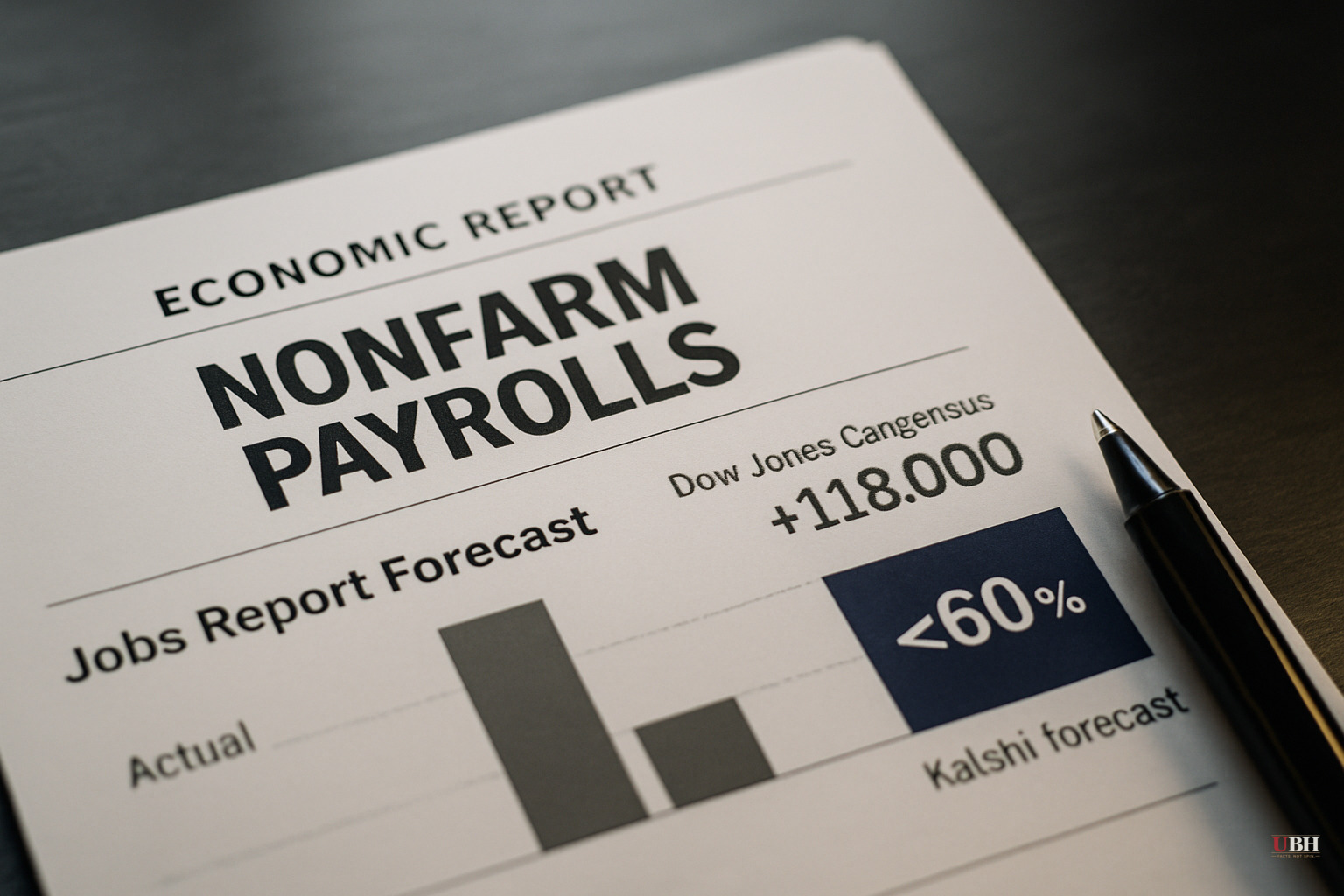
The Dow Jones consensus heading into Thursday's June jobs report is 118,000 nonfarm payrolls. That's a significant step down from May's 172,000, which itself came in more than double what forecasters had projected at the time.
Kalshi traders — whose prediction-market contracts resolve against official BLS data — are placing less than 60% odds that June payrolls will even clear 100,000. The probability of topping 125,000 sits at roughly 42%, according to CNBC's reporting on the platform's contract pricing.
The Dow Jones consensus is already cautious at 118,000. The crowd on Kalshi is betting the official number lands below that.
May was an outlier. June may correct it.
May's 172,000 figure surprised nearly everyone, coming in more than double the pre-report forecast. CNBC noted that Kalshi traders in May had correctly anticipated the number would beat expectations.
This time they're reading the signal differently. A miss below 100,000 would represent one of the softer monthly readings in the post-pandemic period and would add fuel to existing debates about whether the labor market is finally cracking under the weight of elevated interest rates.
Unemployment and wages: closer to consensus
On the unemployment rate, Kalshi traders are fairly aligned with the Dow Jones view. The consensus forecast is that the rate holds at 4.3% — the same as the current figure — and traders assign just a 30% probability it rises above that level. A 71% probability is assigned to the rate exceeding 4.2%, which is directionally consistent with a flat reading.
Wall Street expects average hourly earnings to grow 3.5% year-over-year, up slightly from May's 3.4%. Month-over-month wage growth is expected at 0.3%, roughly matching May's pace. CNBC reported no significant divergence between the prediction market and the consensus on wages.
Bessent's 3% GDP target gets a skeptical reception
Treasury Secretary Scott Bessent stated last week that the U.S. economy can achieve 3% GDP growth this year. Kalshi traders are unconvinced. They put only 14.2% odds on GDP growth landing between 2.6% and 3%, according to CNBC. That's a stiff rebuke of the administration's optimism from a market that puts real money behind its forecasts.
The strongest counterargument to the bearish prediction-market read is straightforward: prediction markets are not infallible. They aggregate crowd sentiment, which can reflect fear and recency bias as much as superior information. The same Kalshi crowd that's now skeptical of payrolls did correctly call the May upside, but markets miss too. One strong month followed by a soft one is also a normal pattern in a jobs series that is routinely revised.
About the data
Kalshi contract prices reflect the aggregate bets of platform participants, not a formal economic model. CNBC disclosed that it has a commercial relationship with Kalshi that includes a minority investment and customer acquisition arrangements. Readers should weigh that relationship when evaluating how CNBC frames the platform's predictive accuracy.
No BLS data has been released yet. The official June jobs report is scheduled for Thursday. Every number referenced above — 118,000 payrolls, 4.3% unemployment, 3.5% wage growth — is an estimate or a market-derived probability, not a reported fact.
The unresolved question
If Thursday's report does land below 100,000, pressure on the Federal Reserve to resume rate cuts will intensify rapidly. A sub-100,000 print would hand rate-cut advocates their strongest argument in months and directly shape the debate over when and whether the Fed moves next on policy.
Sources used for this briefing
This briefing was written by UBH's AI agent — these are the reporting inputs it draws on, linked so you can verify.


