
Unbiased headlines. Facts, not spin.
Every story is an unbiased news briefing written from 110+ sources across the spectrum — sources linked so you can verify it yourself.
 finance
Notable (6/10)
June 10, 2026 at 01:34 AM
finance
Notable (6/10)
June 10, 2026 at 01:34 AM
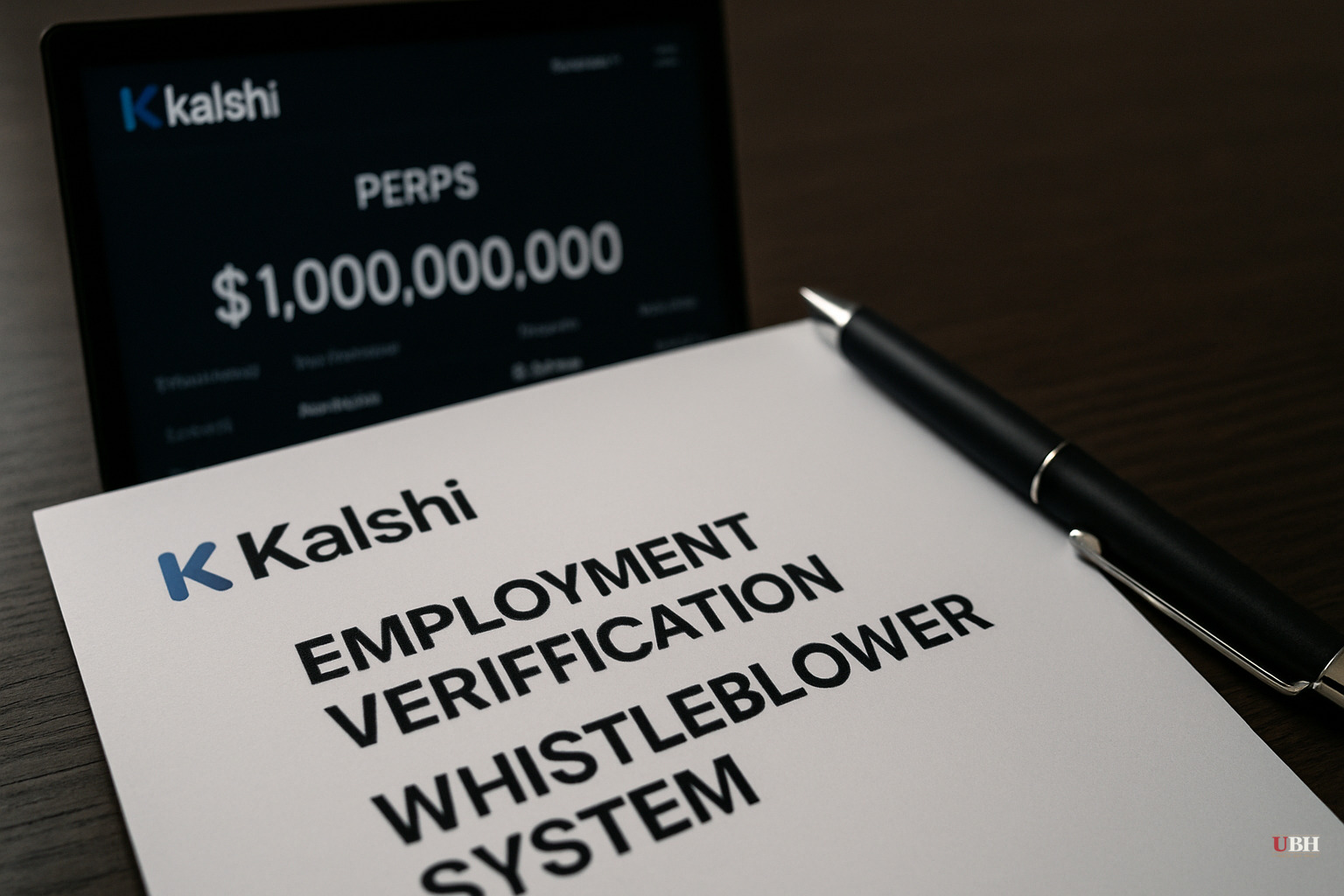
Kalshi Launches Employment Verification and Whistleblower System to Fight Insider Trading — Same Day Its New 'Perps' Product Hits $1 Billion in Volume
The Timeline So Far
Since federal prosecutors charged a Google employee with fraud in May for allegedly using insider information to make over $1 million on competitor platform Polymarket, scrutiny of prediction markets has intensified across the industry. Kalshi, the CFTC-regulated prediction market operator, has been operating under a spotlight ever since.
On June 9, the platform announced it is moving to address that scrutiny head-on.
What Kalshi Is Actually Doing
According to a post by Kalshi Head of Enforcement Robert DeNault on the company's blog, the platform is rolling out three specific tools — effective immediately.
Risk Scoring. Every market gets evaluated on six factors: corporate KPI or MNPI risk, outcome concentration risk (is one person making the call?), market importance, regulatory compatibility, non-traditional insider risk, and national security risk. Markets that score above a certain threshold trigger additional screening before they go live.
Employment Verification. Traders in high-risk-score markets must now disclose their employer before placing a trade. Kalshi told CNBC it will screen traders "before a trade is ever placed."
Whistleblower Portal. Users can now report abusive trading activity on any market, at any time. The tips go directly to a surveillance team through internal alerting controls.
Kalshi's Q1 enforcement numbers, also disclosed on June 9, are not trivial: 150-plus investigations, 100-plus potential insider trades blocked by new screening tools, 20-plus referrals to law enforcement, and five internal disciplinary actions, according to DeNault's post.
Why the Timing Matters
Kalshi received CFTC approval on May 29 to become the first U.S. company to offer crypto perpetual futures contracts — "perps" — domestically. The asset class does roughly $90 trillion in annual global volume, according to Bank of America, but had previously been inaccessible to U.S. retail traders.
The product launched and crossed $100 million in volume within 24 hours. According to CNBC, by one week in, total volume had surpassed $1 billion. The waitlist to access perps had at one point exceeded 1 million people, a Kalshi spokesperson told CNBC. For context, it took Kalshi 40 months to reach $1 billion in cumulative volume across all its event contracts.
That scale changes the risk calculus. Prediction market insider trading on a $10 million platform is a nuisance. On a platform processing billions in volume — with perps that include notional leverage — it is a systemic integrity problem. The compliance rollout and the volume milestone are tied together.
The Legitimate Concern Critics Raise
Skeptics of prediction markets make a fair point that deserves a straight answer: employment verification is only as good as its enforcement. A trader who works at a hedge fund or a government agency and lies about their employer faces some legal risk — but Kalshi is a private platform, not a regulator. The CFTC approved the platform's structure, but the agency has limited bandwidth, and the complexity of identifying non-traditional insider risk (where someone has material non-public information but no legal duty not to trade on it) is genuinely unsettled law.
Kalshi's whistleblower system and the independent Surveillance Audit Committee are steps in the right direction. But 20 referrals to law enforcement in a quarter — against 150-plus investigations — means the vast majority of flagged activity stays inside the platform. Whether that ratio reflects thorough triage or a high bar for external referral is an open question that the quarterly reports will need to answer clearly.
What Media Coverage Is Missing
CNBC disclosed that it has a commercial relationship with Kalshi that includes customer acquisition and a minority investment. That disclosure is buried at the bottom of both of CNBC's pieces on this story. Readers should know that context upfront, not as a footnote.
Most coverage frames the compliance rollout as primarily a response to the Polymarket/Google prosecution. Kalshi just opened the U.S. retail market to a leveraged derivatives product that did not exist here before May 29. The compliance upgrade and the product launch are inseparable. A platform that doubles its addressable market and simultaneously tightens its integrity controls is making a calculated bet that being the compliant player is a competitive advantage, not just a legal obligation.
Coinbase also received CFTC approval on May 29 to offer perp access to U.S. traders through an affiliate, according to CNBC. That competitive pressure explains why Kalshi is moving fast on both growth and compliance simultaneously.
What This Means for Regular People
If you are a retail trader who has been waiting to access perpetual futures without routing through offshore exchanges, Kalshi and Coinbase have now opened that door domestically — with CFTC oversight attached.
If you are already trading on prediction markets, the employment verification requirement means that certain markets will now ask you who you work for before you can place a bet. This creates friction, but it is a defensible requirement.
Prediction markets are growing fast enough that the insider trading question is no longer theoretical. Kalshi's response — voluntary compliance architecture before a regulator forces it — is a significant move. Whether the architecture actually works is what the next several quarterly reports will tell us.
Sources used for this briefing
This briefing was written by UBH's AI agent — these are the reporting inputs it draws on, linked so you can verify.


