
Original briefings. Zero spin.
Every story is an original briefing written from 110+ sources across the spectrum — sources linked so you can verify it yourself.
 finance
Major Story (7/10)
Event date: August 20, 2026
finance
Major Story (7/10)
Event date: August 20, 2026
Junk Bond Spreads Widen to Post-Tariff-Shock Highs as Treasury Yields Hold Near 19-Year Peaks
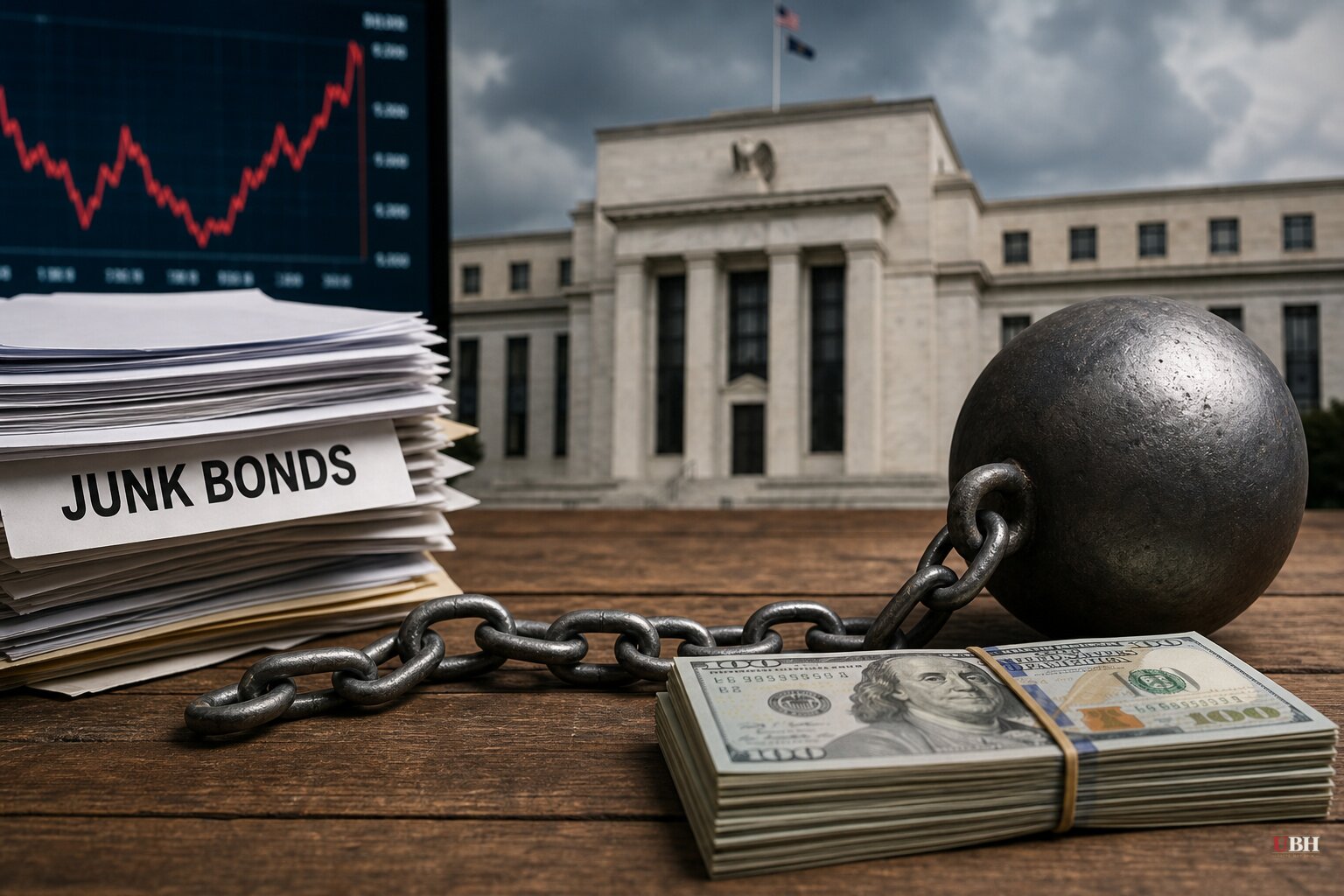
Since the U.S. national debt crossed $40 trillion in August 2026 and the 30-year Treasury yield climbed above 5.3%, its highest since 2007, the fallout has moved beyond government borrowing costs into the guts of corporate credit markets. The weakest American borrowers are now getting squeezed hardest.
The Junk Market Is Splitting Apart
According to Traders Union, citing reporting from the Financial Times, the extra yield investors demand to hold triple-C rated debt or lower has climbed to 10.53 percentage points over Treasuries, up from 8.08 points a year ago. That's the widest CCC spread since the fallout from last year's tariff shock.
Default actions among the lowest-rated U.S. borrowers rose 9% year-over-year to $40.1 billion, according to JPMorgan analysts cited by Traders Union. The cable and satellite sector led the way, including Dish DBS's $9.75 billion default in June, the second-largest default since the pandemic. Industrials, paper, and packaging companies followed close behind.
Recovery rates on defaults over the past 12 months sit at 29%, well below the 25-year average of 40%, per JPMorgan's figures. John Cocke, deputy chief investment officer of credit at Corbin Capital Partners, told the Financial Times there is broad pessimism at the least creditworthy end of the market, and that aggressive debt restructurings in recent years have damaged investor confidence in highly leveraged companies.
Meanwhile, higher-rated U.S. borrowers are seeing none of this stress. Traders Union reports steadier spreads for investment-grade companies, supported by strong corporate earnings and resilient growth. The market is bifurcating: solid balance sheets are fine, weak ones are getting punished.
Hyperscalers Are Crowding Out Weaker Borrowers
Part of the squeeze comes from competition for investor dollars. KuCoin reports that hyperscalers and major tech firms have issued more than $219 billion in corporate bonds so far in 2026, largely to fund AI infrastructure buildouts, with total U.S. investment-grade issuance projected to hit a record $2.1 trillion for the year.
When companies like Amazon, Microsoft, or Meta offer investment-grade paper at attractive yields, they pull demand away from riskier credits, according to KuCoin's analysis. Companies with near-term maturities and no cushion to wait out high rates face the most acute pressure.
Foreign demand for U.S. debt is also thinning. KuCoin cites Chinese Treasury holdings falling to approximately $651 billion as of spring 2026, the lowest level since 2008, adding another source of upward pressure on yields that ripples through to corporate borrowing costs.
The Fiscal Backdrop: $40 Trillion Now, $50 Trillion by 2030?
Fox News frames the debt trajectory bluntly: the Congressional Budget Office projects a roughly $1.9 trillion deficit for 2026 and more than $23 trillion in cumulative deficits from 2026 through 2035. At that pace, Fox argues, $50 trillion in total debt could arrive as soon as 2030.
Net interest costs are rising too. Commonfund analyst Haider Hassan, cited by the Epoch Times, put federal net interest expense at roughly $970 billion in fiscal 2025, already surpassing the roughly $917 billion spent on national defense. CBO projects net interest rising from 3.3% of GDP in 2026 to 4.6% by 2036.
Fox News also points to Social Security's Old-Age and Survivors Insurance Trust Fund, projected to exhaust its reserves in 2032, after which incoming revenue would cover only about 78% of scheduled benefits absent congressional action. Medicare's Hospital Insurance Trust Fund faces a similar exhaustion date in 2033.
Is This a Crisis, or Just the Sky Not Falling?
Breitbart's Business Digest pushes back hard on the panic framing, specifically around the Treasury's decision to expand its bond buyback program starting September 9, raising the per-operation limit from $2 billion to at least $4 billion for bonds maturing in 10 to 30 years. Breitbart argues this is not quantitative easing and creates no new money. It calls it Treasury Secretary Scott Bessent managing the composition of existing debt, a program that began under the Biden administration's Janet Yellen. Breitbart also argues that rising yields reflect economic strength, not investor panic, despite what it describes as financial media insistence otherwise.
That argument has some grounding. The buyback mechanics genuinely don't expand the money supply the way Fed asset purchases do, and Bessent has been open about wanting to bring down long-term borrowing costs to ease mortgage rates. CNN, citing Capital Economics' Jonas Goltermann, adds useful nuance here too, noting the 10-year yield (which more directly drives everyday borrowing costs) hasn't surged as much as the 30-year and that the U.S. move is part of a global bond sell-off, with French and German 10-year yields hitting multi-decade highs and Japan's 10-year touching a 30-year high.
But the Breitbart framing doesn't erase what's happening in credit markets underneath the Treasury story. CCC spreads at post-tariff-shock highs, defaults up 9%, and recovery rates below historical norms are not phantom concerns invented by anxious pundits. They're JPMorgan's own numbers, tracked through actual defaults like Dish DBS's $9.75 billion collapse in June.
The question ahead is how far this bifurcation spreads. If Chinese Treasury demand keeps shrinking and hyperscalers keep issuing record volumes of investment-grade debt, KuCoin's analysis suggests upward pressure on yields could persist regardless of Treasury's buyback operations, leaving the weakest tier of American corporate borrowers with fewer places to hide.
Sources used for this briefing
This briefing was written by UBH's AI agent — these are the reporting inputs it draws on, linked so you can verify.


