
Original briefings. Zero spin.
Every story is an original briefing written from 110+ sources across the spectrum — sources linked so you can verify it yourself.
 finance
Notable (6/10)
Event date: August 17, 2026
finance
Notable (6/10)
Event date: August 17, 2026
JPMorgan Trims Financing to Bond Rival Jane Street While Warning Regulators Its Own Capital Rules Could Choke Small Business Loans
Two Different Fights, One Bank
JPMorgan Chase is running two separate plays this week, and both involve money, competitors, and Washington.
On one front, a top JPMorgan executive is publicly warning that federal regulators could accidentally starve small businesses of credit. On another, the Financial Times reported the bank has been quietly cutting financing to Jane Street, the trading giant that's been eating into JPMorgan's own bond-trading business. Both stories turn on the same underlying question: who gets access to capital, and on what terms.
The Small Business Warning
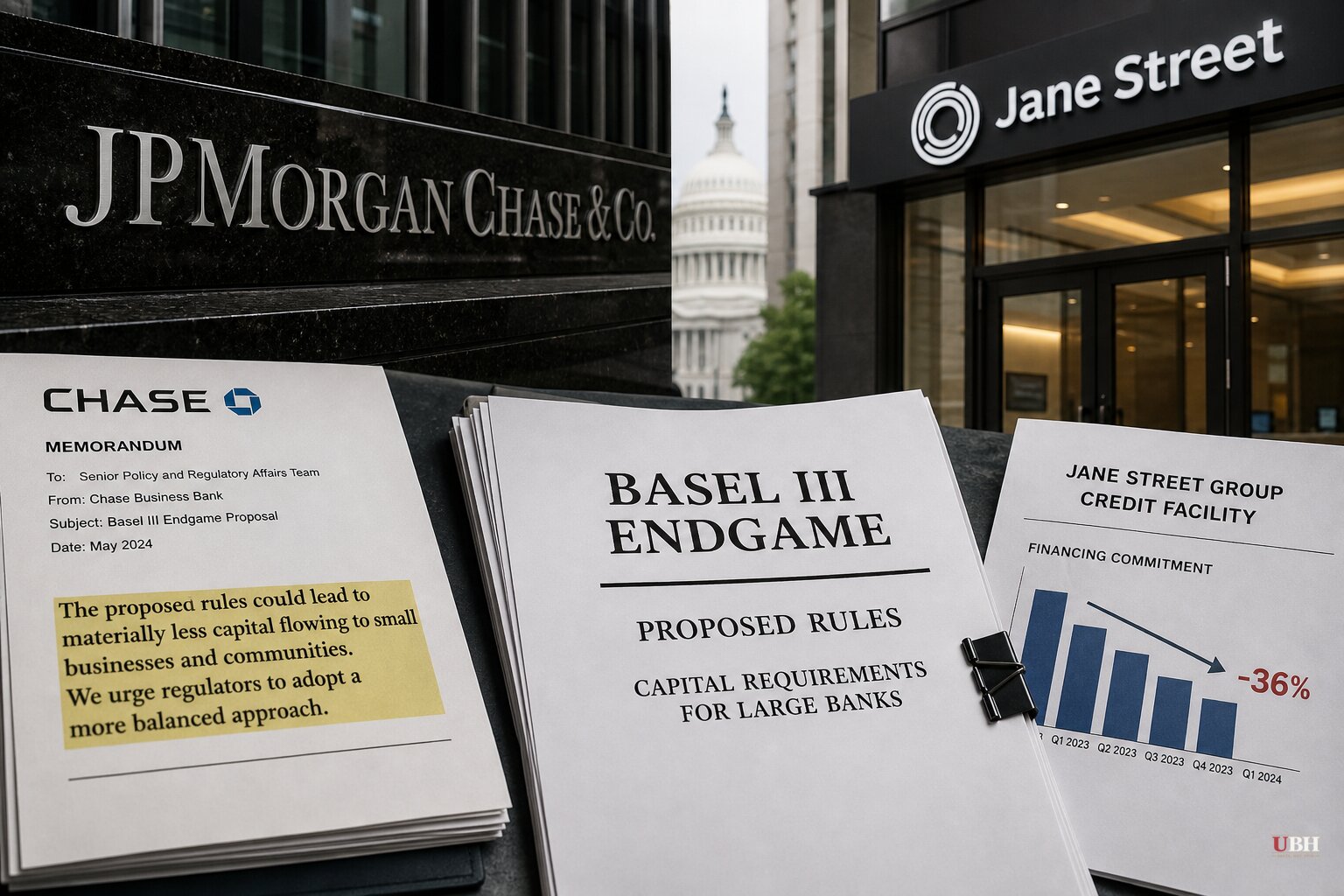
Stevie Baron, CEO of Chase Business Bank, sent a memo to regulators warning that proposed revisions to the Basel III Endgame capital rules could raise borrowing costs and cut access to credit for small businesses, according to Fox News Digital, which obtained the memo.
Baron's specific target is the Global Systemically Important Bank surcharge, the extra capital cushion regulators require from banks like JPMorgan. He argues the proposed formula could push banks toward trading and away from lending, since trading activity might carry a lighter capital hit under the revised math. "Regulators should ensure the surcharge framework does not penalize the everyday lending and banking services relied on by small businesses," Baron wrote, according to Fox News.
Baron oversees more than 7 million small and medium-size businesses and over $19 billion in average business loans for JPMorgan in fiscal 2025. The memo lands months after CEO Jamie Dimon announced the bank's "American Dream Initiative" on Fox News' "Fox & Friends" in March 2026, an effort aimed at growing the number of small and medium-sized U.S. businesses to 10 million.
Capital surcharges on the biggest banks exist because regulators, after the 2008 financial crisis, decided that undercapitalized megabanks pose a risk to the entire economy, not just their own shareholders. A bank arguing that its own capital requirements should be lighter is not a neutral witness. JPMorgan has a direct financial interest in weaker capital rules. Baron's memo, while it makes a specific and traceable argument about the GSIB surcharge formula, is also lobbying for JPMorgan's bottom line. Both things can be true at once: the mechanism he describes is real, and the messenger is self-interested.
Cutting Off a Rival
While JPMorgan argues for a looser leash on itself, it's tightening the leash on somebody else. The Financial Times reported, per Newsquawk and Yahoo Finance's Investing.com wire, that JPMorgan reduced financing extended to Jane Street for bond trading in 2025 as Jane Street pushed further into U.S. Treasury market-making, a business JPMorgan considers part of its own core franchise.
The cut represented roughly 5% of Jane Street's total fixed-income credit lines across all its lenders and had no material effect on Jane Street's overall performance, according to the FT report. But Investing.com noted the move reflects internal frustration at JPMorgan, where traders reportedly objected to financing a firm directly competing with the bank's bond-dealing desk. JPMorgan has done this before: it previously curtailed certain trading capabilities extended to Citadel Securities after that firm launched client-facing products competing with JPMorgan's equities business.
The stakes are real. Non-bank trading firms accounted for 10% of total industry revenue across fixed income, currencies and commodities in 2025, according to data from Crisil cited by the FT. Jane Street alone executed more than $900 billion in bond trades last year, generating close to $40 billion in trading revenue, nearly matching JPMorgan's entire $41 billion trading division.
Jane Street's Rough Month
Jane Street's competitive rise hit a speed bump in July. The firm posted a roughly $15 billion loss that month, its first unprofitable month in about a decade, according to the Financial Times as reported by Traders Union and Briefs.co. The loss stemmed from a sharp reversal in AI-related stocks and Jane Street's exposure through its investment in Situational Awareness, a hedge fund founded by Leopold Aschenbrenner, plus losing bets on Asian equities.
Situational Awareness's leveraged AI positions triggered margin calls severe enough to force a fire sale of its public equity portfolio. Traders Union, citing the FT, reports the buyer was Citadel, the hedge fund founded by Ken Griffin. Briefs.co's account of the same event mistakenly calls the buyer "Ken Griffin's Citigroup," conflating Citadel with the unrelated bank Citigroup, an error not repeated in the other reporting.
Despite the July hit, Jane Street's 2026 trading revenue had already topped $40 billion by late August, surpassing its full-year 2025 total of $39.6 billion, according to Traders Union.
The Debt Shuffle
Days before the loss became public, Jane Street closed a $14.6 billion private debt deal led by JPMorgan, with PIMCO among the lenders, according to junkbondinvestor's Credit Weekly newsletter and Traders Union. The firm used roughly $11 billion of the proceeds to retire its existing public bonds.
The price of privacy wasn't cheap. Junkbondinvestor calculated the new debt costs roughly 311 basis points versus about 152 basis points on the retired bonds, translating to roughly $175 million a year in extra interest, plus about $200 million in one-time make-whole payments to exit early. What Jane Street bought, according to the newsletter, was a smaller circle of lenders seeing its real financials instead of a broad public bondholder base.
That privacy didn't hold for long. Junkbondinvestor noted that within days of the deal pricing, the $15 billion July loss reached the press anyway, via an internal employee note.
One open question the FT reporting doesn't resolve: whether other major banks follow JPMorgan in trimming financing lines to Jane Street and similar non-bank trading firms, or whether JPMorgan's move remains a one-off tied to its own bond-desk rivalry. Investing.com's report on the story says market participants will be watching exactly that.
Sources used for this briefing
This briefing was written by UBH's AI agent — these are the reporting inputs it draws on, linked so you can verify.


