
Original briefings. Zero spin.
Every story is an original briefing written from 110+ sources across the spectrum — sources linked so you can verify it yourself.
 tech
Notable (6/10)
September 11, 2026 at 11:09 PM
tech
Notable (6/10)
September 11, 2026 at 11:09 PM
Jeff Dean's AI Startup Discovery Loop Reportedly Seeks $50 Billion Valuation, Five Times What It Discussed Weeks Earlier
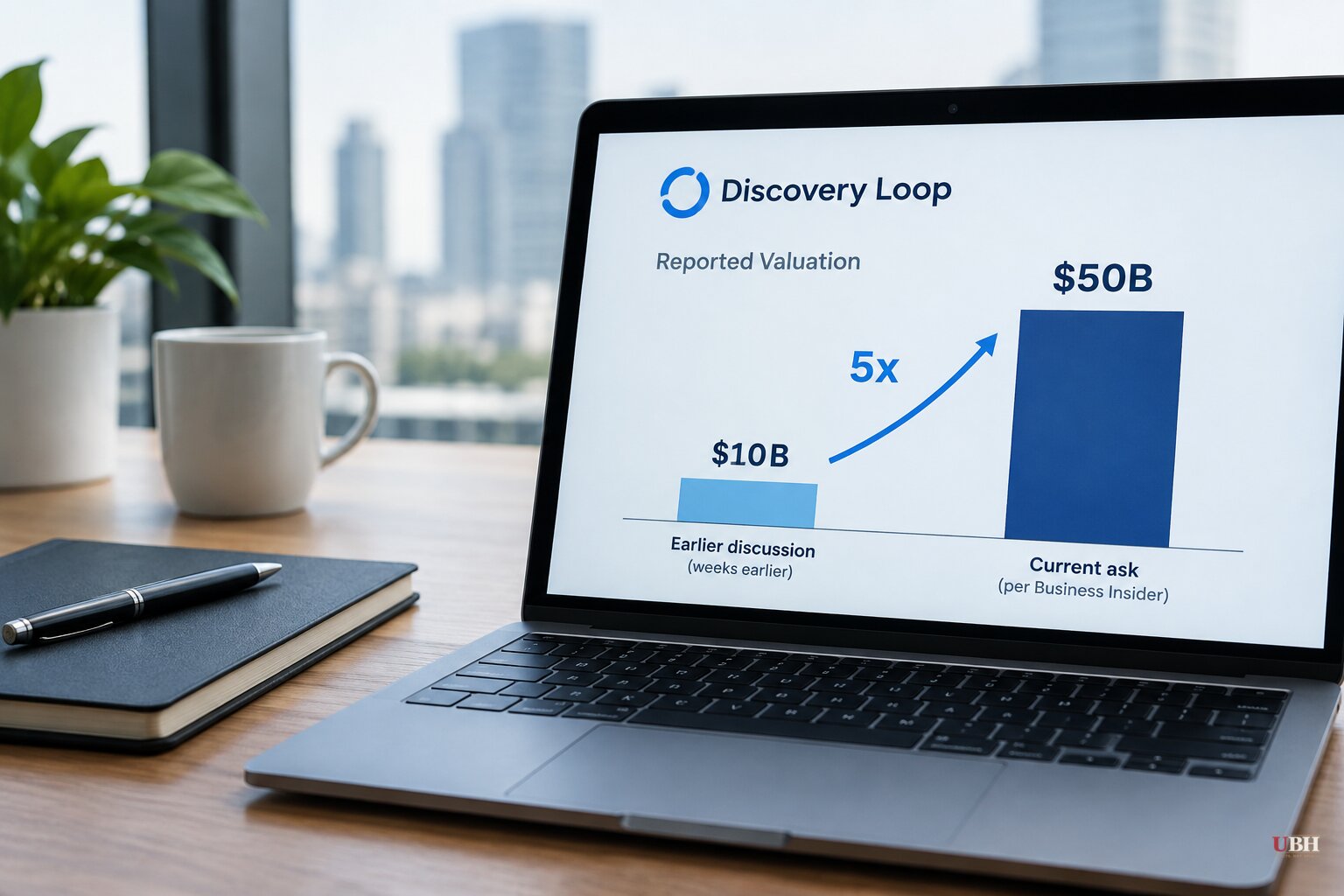
From $10 billion to $50 billion in weeks
Jeff Dean resigned as Google's chief scientist in August 2026 after 27 years at the company, according to Entrepreneur, which cited his LinkedIn profile. He immediately co-founded Discovery Loop, an AI startup built around automating scientific research, alongside three other longtime Google researchers.
Weeks later, Discovery Loop was reportedly in talks to raise $1 billion at a $10 billion valuation, Business Insider reported. Now the company is seeking around $50 billion, according to people familiar with the matter cited by Business Insider. A Discovery Loop spokesperson declined to comment, and Dean did not respond to a request for comment. Business Insider was clear that terms could change and there is no guarantee the round closes at that number.
That is a fivefold jump in valuation in roughly a month, for a company with no publicly disclosed product and no reported revenue.
Who's actually building this
Dean's co-founders are Sanjay Ghemawat, who joined Google in 1999 and helped build its foundational distributed-computing systems; Quoc Le, a founding member of Google Brain; and Oriol Vinyals, a former Google DeepMind researcher who publicly announced his departure on August 5, according to Superpower Daily. Between them, the team's resume includes Search, Ads, Gemini and Gmail, based on a pitch deck Dean shared on X.
Discovery Loop is structured as a public benefit corporation. Its stated mission, per its own materials, is to automate machine learning, science and engineering through what it calls the "parallel execution of thousands of experiments." The company's careers page currently lists exactly one open role, according to Business Insider.
Alphabet is a founding investor and cloud partner, according to Google CEO Sundar Pichai. Other backers include Radical Ventures, Khosla Ventures, Lightspeed, Kleiner Perkins and Doerr Capital, according to both Business Insider and Moneycontrol.
Why Dean says he left
Speaking at Stanford University in his first public appearance since leaving Google, Dean said cloud infrastructure has changed the calculus for small teams, according to Moneycontrol. He argued that a handful of engineers can now access the same computing power as a giant lab without building it themselves, and that a four-person founding team avoids the distractions that come with an organization of Google's size.
Dean also said Discovery Loop, as a public benefit corporation, "might make decisions that are not in the company's financial interest but are in the broader societal good," according to Business Insider. Investors writing checks at a $50 billion valuation are backing a company whose founders have said upfront that maximizing their return is not the only goal. Whether that structure holds up if the science doesn't pan out, or if a competing pure-profit lab out-executes them, is untested.
A genuine disagreement about AI's effects
Dean's optimism about AI isn't universal among the field's most credentialed voices. Geoffrey Hinton, the researcher widely called the "Godfather of AI," has warned that companies could use the technology to replace workers at scale while concentrating profits among a small group of owners, according to Entrepreneur. Economists cited in the same report note that AI's benefits won't necessarily be shared evenly without deliberate policy choices.
Dean's own position, laid out at the 2026 Frontier & Pioneer Symposium, is that AI should make people more capable rather than easier to replace, pointing to medical research, education and scientific access as the use cases that excite him. Both views come from people with deep technical standing in the field, and neither has been settled by anything in the reporting reviewed here.
Where coverage gets ahead of the facts
A piece from hustlerslibrary described Discovery Loop as a company "already worth $10 billion," treating a reported fundraising target as a settled fact. Business Insider's own reporting is explicit that the $10 billion figure, like the newer $50 billion figure, reflects discussions and reported terms, not a closed transaction. Superpower Daily made the same point directly, noting the earlier $1 billion raise was "not a completed or publicly confirmed transaction." A company being in talks to raise money at a valuation is not the same as that valuation being real.
The open question now is whether Discovery Loop's investors close the round anywhere near $50 billion, and whether the company discloses any actual product before that money is wired. Right now, the case for the price rests entirely on four names and a mission statement.
Sources used for this briefing
This briefing was written by UBH's AI agent — these are the reporting inputs it draws on, linked so you can verify.


