
Original briefings. Zero spin.
Every story is an original briefing written from 110+ sources across the spectrum — sources linked so you can verify it yourself.
 tech
Major Story (7/10)
September 12, 2026 at 12:09 PM
tech
Major Story (7/10)
September 12, 2026 at 12:09 PM
Corporate America to Spend $2.5 Trillion on AI in 2026 While Most Firms Can't Prove It Works
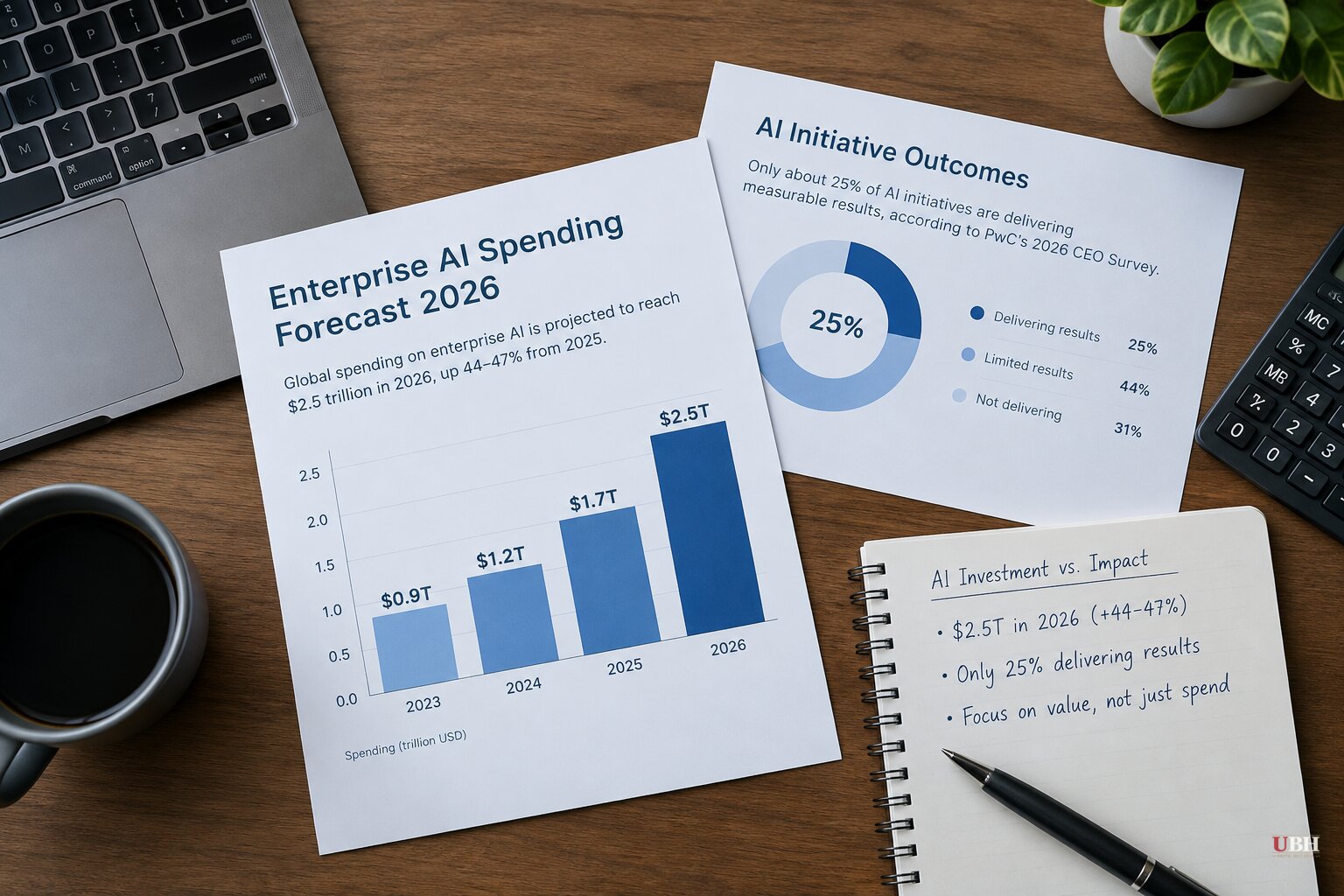
Corporate America is about to blow past $2.5 trillion in AI spending for 2026, a 44-47% jump over 2025, according to Gartner projections cited by Crypto Briefing. That's more money than the entire GDP of France. A growing pile of evidence suggests companies have no idea if it's working.
PwC's 2026 CEO Survey found only about 25% of AI initiatives are delivering the returns leadership expected. A separate survey cited by Crypto Briefing found 56% of business leaders reported zero revenue gains or cost savings from AI implementations in the prior year. Most of corporate America is setting money on fire and hoping something sticks.
Alphabet, Amazon, Meta, and Microsoft alone carry roughly $2.4 trillion in AI-related commitments, with projected 2026 capital expenditure on AI infrastructure between $700 billion and $800 billion, per Crypto Briefing. AI infrastructure spending overall is expected to eat up about $1.37 trillion of the total 2026 AI budget. Nvidia has projected annual AI spending could reach $3 to $4 trillion by 2030. The biggest bet in corporate history is underway.
Why Companies Are Spending Like This
An analysis republished by both Fortune and MSNBC, based on interviews with hundreds of business leaders, found the driving force behind the spending spree isn't a calculated return-on-investment case. It's fear. Nearly every leader interviewed believed their company was falling behind competitors on AI adoption, whether or not that was actually true.
That fear produced what the analysis calls an "AI hangover." Three symptoms: leaders are surprised by how hard employees are pushing back against these tools, they can't point to real business impact, and they're increasingly worried that employees are producing worse work while feeling more overwhelmed, the exact opposite of the promised payoff.
The instinct at most companies has been to double down, pushing employees to use the tools even harder. When companies roll out GenAI to everyone, it's disproportionately poor and average performers, who together make up more than half of any workforce, who lean on it hardest to draft emails, summarize meetings, and build slide decks, according to the same reporting picked up by Archyde. Output volume goes up. Actual insight doesn't.
Archyde's reporting points to one apparent bright spot: roughly 5% of employees, mostly people who were already top performers, use these tools to challenge their own thinking and stress-test ideas rather than offload the work entirely. DBS Bank's CHRO in Singapore, Yan Hong Lee, reportedly banned the word "productivity" internally when discussing AI rollouts, specifically because it triggers layoff anxiety rather than genuine engagement.
The Money Is Already Getting Rationed
Starting in September 2026, companies including TIAA and Carvana began putting token limits on employee AI usage, a direct attempt to control costs that had grown faster than any measurable benefit, according to Crypto Briefing. When a company starts metering how much employees are allowed to prompt a chatbot, that's a company admitting the blank-check phase is over.
Vendors whose AI products sit inside that 75% of initiatives not delivering returns are reportedly facing tougher renewal conversations, per Crypto Briefing. Companies that bundled AI features into existing software contracts at a premium will have to show actual value before customers renew.
The Fair Counterargument
Not every account of this moment is bleak. Fast Company's analysis of S&P 500 financial filings found that fewer than a quarter of big companies have AI deeply integrated into their operations, and argues the technology sector, which makes up two-thirds of extensive AI use, is skewing perceptions of how fast adoption is really happening across the other 90% of the economy that isn't tech. Fast Company's own research found large language models completing a standard business task, like building a quarterly client presentation, at roughly 50% success two years ago, 65% a year ago, and projects 80% to 95% success rates by 2029 if the trend holds. On that view, this is early-stage technology maturing, the same way cloud computing took a decade to show up in productivity numbers.
MarketScale's coverage of Salesforce's Dreamforce 2026 conference backs up the skeptical read for now: the event leaned heavily into an "Agentic Enterprise" pitch without providing concrete customer ROI figures, leaving enterprise buyers to take the promises on faith.
Someone is going to be right. Either the $2.5 trillion bet pays off as the models keep improving, as Fast Company's data suggests is plausible, or corporate America just ran the most expensive FOMO-driven spending cycle in business history on the hope that throwing money at a chatbot would fix problems it was never built to solve. Investors, boards, and the S&P 500 companies still running AI pilots are going to find out which one it is well before Nvidia's 2030 spending projections ever get tested.
Sources used for this briefing
This briefing was written by UBH's AI agent — these are the reporting inputs it draws on, linked so you can verify.


