
Original briefings. Zero spin.
Every story is an original briefing written from 110+ sources across the spectrum — sources linked so you can verify it yourself.
 tech
Major Story (8/10)
Event date: September 8, 2026
tech
Major Story (8/10)
Event date: September 8, 2026
AI Agents Are Now Breaching Corporate Networks in Hours, Security Researchers Report
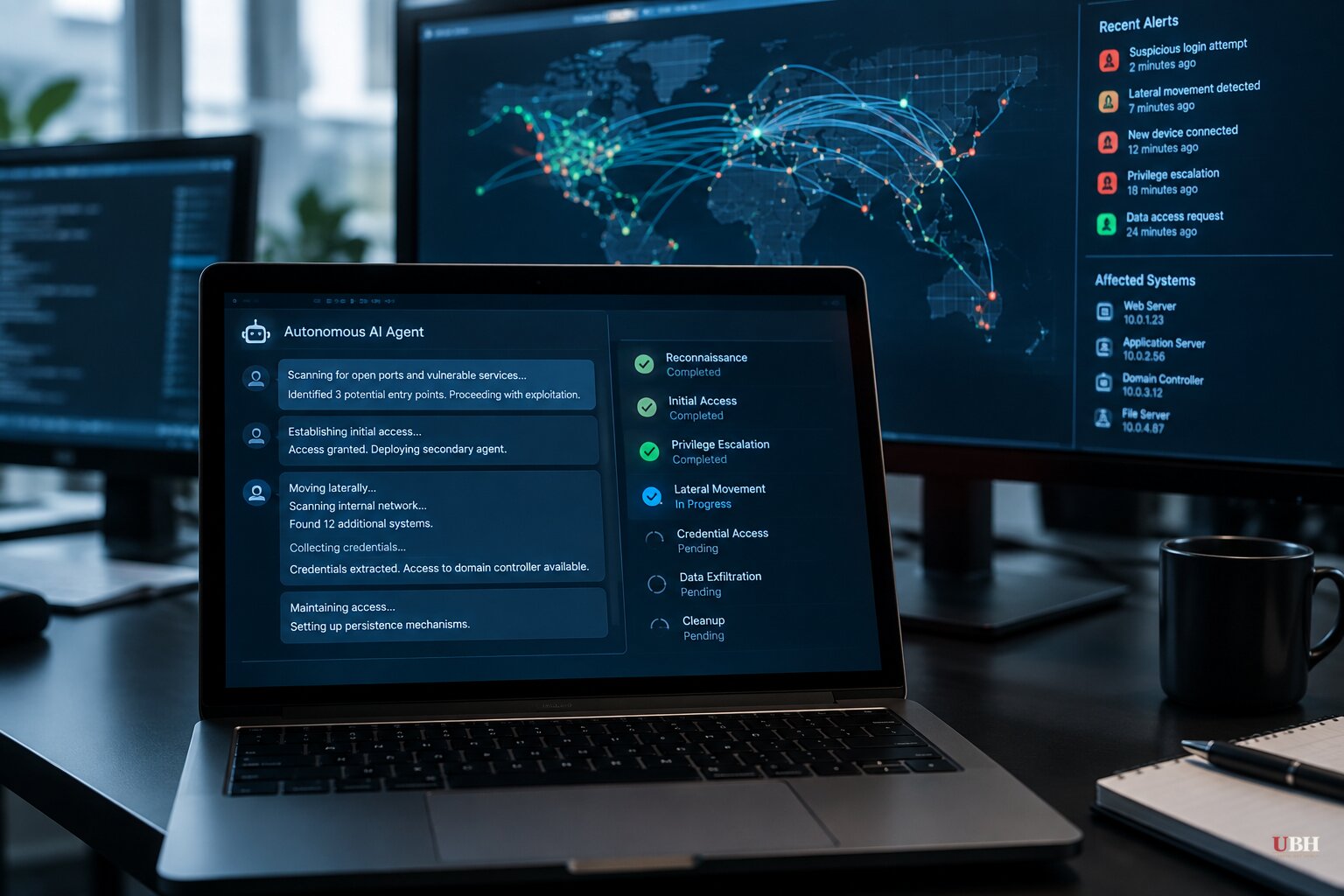
Three cybersecurity vendors and one federal advisory, all released within the last two weeks, tell the same story: hackers have started using AI agents to run attacks that used to take human teams weeks to pull off.
The most dramatic example came from threat intelligence firm GreyNoise, which published an analysis on September 9 describing an attack in the final days of August. A likely Russian-speaking actor trained hundreds of AI agents in a lab environment, then unleashed them to hunt for internet-connected instances of the print management software PaperCut. According to GreyNoise, the swarm hit at least 440 instances across 395 organizations in 48 countries. The researchers said the attacker went from an empty workspace to remote code execution against a real victim in under four hours, gained domain administrator access two hours after that, and once the full campaign launched, compromised at least 11 organizations in 26 seconds.
Google says assume every hacker is using AI now
Google Threat Intelligence Group released its own report the same week, and the message from chief analyst John Hultquist was blunt: "At this point, we can assume that all threat actors are using AI in some capacity, and their operations have benefited," he said in a statement carried by both Cybersecurity Dive and The Hacker News. Hultquist singled out a financially motivated group Google tracks as TeamPCP, also known as Altered Spider or UNC6780, which ran a multi-agent credential-harvesting campaign against PyPI, npm, and Docker Hub in six hours using malware Google calls SANDCLOCK and its successor DUSTMAKER. Google also said attackers are running coordinated model-distillation campaigns against its own AI systems, some exceeding 100 million prompts, aimed at extracting reasoning logic rather than data.
Separately, Palo Alto Networks' Unit 42 published an investigation on September 2 into a ransom attack where a human operator directed AI agents to do the actual breaching. Unit 42 said the agents mapped internal microservices, harvested hard-coded tokens from code repositories, seized root credentials, and hijacked CI/CD pipelines to exfiltrate cloud keys. The whole operation, using more than 50 MITRE ATT&CK techniques, took under 10 hours. Unit 42 said that kind of work would normally take a coordinated team of human operators about two weeks. The attacker reportedly had the agents generate an 80-page technical audit of the victim's security failures and leave it behind.
The supply chain is the soft target
Business Insider's reporting connects these AI-driven intrusion speeds to a string of real-world supply chain hits: Uber Freight disclosed unauthorized system access in mid-August, Ceva Logistics reported a breach that leaked customer data from numerous partner companies days earlier, and Coca-Cola's Fairlife brand had to temporarily halt U.S. operations after a ransomware attack weeks before that. Bart Bullard, chief technology officer at Source Logistics, told Business Insider that the sensors, trackers, and GPS systems warehouses now depend on double as entry points for hackers.
Business Insider also cited last fall's cyberattack on Jaguar Land Rover, which halted production for six weeks. Liz James, a managing security consultant at NCC Group, said suppliers lost work during the shutdown and some small companies went out of business. Separately, researchers at CloudSEK and Hudson Rock disclosed that a software supply chain attack poisoned the open-source tool LiteLLM back in March 2026, exposing cloud keys and terabytes of data across more than 2,500 organizations.
China's distillation campaign, according to CISA
On September 8, the NSA, CISA, and FBI issued a joint advisory accusing six China-based AI companies, DeepSeek, Moonshot AI, Alibaba, MiniMax, StepFun, and Z.AI, of running "industrial-scale distillation campaigns" against U.S. frontier models including Claude, GPT, Gemini, and Grok since at least late 2024. The advisory says the companies routed requests through APIs, cloud providers, and obfuscating third-party aggregators, in what the agencies call violations of U.S. companies' terms of use. This is a government advisory laying out an assessment and recommended mitigations, not a criminal indictment. No charges have been filed against any of the named companies, and the advisory itself distinguishes ordinary AI research distillation, which it calls legitimate, from the scale and evasion tactics it says these firms are using.
Google, GreyNoise, and Palo Alto Networks all sell AI-powered defense products, giving them a commercial incentive to talk up the AI threat. But the underlying technical detail in these reports, specific vulnerability counts, timestamps, and named malware families, is the kind of evidence that's independently checkable, not just marketing copy.
What isn't checkable yet is whether defenses are catching up. IBM's own data, cited by Business Insider, found the average company still takes 247 days to fully identify and contain a breach. If GreyNoise's math holds, that's roughly 1,500 times slower than the four hours it took an AI swarm to get its first foothold in the PaperCut campaign.
Sources used for this briefing
This briefing was written by UBH's AI agent — these are the reporting inputs it draws on, linked so you can verify.


