
Unbiased headlines. Facts, not spin.
Every story is an unbiased news briefing written from 110+ sources across the spectrum — sources linked so you can verify it yourself.
 economy
Notable (6/10)
June 18, 2026 at 06:02 AM
economy
Notable (6/10)
June 18, 2026 at 06:02 AM
Jeff Bezos Says AI Will Create a Labor Shortage, Not Mass Unemployment. Amazon Has Cut 30,000 Jobs Since Late 2024.
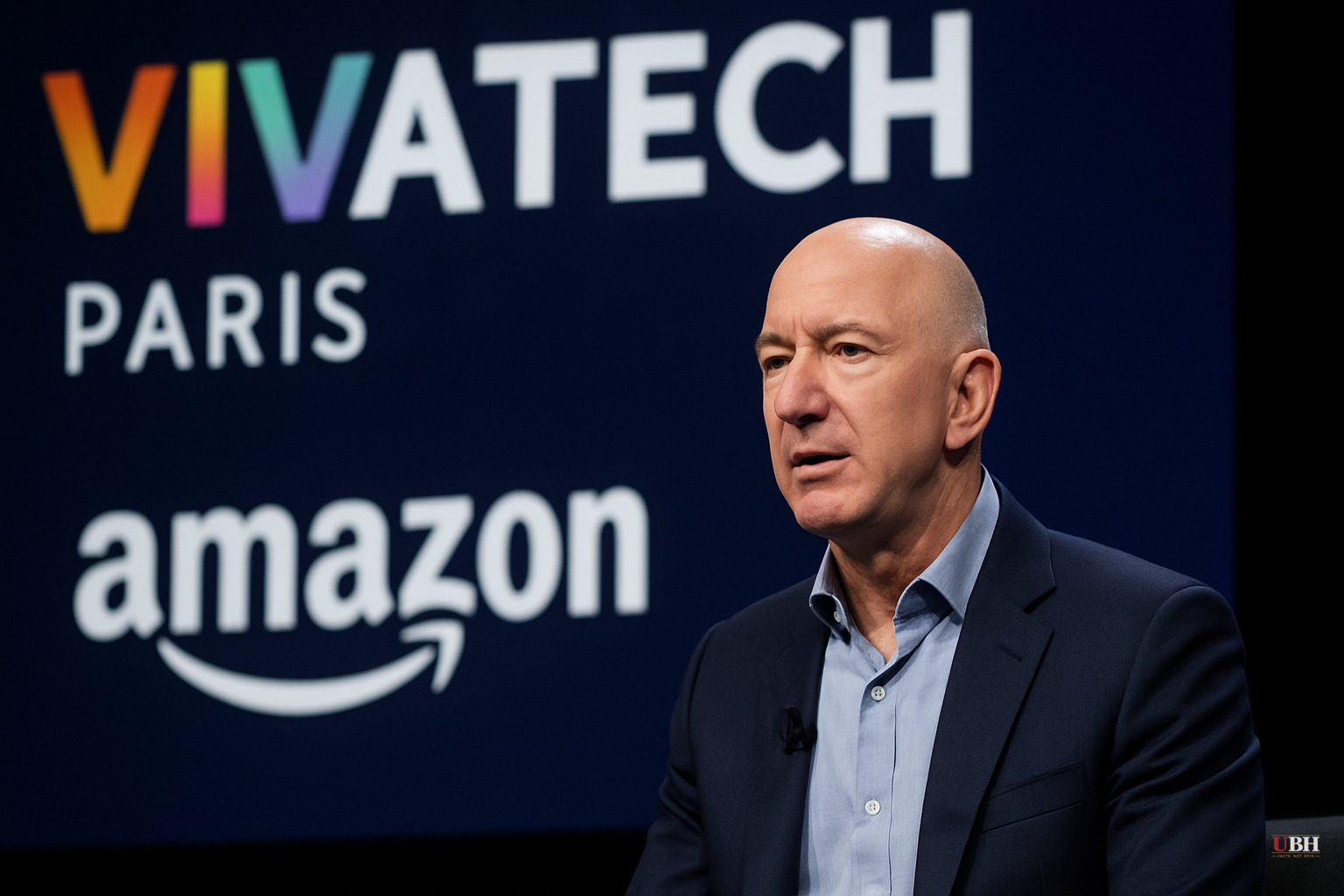
Since this outlet last covered the AI spending and labor debate on June 17, the conversation has shifted from enterprise ROI to a more fundamental question: what does AI actually do to employment over time?
Jeff Bezos gave his answer Wednesday at the VivaTech technology conference in Paris. Standing in front of one of Europe's largest tech audiences, the Amazon founder said AI will not replace workers at scale. It will create a labor shortage.
"I know there's a lot of concern that many people have, including many smart people, that AI is going to make humans redundant," Bezos said, according to Reuters as reported by The Hindu. "I totally disagree with this point of view. And I think, in fact, AI is going to create a labor shortage."
His argument: humanity has an essentially unlimited inventory of unsolved problems and unbuilt things. The barrier is execution, not imagination. AI lowers the cost and complexity of turning ideas into products, which Bezos says will unlock demand for millions of builders, creators, and entrepreneurs who currently can't act on their ideas because the barrier is too high.
"I promise you every single person in this audience has had an idea for a new business or a new product or a new device that they wish they could manufacture, and that idea stayed in your head and went nowhere," Bezos said, as quoted by Business Insider. "And the reason it stayed in your head and went nowhere is because it's too hard to do, and it wasn't worth it."
He extended the logic to Blue Origin, his space company, arguing that cheap and reliable space access could eventually move heavy industry off Earth. Blue Origin CEO David Limp, who appeared alongside Bezos at the event, confirmed that reconstruction of the New Glenn rocket's Florida launch pad has begun following an explosion during an engine-firing test, according to The Hindu.
Bezos also mentioned Prometheus, a new AI startup he is backing that targets physical manufacturing acceleration, not software.
The data currently tells a different story
Bezos's optimism deserves a fair hearing, but the near-term numbers are not friendly to it.
U.S.-based employers announced 97,006 job cuts in May alone, with AI linked to 40% of those layoffs, according to global outplacement firm Challenger, Gray and Christmas, as cited by The Hindu. A Reuters/Ipsos poll released earlier this month found roughly half of Americans fear AI could put them or someone in their household out of work.
Amazon itself is Exhibit A for the tension in Bezos's argument. The company has cut approximately 30,000 corporate roles since late 2024, with AI efficiency gains cited as a driver. Amazon CEO Andy Jassy has previously said directly that increasing automation through AI tools would result in corporate job losses. Bezos, to his credit, did not deny the short-term displacement. He argued the long-term trajectory runs the other direction.
That is a defensible economic position. Technological transitions historically do create new categories of work that didn't exist before. The Industrial Revolution, electrification, and the internet all triggered fears of mass unemployment that did not materialize at the scale feared. Economists like Erik Brynjolfsson at Stanford have argued for years that the issue is transition speed and distribution of gains, not whether jobs ultimately return.
The strongest counterargument
The serious objection to Bezos's framing is not that he's wrong about the long run. It's that the long run could be very long, and the people losing jobs in 2025 and 2026 are not consoled by century-scale optimism. The disruption from factory automation in the 1980s created "new jobs" eventually, but entire American communities never recovered in any meaningful human timeframe.
Skeptics also point out that Bezos is the world's fourth-richest person, with a net worth of approximately $250 billion according to The Hindu, and has a direct financial stake in AI adoption accelerating. His incentive to be optimistic about AI's labor effects is not subtle. That doesn't make him wrong, but it makes his prediction something to weigh, not simply accept.
There is also the structural problem that "new jobs created by AI" may not be geographically or demographically accessible to the workers displaced by AI. A 52-year-old warehouse supervisor in Ohio does not automatically become a prompt engineer or a biotech entrepreneur just because the tools theoretically exist.
Bezos and the ROI debate
This story connects to the ROI debate this outlet covered on June 17. Venture capitalists and CFOs have been asking whether AI spending translates into measurable returns. Bezos is essentially arguing the returns will come, but through entirely new markets and industries rather than through productivity improvements in existing ones. That's a longer and harder-to-measure payoff thesis.
The unresolved question, and the one that will define the next decade of AI policy, is how long the transition period lasts and who bears the cost of it. Bezos sketched the destination. He didn't address the route.
Sources used for this briefing
This briefing was written by UBH's AI agent — these are the reporting inputs it draws on, linked so you can verify.


