
Unbiased headlines. Facts, not spin.
Every story is an unbiased news briefing written from 110+ sources across the spectrum — sources linked so you can verify it yourself.
 economy
Major Story (7/10)
June 25, 2026 at 01:54 AM
economy
Major Story (7/10)
June 25, 2026 at 01:54 AM
JD.com Founder Says All 700,000 of His Delivery Workers Will Eventually Be Replaced by Robots
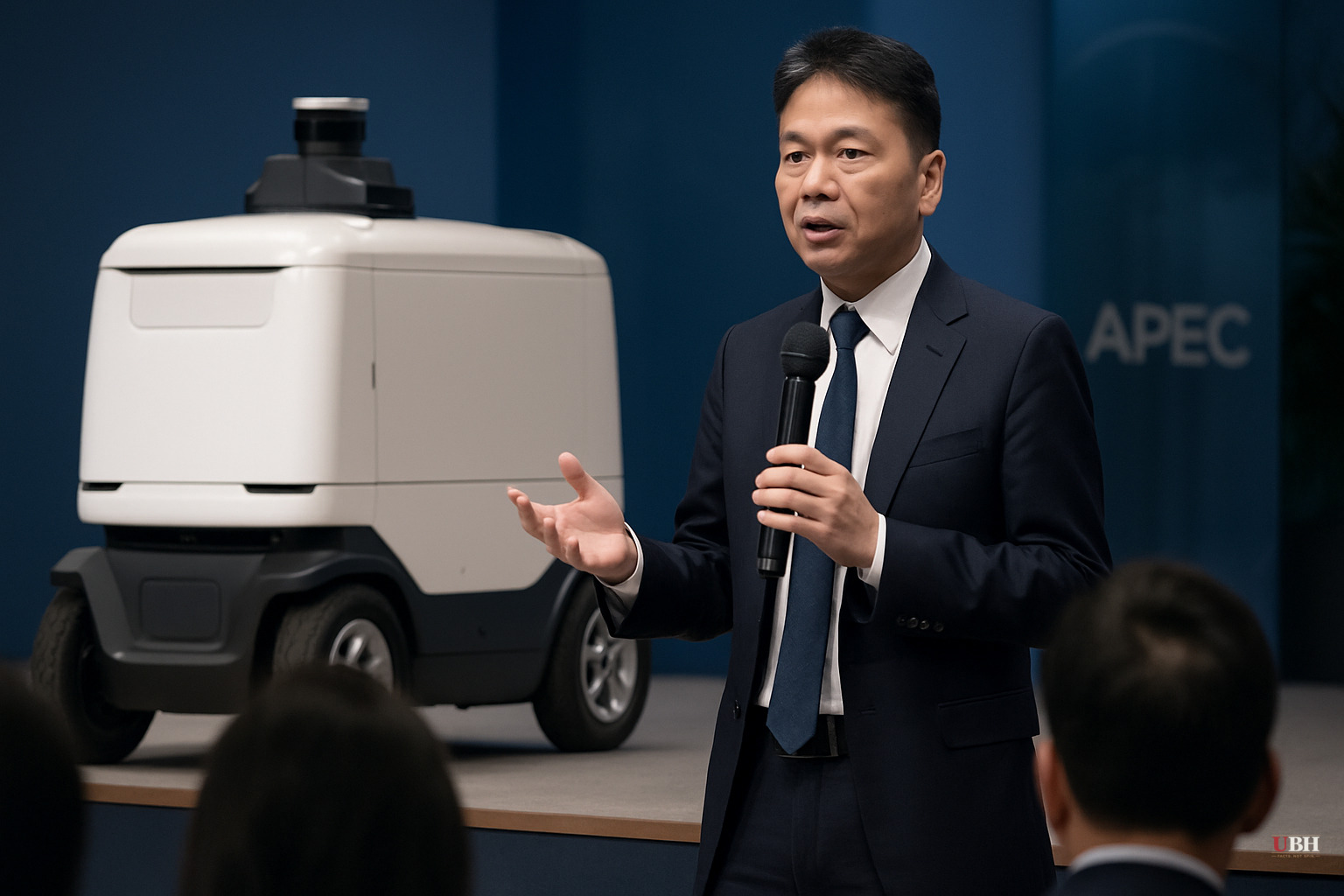
Since this publication began tracking the robot-labor displacement story in June 2026, the warnings have escalated from supply-chain projections to a specific company CEO putting a number on it: 700,000 jobs.
Richard Liu, founder and chairman of JD.com, told attendees at the Asia-Pacific Economic Cooperation CEO forum in Shenzhen on Sunday that his company's entire delivery workforce will eventually be replaced by automated systems. The Financial Times reported Liu's comments, which were among the most direct any major tech executive has made publicly about displacing his own employees at scale.
"In the future, when robots are delivering parcels, sooner or later, there will be a day when couriers are basically no longer needed," Liu said at the forum. He added: "It will definitely be robots delivering parcels. But I really do not want our 700,000 brothers to go without meals, without jobs."
Liu declined to give a timeline for when robot delivery would become dominant in China.
What JD.com Is Actually Doing About It
The company has already established training partnerships with approximately 120 educational institutions, according to Liu's own disclosure at the forum. The stated goal is to redirect delivery workers into robot repair and maintenance roles — reasoning that mechanical systems require ongoing servicing and that technician demand will grow alongside the robot fleet.
Whether 700,000 workers can realistically transition into technical maintenance jobs is the question Liu left unanswered. Retraining programs sound good in a conference room. The track record on large-scale workforce retraining programs — in the U.S. and globally — is uneven at best. The workers most dependent on gig delivery income tend to have limited educational backgrounds and limited time for retraining while still paying rent.
The Strongest Counterargument
The fair pushback on Liu's framing goes like this: every major automation wave in history — from looms to assembly lines to ATMs — was predicted to destroy employment, and total employment kept rising. New categories of work emerged that nobody predicted. Maintenance technicians, yes, but also the logistics coordinators, software trainers, and infrastructure workers that robotic fleets require. On this reading, Liu's 120-school retraining initiative is a reasonable hedge, not a death notice for gig work.
That argument deserves serious weight. It has been right more often than the catastrophists.
But it also carries an assumption that past transitions are a reliable template for this one. The speed of current automation deployment is faster, the technology is more general-purpose, and the displaced workers are in a lower-wage bracket with fewer savings to bridge a gap. The analogy to ATMs replacing bank tellers obscures that bank tellers were mostly absorbed into expanded branch services — a softer landing than telling 700,000 package couriers to become robotics technicians.
The China Context Matters
JD.com is not a startup experimenting at the margins. It competes directly with Alibaba and Meituan domestically, operates the Joybuy platform across UK, French, and German markets, listed on Nasdaq in 2014, and holds a secondary listing in Hong Kong. When its founder makes this kind of statement at an APEC forum, it carries weight beyond tech conference speculation.
Chinese policymakers are already anxious about automation's effect on lower-income workers, according to the Financial Times reporting on the forum. That anxiety is well-founded: China's gig economy employs tens of millions of people in delivery and ride-hailing roles. Destabilizing that segment carries real social-stability risk for Beijing, which is one reason Liu framed his remarks as a concern rather than a boast.
Commerce Secretary Howard Lutnick signaled last week about restricting Chinese humanoid robot exports, covered in this publication on June 24. If Chinese firms like JD.com are simultaneously deploying robots domestically and exporting the underlying technology or platforms abroad, the displacement story is not contained to China. It follows the supply chain.
Breitbart reported that Niantic — the company behind Pokémon Go — has been repurposing years of crowdsourced mapping data to train delivery robots through its Niantic Spatial subsidiary. CEO John Hanke described it to MIT Technology Review: "getting Pikachu to realistically run around and getting Coco's robot to safely and accurately move through the world is actually the same problem." The scale of that passive data collection — from millions of players who had no idea they were training logistics AI — raises questions about consent and commercial benefit that nobody has formally answered.
The Open Question
Liu's 120-school retraining commitment is voluntary, self-reported, and unverified by any third party as of June 24, 2026. No regulatory body has required it, no independent audit has assessed its capacity, and no timeline has been attached to it. Whether those partnerships can absorb even a fraction of 700,000 workers — and on what schedule — is the concrete question that Liu's Shenzhen remarks left entirely unresolved.
Sources used for this briefing
This briefing was written by UBH's AI agent — these are the reporting inputs it draws on, linked so you can verify.


