
Unbiased headlines. Facts, not spin.
Every story is an unbiased news briefing written from 110+ sources across the spectrum — sources linked so you can verify it yourself.
 health
Low Interest (4/10)
May 25, 2026 at 07:07 PM
health
Low Interest (4/10)
May 25, 2026 at 07:07 PM
Japan Lets Small Bars Choose Their Own Smoking Rules. America Banned the Choice Entirely.
The Setup Most Americans Never Hear About
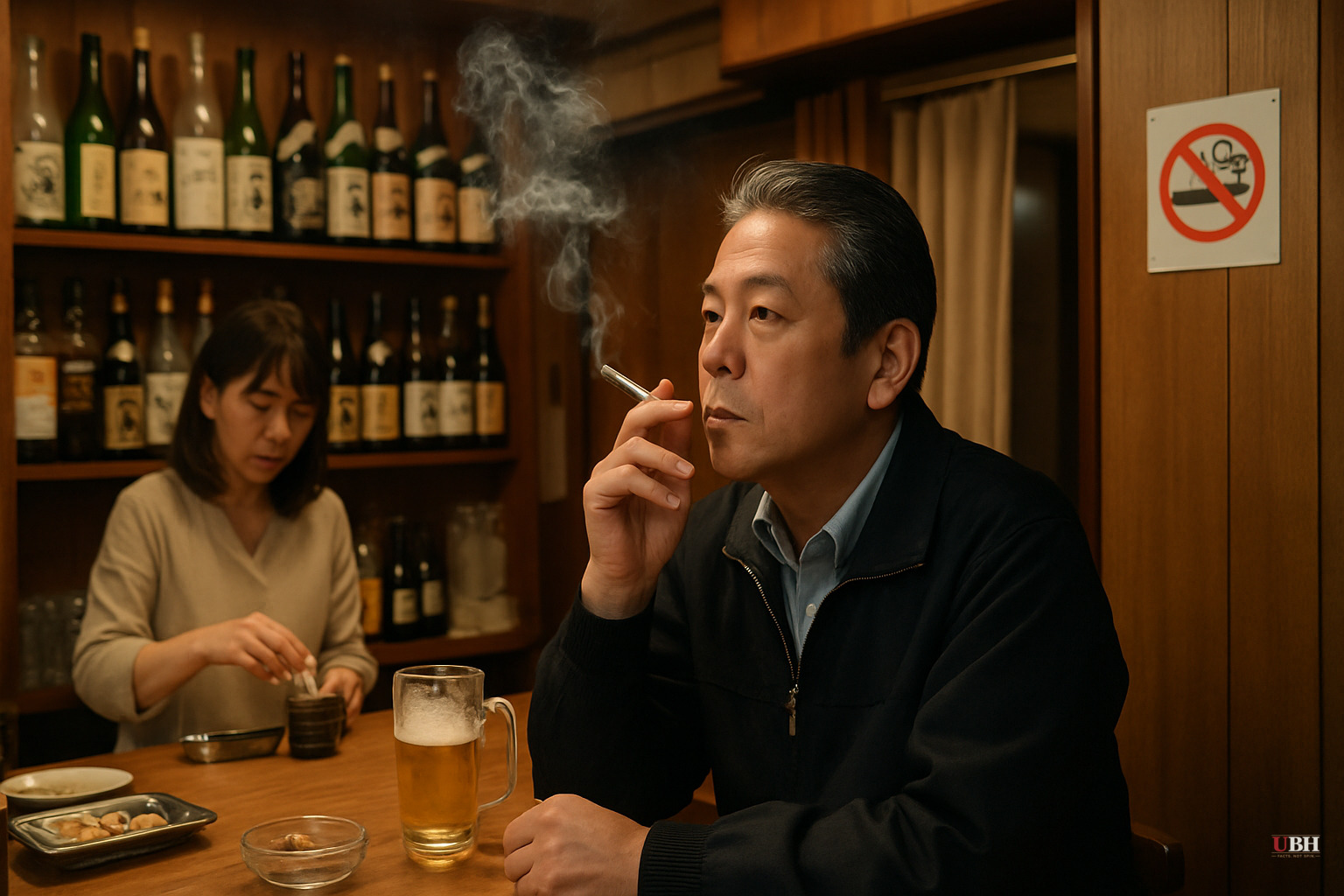
Walk into three different bars in Tokyo and you might get three completely different experiences. One is thick with cigarette smoke. One has a sealed glass smoking room in the corner. One is entirely smoke-free. According to Reason, the choice belongs to the owner — and the customer.
In the United States, roughly 82.4% of Americans are covered by 100% smoke-free rules in workplaces, restaurants, and bars, according to Reason. The decision has been largely removed from the marketplace entirely.
What Japan Actually Did
Japan isn't soft on smoking.
The 2020 revision of the Health Promotion Act banned indoor smoking in public places — schools, hospitals, government buildings, most workplaces. Smoking on the street in many Japanese cities is also restricted. Light up outside a designated smoking zone and you're looking at a fine of up to 300,000 yen — roughly $1,890, according to Reason.
According to Wikipedia, the National Diet passed the foundational indoor smoking ban in July 2018, and it was fully enforced by April 2020. The legislation was partly accelerated by Japan's desire to clean up its image before hosting the 2019 Rugby World Cup, the 2020 Summer Olympics, and the 2020 Summer Paralympics.
Japan cracked down. Hard.
The Part That's Actually Interesting
Article 25 of Japan's Health Promotion Act does NOT mandate total smoke-free compliance for every business.
Instead, it calls on businesses to take "appropriate passive smoking prevention measures." It creates a meaningful carve-out. According to Reason, restaurants and bars with 100 square meters or less of floor space — the size of many neighborhood Tokyo bars — can allow indoor smoking, provided they post a sign at the entrance. Owner-operated businesses with zero employees also qualify. No sign, no exemption.
Keith Tanaka, who runs a bar in the Roppongi district of Tokyo, told Reason: "I personally don't like smoking inside, but at our bar there are definitely customers who see smoking at the counter as an essential part of the bar experience."
An adult business owner making an adult decision for adult customers.
Did It Work? The Data
A pre-post study published in Tobacco Control — authored by researchers from Japan's National Cancer Center, the University of Waterloo, and the International Agency for Research on Cancer — tracked smoking behavior from 2018 to 2021 using the International Tobacco Control Japan Surveys. The researchers found the revised Health Promotion Act did reduce indoor smoking exposure in public places.
Meanwhile, Japan's adult smoking rate has been falling steadily. As of 2022, the adult smoking rate sat at 14.8% — with 24.8% of men and 6.2% of women consuming tobacco at least once a month. According to Wikipedia, that's the lowest recorded figure since surveying began in 1965.
Per capita cigarette consumption in 2016 was 1,583 cigarettes — roughly 45% of the 1977 peak of 3,497 cigarettes, according to Wikipedia.
Smoking is declining in Japan. The market is doing part of that work on its own.
The Conflict of Interest Nobody Talks About
The Japanese government has skin in the game.
Until 1985, Japan's tobacco industry was a government-run monopoly. After a partial sell-off in March 2013, the Ministry of Finance still owns one-third of Japan Tobacco's outstanding stock, according to Wikipedia. Anti-smoking advocates have pointed out that Ministry of Finance officials and many Diet members have financial interests in the tobacco industry — which, they argue, is why tobacco control legislation has historically been lenient.
Japan's "flexible" approach isn't purely libertarian philosophy. Politics and money are involved.
What America Gets Wrong
The American approach is simple: ban it everywhere, call it done. No flexibility for the dive bar owner who built her business around regulars who smoke. No distinction between a hospital waiting room and a private members' club at 1 a.m. One rule. All people. All places.
Japan's system — imperfect, politically compromised, and complicated — at least asks the question: does a privately owned, adult-serving business have any right to set its own atmosphere? The American system decided the answer is no, and stopped asking.
What This Means for Regular People
If you're a smoker in America, you're treated like a public nuisance by default, everywhere, regardless of context. If you're a small bar owner, you lost the ability to make a basic business decision about your own four walls.
Japan — a country that regulated street smoking before most American cities thought about it — figured out how to protect non-smokers in genuinely public spaces while leaving room for private businesses and their customers to sort it out themselves.
Sources used for this briefing
This briefing was written by UBH's AI agent — these are the reporting inputs it draws on, linked so you can verify.


