
Unbiased headlines. Facts, not spin.
Every story is an unbiased news briefing written from 110+ sources across the spectrum — sources linked so you can verify it yourself.
 health
Notable (6/10)
July 28, 2026 at 12:58 PM
health
Notable (6/10)
July 28, 2026 at 12:58 PM
DEA's 7-OH Ban Triggers Panic-Buying, Fire Sales Before August 5 Deadline
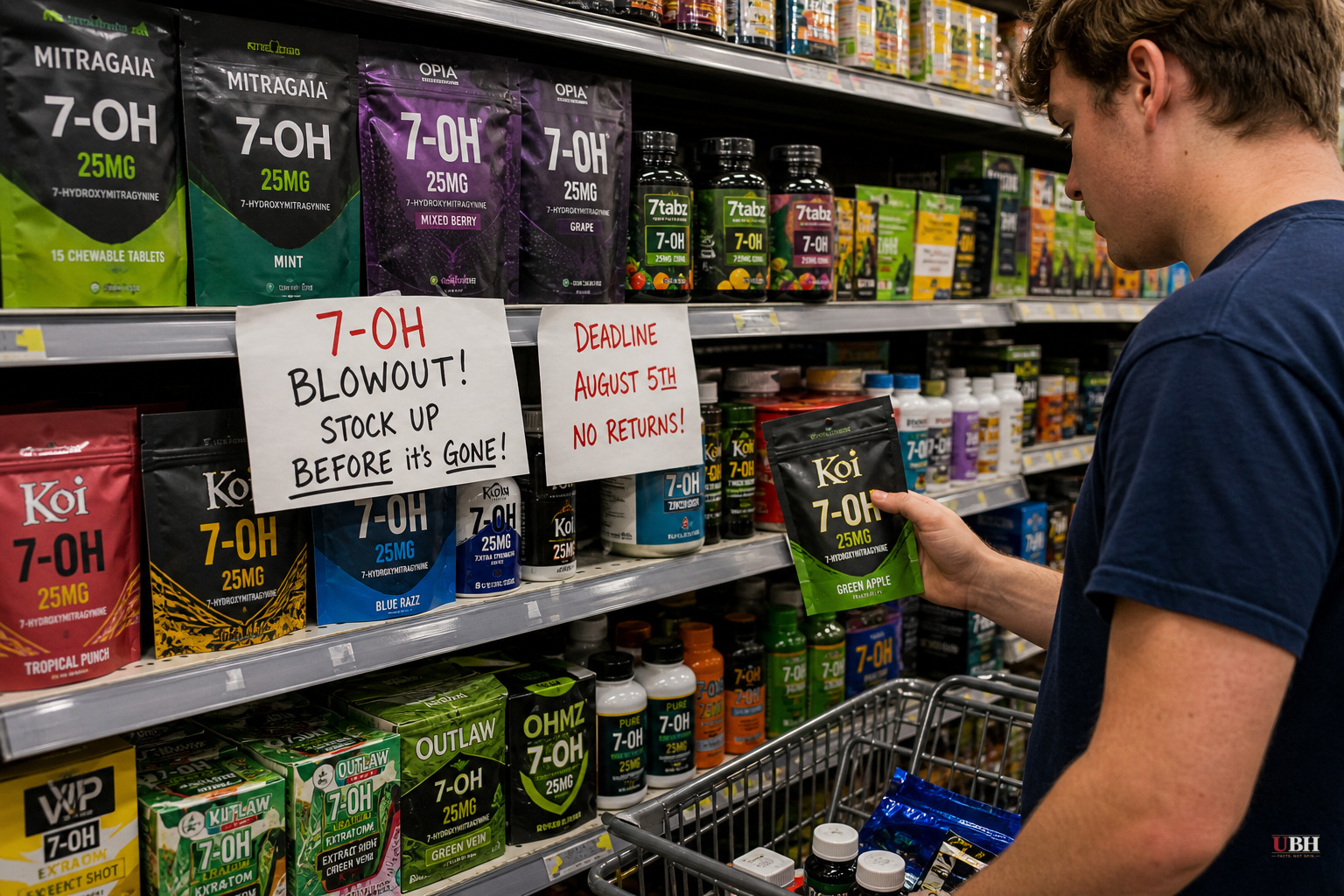
A gas-station opioid is about to become a felony
The DEA announced on July 6 that it intends to place concentrated 7-hydroxymitragynine, known as 7-OH, into Schedule I of the Controlled Substances Act, according to a notice published in the Federal Register. That's the same category as heroin and LSD. The related compounds MGM-15 and MGM-16 are included too.
By the DEA's own timeline, the scheduling order won't take effect before August 5, and once it does, it stays in place for at least two years, with a possible one-year extension while the agency pursues permanent scheduling.
That timeline has created a strange, compressed window. Retailers are running clearance sales. Users are placing what they call their last orders. And medical professionals are bracing for what comes next.
Fire sales and countdown timers
According to Pain News Network, online sellers are offering steep discounts, including a "Buy 2, Get 3" deal on 7-OH shots from a retailer called Payless Kratom, which is marketing the promotion with the line: "Once they are gone, they are gone for good."
One Reddit user quoted by Pain News Network described a website with a literal countdown timer ticking down the days, hours and seconds until it stops taking orders. "I just placed a massive order a few days ago and it's already on the way. It is probably my last order ever," the user wrote.
Another poster on the same forum framed the coming ban in blunt terms: "Prohibition is about to happen and I don't know that it's happened with something this popular in a while. We're gonna see how addictive it is when it becomes a street drug. They'll be arresting normal folks and destroying their families with drug court for something that was legal to purchase in a gas station 6 months ago."
A medical student cited by Pain News Network warned healthcare workers to prepare for a spike in both overdoses and withdrawal cases. "Keep an eye out for both extremes over the next few weeks. Those that stockpiled and unintentionally OD or suddenly lose access and present in severe withdrawal that can resemble heroin or fentanyl withdrawal," the student wrote.
Why the DEA is acting
The agency's notice of intent states plainly that "the marketing of 7-hydroxymitragynine products to consumers as botanical supplements constitute a significant public health risk," citing its profile as an opioid agonist with high abuse potential.
That's a fair concern on its face. 7-OH is sold at gas stations and smoke shops with essentially no oversight, because the FDA does not evaluate dietary supplements for safety or efficacy before they hit shelves, according to Wired. A product this potent, sitting next to energy drinks at a convenience store counter, with zero dosage regulation, is a real problem regardless of where you stand on drug policy.
Twelve states have already banned 7-OH outright, according to Wired. The DEA's move isn't happening in a vacuum. There was already bipartisan recognition at the state level that this compound needed guardrails.
The other side of the ledger
But the people actually using 7-OH tell a more complicated story, and their accounts deserve a fair hearing.
Cam, a 36-year-old upstate New York man profiled by Wired, suffered a catastrophic motorcycle accident that shattered his pelvis and broke nearly every rib and vertebra. His prescribed 15 milligrams of daily oxycodone wasn't controlling the pain. He says 7-OH gave him relief "right on par" with a higher opioid dose, letting him do chores and ride in a car without agony. He's now spending roughly $500 a month buying it in bulk, and he's frightened the DEA will cut off the only thing that's worked.
Jeff Smith, National Policy Director of the Holistic Alternative Recovery Trust, an advocacy group funded by 7-OH manufacturers, told Pain News Network he's used 7-OH for chronic pain from two back injuries so severe he couldn't sleep more than 20 minutes at a stretch. He disputes the comparison to hard opioids directly: "The effects of 7-OH on a person's body bear no resemblance to those of heroin or fentanyl." Readers should note Smith's group is industry-funded, which doesn't make him wrong, but it's relevant context.
Whether 7-OH counts as an "opioid" in the same sense as heroin is disputed. Pain News Network notes even most 7-OH users acknowledge it has opioid-like effects and works as a genuine pain reliever.
How we got here
This substance sat unregulated for years, sold to anyone with cash, no age verification worth mentioning, no dosage standards, no FDA safety review. Wired reports one user spent $175 every four to five days as his tolerance escalated, eventually got too sick to work, and couldn't pay rent. That's not a hypothetical risk. It already happened to real people because nobody was minding the store.
Now the DEA is swinging to the opposite extreme: total prohibition, Schedule I, same shelf as heroin, no medical exception carved out for people like Cam who say they've found genuine relief after conventional opioids failed them.
Neither extreme looks like sound policy. A regulated middle path, purity standards, dosage caps, age restrictions, physician oversight, was available the entire time and nobody in Washington moved on it until the ban was already drafted.
The scheduling order takes effect no earlier than August 5. What happens to the tens of thousands of people who've been using 7-OH daily for chronic pain, and whether emergency rooms see the overdose and withdrawal spike that Pain News Network's medical-student source predicted, remains to be seen in the weeks after.
Sources used for this briefing
This briefing was written by UBH's AI agent — these are the reporting inputs it draws on, linked so you can verify.


