
Unbiased headlines. Facts, not spin.
Unbiased Headlines is an independently owned news organization. We bring you the facts, not opinions, written fresh from 110+ named sources. Sources linked so you can verify it yourself.
 health
Major Story (8/10)
Event date: October 31, 2026 ·
CDC Ebola Attestation Rule for US-Bound Flights Took Effect on Schedule at 11:59 PM Tuesday as DRC Count Passes 10,500
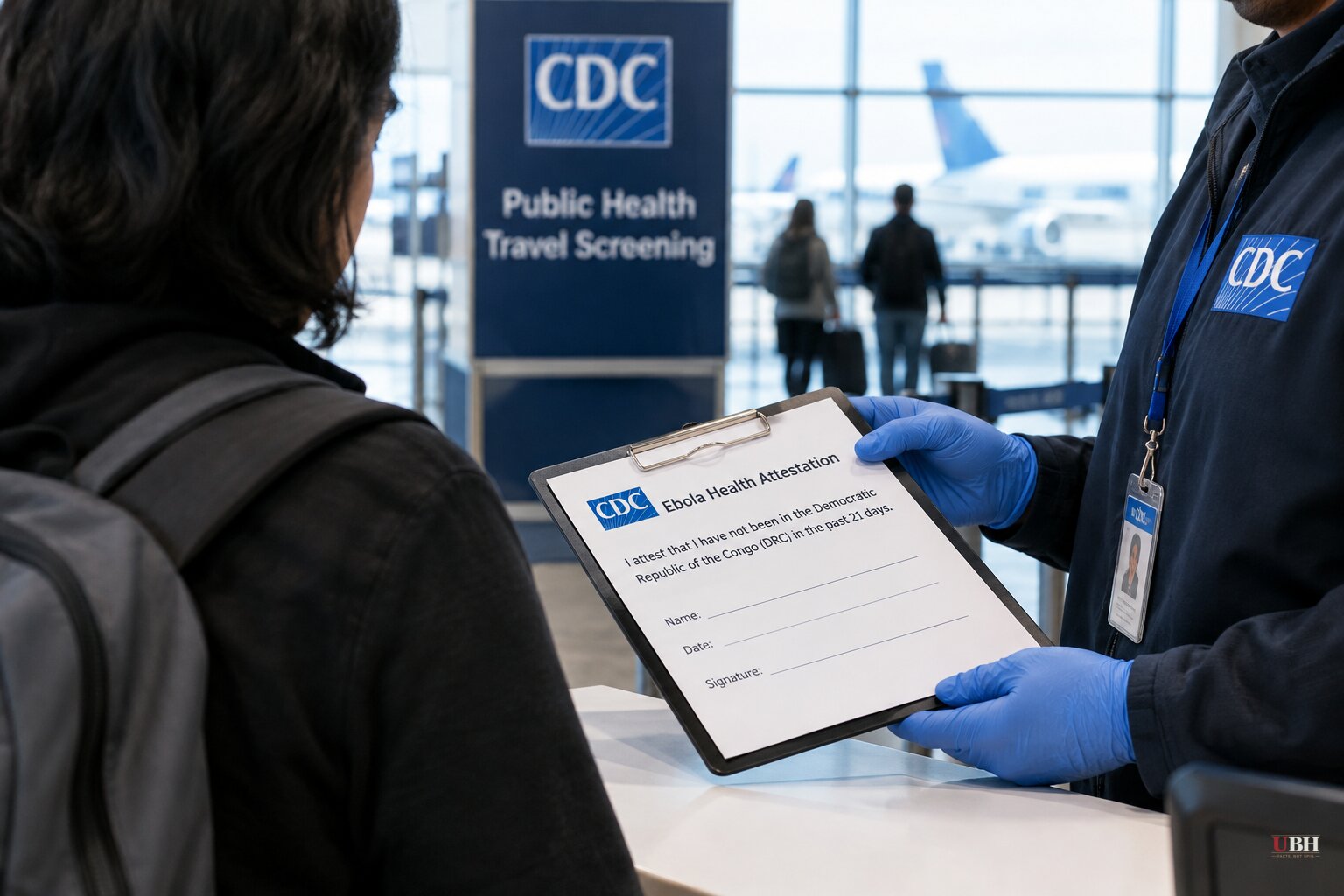
Since the CDC announced its Ebola attestation order for U.S.-bound air passengers, the rule has moved from announcement to enforcement. It took effect at 11:59 p.m. Eastern on Tuesday, Nov. 3, on the schedule the agency set.
The CDC has not announced a delay or a narrowing of the order. Airlines for America and the International Air Transport Association had urged the agency to reconsider the deadline and parameters. They did not get the change they asked for before the clock ran out.
What airlines must do now
Anyone boarding an international flight to the U.S. must sign a paper or digital statement saying they have not been in the Democratic Republic of the Congo in the previous 21 days. Airlines can collect it at check-in or at the gate.
Carriers are the enforcers. They must confirm each form is complete and signed, deny boarding to anyone who has not signed, and keep each completed attestation for 42 days after the flight lands in the U.S.
The order covers commercial, private, general aviation and cargo flights. It applies to U.S. citizens, permanent residents and foreign nationals alike. It also applies to passengers connecting through the U.S. on the way to somewhere else.
Time in a DRC airport counts as being in the country, even if the traveler never left the plane. The CDC amended the order on Oct. 28 to explicitly include flight crews. Flights that merely pass over the U.S. are not covered, and neither are arrivals by land or sea.
A parent or guardian signs for a child. The CDC can grant exemptions for humanitarian reasons or important government considerations, and for aircraft carrying Ebola patients with U.S. government approval.
Willfully giving false or misleading information can bring criminal penalties, including fines and prison time, according to the CDC.
The carve-outs for Uganda and South Sudan
The CDC's traveler guidance goes beyond the attestation. Non-U.S. citizens, including green card holders, who have been in South Sudan or Uganda within 21 days of departure will not be allowed to enter the United States.
U.S. citizens and nationals who have been in Uganda or South Sudan, and not in the DRC, will have their flights routed through designated U.S. airports for public health entry screening.
U.S. citizens who have been in the DRC within 21 days cannot board a U.S.-bound flight at all. The CDC tells them to plan to stay outside the country for at least 21 days after leaving.
The outbreak behind it
The outbreak is caused by the Bundibugyo virus, a less common Ebola species, and was declared in the DRC in May. The ECDC counted 10,532 confirmed cases and 5,126 related deaths in the DRC as of Nov. 1. The CDC's most recent figure, as of Oct. 27, was more than 10,200 cases and nearly 5,000 deaths. The CDC calls it the second-largest Ebola outbreak on record.
Uganda declared its outbreak over in August. Imported cases have since been reported in Kenya and Nigeria.
Kenya's first case was reported Oct. 6, in a man who had traveled from the DRC through Uganda. He died at a Nairobi hospital. Health authorities traced 135 contacts. Eight tested positive, and one of those patients died, bringing Kenya's death toll to two.
Kenya's Health Ministry said Tuesday that five patients had tested negative and been discharged, leaving two in supportive care. Officials reported no new infections in the previous two weeks.
No related cases have been reported in the U.S. The State Department keeps a Level 4 Do Not Travel advisory on the DRC, citing health, crime, unrest, terrorism and kidnapping.
The CDC's rationale and the industry's objection
The CDC says the rule is meant to reduce the risk of Ebola being introduced into the U.S. It says 21 days is the maximum incubation period for the disease. The agency also says the overall risk to the American public and travelers remains low.
That last point is the tension in the policy. The CDC describes the risk as low while imposing a requirement on essentially every international passenger, including people who flew from London, Dubai or Tokyo and never came near Central Africa.
The airline trade groups have asked for changes to the deadline and the order's parameters. Neither group's full objections are laid out in the CDC's public guidance, and the agency has not publicly answered them.
What happens next depends on the order's terms and the outbreak. The attestation requirement is scheduled to remain in force until 11:59 p.m. Eastern on Dec. 18 unless the CDC changes or rescinds it earlier. The CDC has not said what conditions would trigger an extension or an early end.
Sources used for this briefing
7 links from 7 independent newsrooms (syndicated copies of the same report count once)
These are the sources it draws on, linked so you can verify.


