
Unbiased headlines. Facts, not spin.
Unbiased Headlines is an independently owned news organization. We bring you the facts, not opinions, written fresh from 110+ named sources. Sources linked so you can verify it yourself.
 health
Notable (6/10)
Event date: October 14, 2026 ·
health
Notable (6/10)
Event date: October 14, 2026 ·
JAMA Neurology Study Projects 24.7 Million New Dementia Cases a Year by 2050, Up From 11.4 Million in 2023
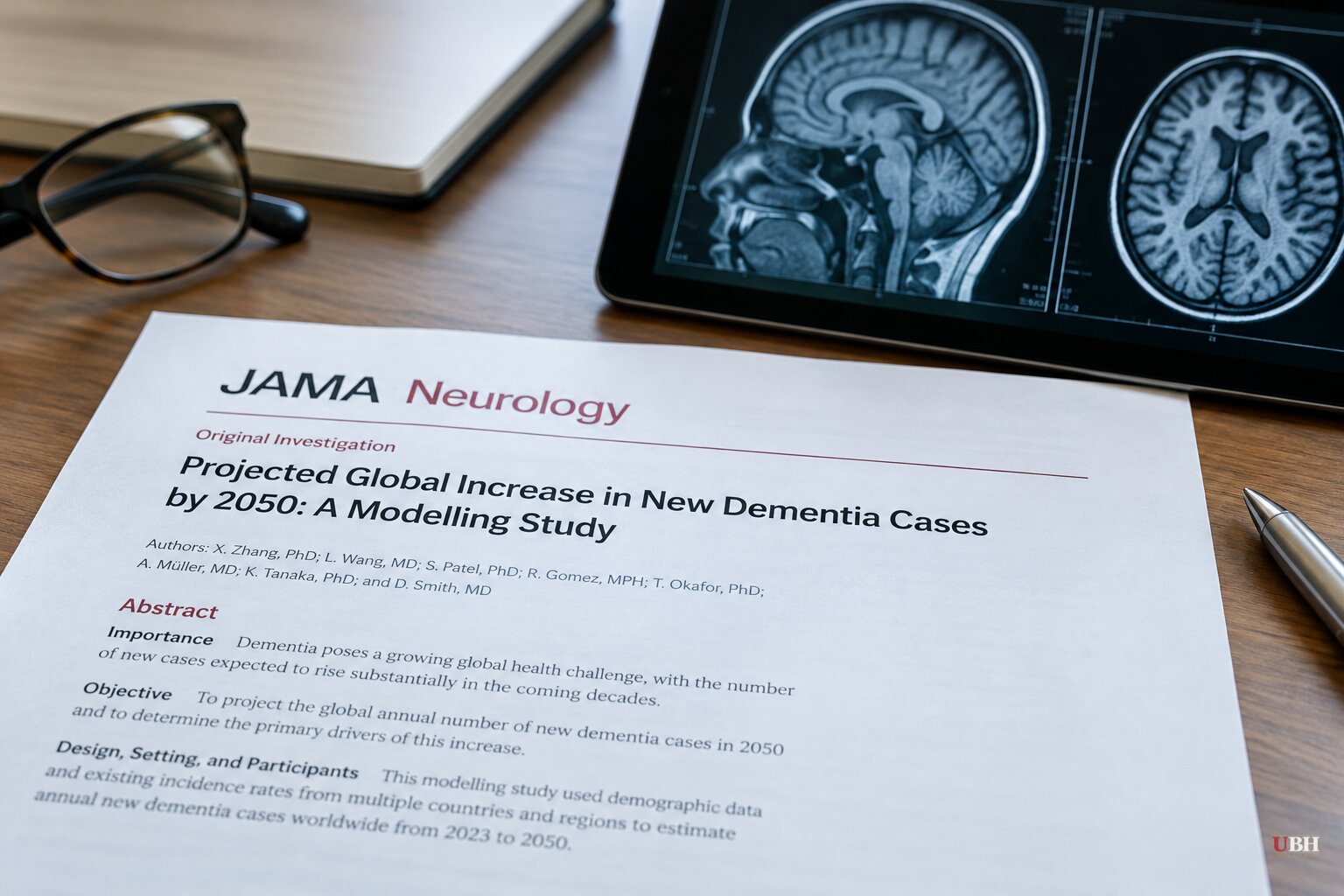
The number of people developing dementia each year is projected to more than double by 2050, according to a study published Oct. 12 in JAMA Neurology.
Researchers at the University of New South Wales Sydney estimate 11.4 million new cases worldwide in 2023. They project 24.7 million a year by 2050. That is a 116% increase over 27 years.
These are new cases per year, not total cases. Dementia already affects more than 57 million people globally. Earlier research cited by the study authors projected that figure could reach 150 million by 2050.
What the study measured
The team at UNSW's Centre for Healthy Brain Ageing pooled data from 22 longitudinal studies. Those covered 38,418 participants in 18 countries and territories: 12 high-income and six low- and middle-income.
Over 287,632 person-years of follow-up, 3,001 participants developed dementia. After adjusting for age and sex, the global incidence rate was 9.7 per 1,000 person-years.
Women had a higher rate than men: 10.6 per 1,000 person-years versus 8.6. Incidence in low- and middle-income countries was 64% higher than in high-income countries, according to Dr. Liron Sinvani of the Northwell Institute for Healthy Aging, who was not involved in the research.
Lead author Ashleigh Vella said this is the first time dementia incidence has been compared across such a geographically diverse group using the same statistical method. "What stands out is that dementia incidence is not evenly distributed," she said.
Ageing drives the number
The projection assumes the same rate of occurrence each year. The growth in cases comes from the population getting older, not from each individual's risk climbing.
Sinvani put it plainly: "It's driven by the aging population." She said that after age 65 about 1 in 9 people have dementia, and after 85 it could be almost 1 in 3.
The U.S. numbers follow the same logic. The National Institutes of Health said in a February 2025 post that dementia affects more than 6 million Americans and accounts for more than 100,000 deaths a year. NIH said population ageing is expected to double annual new U.S. cases by 2060.
Women and poorer countries
The researchers did not establish why women had higher incidence. They suggested several possible factors, including that Alzheimer's disease is more frequent in women, that hormonal changes linked to menopause might play a role, and that metabolic factors affecting heart health might contribute.
Sinvani said the gap is not simply a matter of women living longer. The study team called for "greater vigilance in dementia screening among women" and more attention to sex-specific risk factors.
Senior author Perminder Sachdev called the higher rates in poorer countries "particularly concerning because these regions are experiencing rapid population ageing while often having the fewest resources for prevention, diagnosis and care."
Sachdev said the findings point to a need to strengthen risk reduction and health-care capacity, and to invest in better local data so services can be planned around each country's needs.
Is it inevitable?
Not everyone reads the projection as destiny. Emer MacSweeney, a consultant neuroradiologist and CEO of Re:Cognition Health who was not involved in the study, said an increase in cases is expected because people are living longer. "But I wouldn't dismiss it as an inevitable consequence of aging," she said. "It is a wake-up call to accelerate prevention, diagnosis, and treatment."
MacSweeney said research has changed understanding of Alzheimer's and allowed earlier identification of disease-related change. She said better management of modifiable risk factors "could improve, significantly, the trajectory of Alzheimer's we are projecting today."
The Epoch Times, citing the NIH and CDC, listed lack of physical activity, alcohol and tobacco use, and high blood pressure among known risk factors. Those are things individuals and doctors can act on.
Co-author Henry Brodaty framed the economics in stark terms: "Twenty-four million new cases of dementia every year would place enormous pressure on individuals, families, health systems and economies around the world." He said waiting for people to develop dementia and then responding is not workable, and called for action from risk reduction through diagnosis, treatment and care.
Sinvani went further, calling it "an accelerating epidemic crisis that demands immediate attention." That is her characterization, and the study itself projects a demographic trend under constant rates, not a change in disease risk.
What remains open
The 2050 figure rests on a fixed incidence rate applied to an ageing world. If prevention or treatment lowers that rate, the count falls. If it rises, the count goes higher.
The study does not say how much of the projected burden could be avoided, or what any government should spend to avoid it. Why women face higher incidence after adjusting for age is also unexplained, and the authors' hormonal and metabolic explanations are suggestions, not findings.
Sources used for this briefing
7 links from 7 independent newsrooms (syndicated copies of the same report count once)
These are the sources it draws on, linked so you can verify.


