
Unbiased headlines. Facts, not spin.
Unbiased Headlines is an independently owned news organization. We bring you the facts, not opinions, written fresh from 110+ named sources. Sources linked so you can verify it yourself.
 health
Notable (5/10)
Event date: October 13, 2026 ·
health
Notable (5/10)
Event date: October 13, 2026 ·
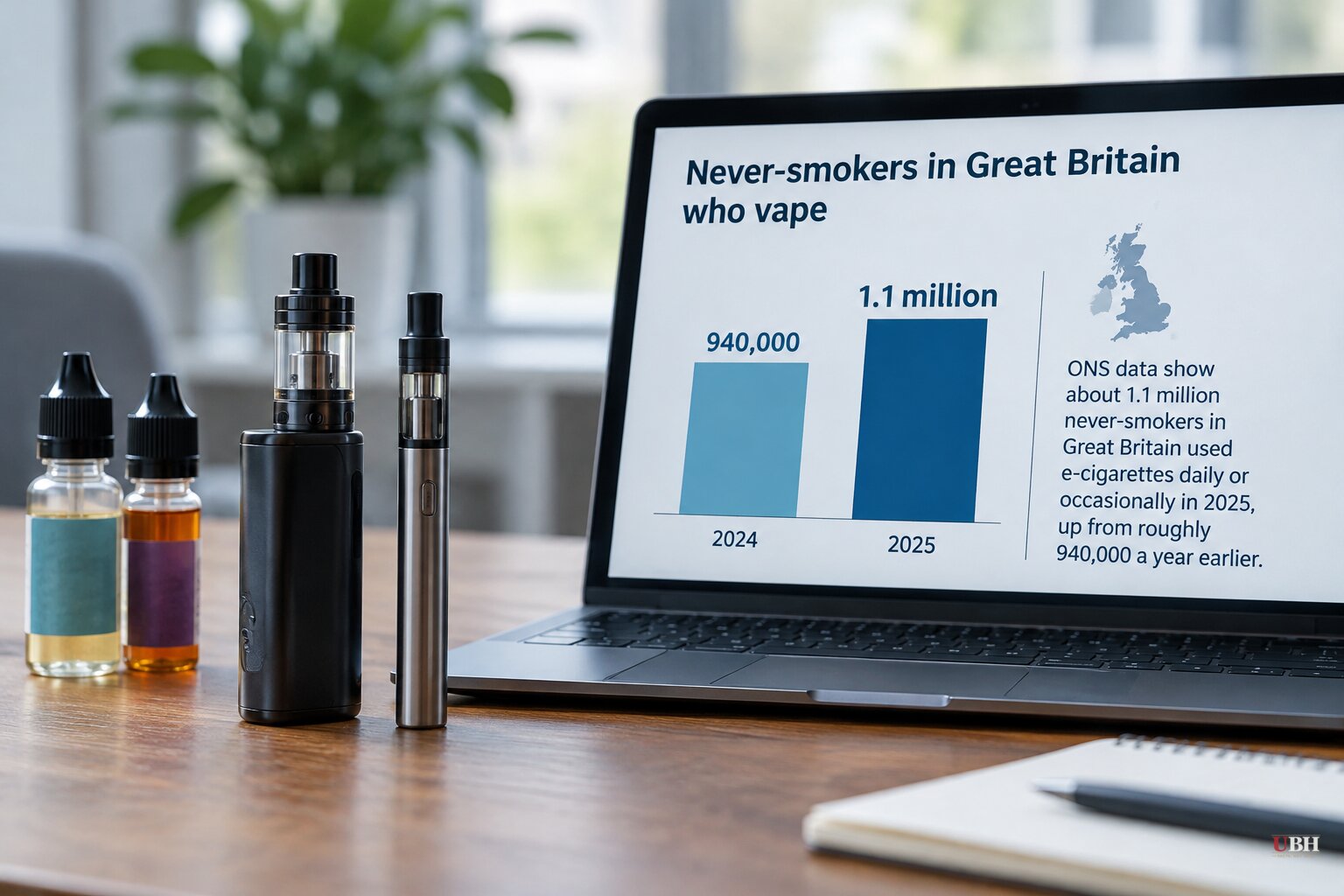
1.1 million never-smokers in Great Britain now vape, up from 940,000, ONS figures show
Vapes were sold to Britain as an off-ramp for smokers. A growing number of people are using them without ever having been on the road.
The Office for National Statistics (ONS) says around 1.1 million people in Great Britain who had never smoked reported using an e-cigarette daily or occasionally in 2025. The figure was around 940,000 in 2024.
The numbers
About 5.4 million adults aged 16 and over in Great Britain vaped daily or occasionally in 2025, according to the ONS Opinions and Lifestyle Survey. That is 9.9% of adults, almost flat from 10.0% the year before. Vaping has trended upward since 2020.
Smoking keeps falling. The number of UK smokers dropped from 5.3 million in 2024 to 4.9 million in 2025, nearly one in 10 adults. For the second year running, more people vape than smoke.
The two figures aren't a perfect match. The vaping data cover people 16 and over in Great Britain, while the smoking data cover UK adults.
Who is picking it up
Vape use fell in every age group between 2024 and 2025 except one. Among 25 to 34-year-olds it rose from 12.9% to 16.4%. That group now has the highest rate, overtaking 16 to 24-year-olds, who held the top spot from 2021 to 2024. Nearly one in six people in that bracket vape.
The ONS's David Mais said the shift could reflect existing users getting older, rising popularity among 25 to 34-year-olds, or both. The data do not settle which.
Children are part of the picture too. One million 11 to 17-year-olds in Great Britain reported having tried vaping in 2025, according to the figures.
What users describe
Gracey Mungulu, 21, a London hairdresser, told the BBC she used to mock classmates for vaping. By 16 she had started. "The more you see it, the more you start trying it a bit more," she said. She now buys a refillable vape every day and says it helps with social anxiety. "It's the hand action," she said.
Malin Andersson, 33, a domestic abuse campaigner and former Love Island contestant, started vaping during a stressful break-up. "It's a dopamine hit," she said. She quit in May after concluding it was dulling her senses and leaving her demotivated.
The habitual pattern is one a GP told the BBC she hears often from patients. "It's that kind of psychological dependence on something else to almost regulate their emotions," she said.
The health argument
The NHS says vaping nicotine is less harmful than cigarettes but that long-term effects are not yet clear. Vaping is recommended to smokers trying to quit, including through the Swap to Stop scheme, and is not recommended for people who have never smoked.
A group of international experts recently argued that vapes are an underused tool for quitting cigarettes, which remain a leading cause of preventable death worldwide. That position is about smokers switching, not about people who never smoked.
Michael Joseph Blaha, director of clinical research at the Johns Hopkins Ciccarone Center for the Prevention of Heart Disease, drew the same line. "It's one thing if you convert from cigarette smoking to vaping," he said. "It's quite another thing to start up nicotine use with vaping." He cited emerging data linking e-cigarettes to chronic lung disease and asthma, and linking dual use of e-cigarettes and cigarettes to cardiovascular disease.
A study by Seoul National University researchers in Nature Medicine, covering more than 4.5 million Korean adults, found former smokers who took up daily vaping developed lung cancer at a rate about 56% higher than those who quit entirely. Their lung cancer death rate was 91% higher. The study is observational and cannot establish causation, and the authors wrote that evidence on e-cigarettes and lung cancer risk remains limited. It also did not cover people who never smoked.
What the government is doing
The Tobacco and Vapes Act received Royal Assent on April 29, 2026. It bars tobacco sales to anyone born after Jan. 1, 2009, restricts vape marketing through strict regulations and extends smoke-free places to outdoor settings such as outside schools, children's play areas and hospitals. It also introduces vape-free places.
Since Oct. 1, a Vaping Products Duty and a Vaping Duty Stamps Scheme have been in force. The aim is to reduce vaping's affordability and appeal, particularly among young people and non-smokers.
The Department of Health and Social Care says colourful packaging, prominent retail displays and child-appealing flavours are among the factors driving young people to vape. A UK-wide consultation on those issues closed Friday, Oct. 2. After the ONS figures came out, the government said it would "carefully consider" the responses and plans to tackle rising e-cigarette use, especially among young people and non-smokers.
The BBC reports the government is expected to give a response to the consultation in due course. Whether the jump among 25 to 34-year-olds was a one-year spike or the start of a new pattern is still unknown.
Sources used for this briefing
7 links from 7 independent newsrooms (syndicated copies of the same report count once)
These are the sources it draws on, linked so you can verify.


