
Unbiased headlines. Facts, not spin.
Unbiased Headlines is an independently owned news organization. We bring you the facts, not opinions, written fresh from 110+ named sources. Sources linked so you can verify it yourself.
 health
Notable (6/10)
health
Notable (6/10)
FDA Approves Roche's Enspryng for Thyroid Eye Disease, First At-Home Shot, After One of Two Trials Missed Its Main Goal
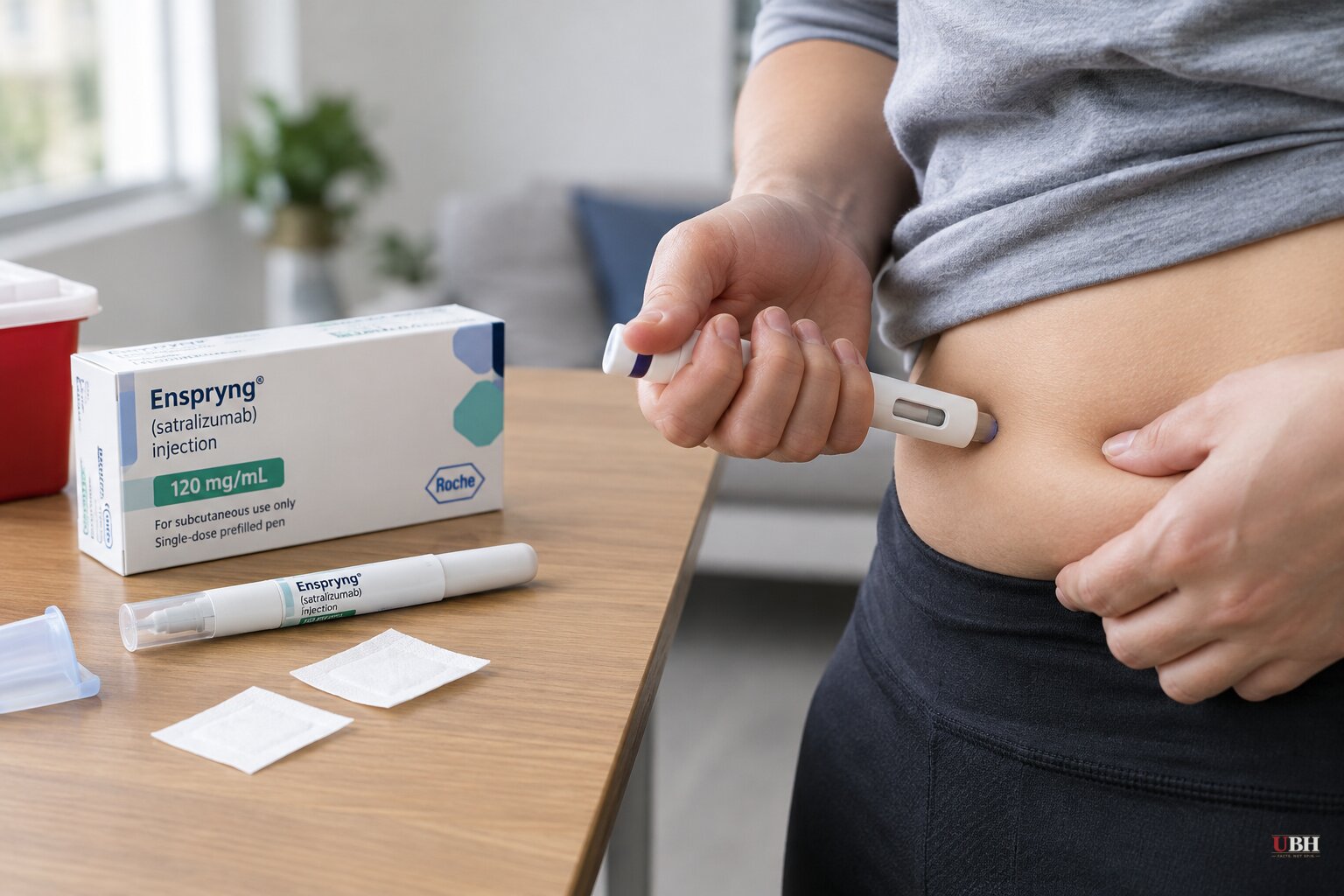
The FDA approved Roche's Enspryng (satralizumab) on Thursday, Oct. 15, for adults with thyroid eye disease, Roche announced. The decision landed on the drug's PDUFA target date of October 15, 2026, after the agency granted priority review to the supplemental application filed by Roche's U.S. unit, Genentech.
It is the first subcutaneous, at-home treatment for the condition. It is also the first IL-6 receptor inhibitor approved for it.
What the drug does and how it's given
Thyroid eye disease, also called Graves' ophthalmopathy, is a rare autoimmune condition that commonly occurs in people with hyperthyroidism. It causes redness, swelling, eyelid retraction, bulging eyes (proptosis), double vision (diplopia) and pain. Roche estimates it affects about 155 of every 100,000 people in the U.S.
Enspryng blocks IL-6, a protein tied to inflammation. The two other approved non-surgical treatments, Amgen's Tepezza (teprotumumab, approved January 2020) and Viridian Therapeutics' Lumvoa (veligrotug), target the IGF-1 receptor and are given by intravenous infusion in a clinic.
Enspryng is injected under the skin by the patient or a caregiver after training from a healthcare provider. The first three doses come at weeks 0, 2 and 4. After that, it's one injection every four weeks.
One trial hit, one trial missed
The approval rests on two identically designed phase 3 trials, SatraGO-1 and SatraGO-2. Together they enrolled 258 patients across 19 countries, 131 in the first and 127 in the second, randomized to drug or placebo.
The primary endpoint was the share of patients with active, moderate-to-severe disease who achieved at least a 2 mm reduction in proptosis at week 24.
SatraGO-2 hit it. Among active-disease patients, 52.9% on Enspryng had that reduction, versus 23.4% on placebo. For double vision, 60.7% improved on the drug versus 25.8% on placebo.
SatraGO-1 did not meet its prespecified primary endpoint. Proptosis response there was 49% on Enspryng versus 31% on placebo (P = .0715).
Roche maintains that the totality of the data shows clinically meaningful improvement, including on double vision. The FDA approved the drug on that body of evidence.
César Briceño, MD, of the Scheie Eye Institute at the University of Pennsylvania, was a trial investigator. He said he is "confident that the proptosis efficacy data are reliable." In his words, the treatment effects were "remarkably consistent across the trials," and the main difference between them "appeared to be the placebo response rates."
That is the investigator's reading. The statistical miss in SatraGO-1 is a matter of record, and the trials were placebo-controlled, not head-to-head against Tepezza or Lumvoa.
Safety and screening
Roche said no new safety signals appeared in the SatraGO trials and that the profile matches what's known from neuromyelitis optica spectrum disorder (NMOSD), where the drug has been approved since 2020. The most common adverse events were upper respiratory tract infections and elevated alanine aminotransferase levels.
The label contraindicates use in patients with active or untreated latent tuberculosis and active hepatitis B. It warns of decreased neutrophil counts, elevated liver enzymes and infection risk. Hepatitis B, tuberculosis and liver enzyme screening are required before the first dose, and patients should finish needed vaccines first and avoid live vaccines while on treatment.
The result is a lab-monitoring requirement for a drug patients will inject on their own.
The money
Enspryng brought in $237 million for Roche in the first half of this year, all from NMOSD. Roche has said new indications could push it past $1 billion in annual sales as early as 2027.
Analysts have estimated the TED indication alone could be worth $500 million to $1 billion in peak annual sales. Roche has also filed Enspryng for MOGAD, another rare neurologic condition, with an FDA decision due in January. Autoimmune encephalitis and Duchenne muscular dystrophy are possible future indications, depending on trial results.
The at-home edge may not stay unique. Amgen has phase 3 results for a subcutaneous Tepezza delivered by an on-body injector. Viridian is developing a subcutaneous alternative, elegrobart, scheduled for U.S. filing early next year.
What patients and advocates say
"Until now, our community has had very limited choices," said Christine Gustafson, CEO of the TED Community Organization. She called the approval "a critical turning point through a convenient, targeted option."
Briceño said a subcutaneous option could offer "greater flexibility for both patients and physicians while reducing the logistical burden associated with infusion-based therapies."
Whether that convenience translates into real access depends on what insurers cover and what patients pay. Roche's launch pricing was not part of the approval announcement. The next markers are the FDA's MOGAD decision in January and Viridian's elegrobart filing early next year.
Sources used for this briefing
7 links from 7 independent newsrooms (syndicated copies of the same report count once)
These are the sources it draws on, linked so you can verify.


